
Summary prepared by The Review of Religions
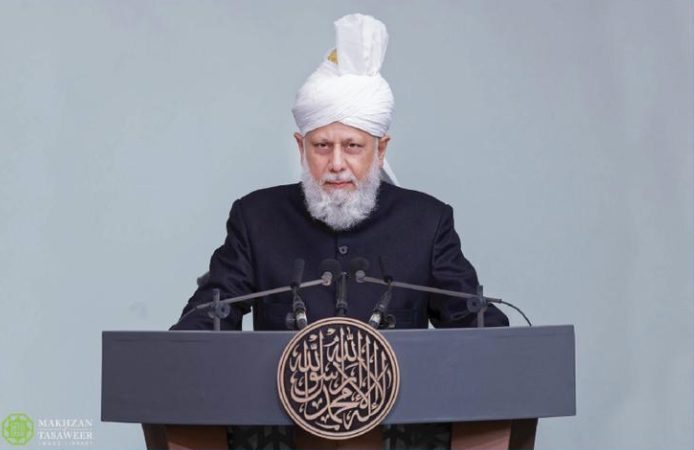
After reciting Tashahhud, Ta‘awwuz and Surah al-Fatihah, His Holiness, Hazrat Mirza Masroor Ahmad (aba) said that in following the teachings and practice of his master, the Holy Prophet (sa), the Promised Messiah (as) exhibited amazing standards of humility and meekness which he not only practised himself but enjoined to his community as well. His Holiness (aba) said that he would relate incidents pertaining to this aspect of the Promised Messiah’s (as) life.
His Holiness (aba) said that God Almighty Himself attested to the humble nature of the Promised Messiah (as) when God revealed to him on 18 March 1907, “He is pleased with your humble ways.”
His Holiness (aba) quoted the Promised Messiah (as) who writes:
‘‘It has been revealed to my humble self that on account of my meekness, humility, trust in God, sincerity and the Signs and [heavenly] light, I resembles the Masih in his previous life; and that the nature of this humble one and the nature of the Masih greatly resemble each other, as if they are two pieces of the same jewel or two fruits of the same tree. The harmony between us is of such a great extent that there is very little that the spiritual eye can distinguish between us.
There also exists an overt resemblance which is that the Masih [Messiah] was the follower and servant of the faith of a perfect and high-standing Prophet, i.e. Musa [Moses] and his Gospel is a branch of the Torah, and this humble one too, is one of the lowliest servants of that majestic Prophet who is Sayyidur-Rusul [the Chief of all Messengers as] and the Crown of all Messengers.’
(Barahin-e-Ahmadiyya Part Four, Sub Footnote Three, pp. 374-375)
Never Desire Praise or Recognition
His Holiness (aba) said that once, someone went to the Promised Messiah (as) and suggested that after writing the book The Philosophy of Divine Revelation, which the Promised Messiah (as) wrote with intense care and scrupulousness, such that it would cause him to become unwell, he should now take some days to rest. Upon this, the Promised Messiah (as) said that his efforts were nothing in comparison to the efforts and sacrifices made by the companions of the Holy Prophet (sa), who would go so far as to lay down their lives.
His Holiness (aba) quoted the Promised Messiah (as), who responded to the allegation that he exaggerated his own status. The Promised Messiah (as), swearing by God, said that it was not within his very nature to desire any form of recognition or appreciation. He preferred a life of humility and to remain unknown. Yet, it was God Himself who brought him out of obscurity and into the realm of recognition.
Preferring to Live a Life of Simplicity
His Holiness (aba) said that once, when someone visited the Promised Messiah (as), he explained that he preferred a simple life, devoid of the excesses that European culture had deemed a compulsory part of life. He said that he did not partake in unnecessary luxuries but preferred to live a simple life.
His Holiness (aba) quoted the Promised Messiah (as), who enjoined his community to adopt humility and learn to be humble. It is not difficult to learn humility, for humans themselves are humble beings. Arrogance is rooted in ostentation, and so, once a person removes the garment of ostentation from themselves, they can learn to adopt humility.
His Holiness (aba) quoted the Promised Messiah (as) who writes:
‘Blessed are those who consider themselves most humble and lowly, speak modestly, respect the poor and needy, and treat the helpless with honour, and never ridicule them out of mischief and arrogance. They remember their Gracious Lord and walk with humility on the earth. So I say repeatedly that such are the people for whom salvation has been made ready. One who is not free from the hell of mischief, arrogance, self-conceit, haughtiness, worship of the world, greed, and depravity in this very world will most certainly not be free from them in the hereafter. What should I do and from whence should I produce such words that should affect the hearts of this group of people? O my God! Bestow upon me such words and reveal to me such discourses that should illuminate these hearts with light and remove their poison with their remedial qualities! My entire being throbs with this deep longing that at some point that day should come when I will see in my Community many such people who have in fact forsaken falsehood and have made a sincere pledge with their Lord that they will safeguard themselves against every kind of evil, and will absolutely distance themselves from arrogance, which is the root of all mischief, and will remain fearful of their Lord.’ (Testimony of the Holy Quran, p. 156)
Do Not Allow Arrogance to Creep in
His Holiness (aba) said that at the Annual Convention (Jalsa Salana) and other similar events, some people wish to be seated at the very front of the hall on the chairs or in the green area. While it is a good thing to desire to sit in close proximity to the Khalifah of the time in order to hear his words, there are some who wish to sit in these areas out of their own arrogance. Advising such people, the Promised Messiah (as) said that when a person goes somewhere, they should select from themselves the lowest place they can find. If they deserve to be seated elsewhere or somewhere with more prominence, then the hosts themselves will arrange for that to be the case.
His Holiness (aba) said humility is also necessary to develop love for God. In this regard, the Promised Messiah (as) writes:
‘No one can attain the love and pleasure of Allah until they inculcate two qualities within themselves. Firstly, one must break their own arrogance in the likeness of a tall standing mountain that crumbles and is razed to the ground. In the very same manner, one ought to dispel all their thoughts of arrogance and superiority. One must adopt humility and lowliness. Secondly, one must sever all of their worldly ties, just as a mountain falls to the ground and is rent asunder – broken into pieces. In the same manner, a person’s earlier associations, which result in impurity and incur divine displeasure, must all be broken, and a person’s interactions, friendships, love and enmity should be purely for the sake of Allah Almighty.’ (Malfuzat, English Translation, Vol. 3, p. 189)
His Holiness (aba) quoted the Promised Messiah (as) who said that even Adam committed sin. However, he displayed humility and repented for his sin, and thus was forgiven. In this way, God gives hope to those who sin, showing that they can indeed be forgiven, given that they show humility. Conversely, Satan showed arrogance and thus became accursed. Therefore, one would do well to avoid the Satanic quality of arrogance.
Avoid Pride in Matters of Disagreement
His Holiness (aba) quoted the Promised Messiah (as) who said that there are some who, as soon as they hear something that they do not agree with, they become impassioned and in an argument care only to defeat the other and nothing else. Even today, there are those who display this sort of false pride. However, one should instead adopt humility and not become bent upon defeating their brother, as doing so only increases arguments and disputes.
Humility Leads to Paradise
His Holiness (aba) quoted the Promised Messiah (as) who writes:
‘Death is the destiny of everyone. This will happen to everyone, one day or the other, but for those who passed away in poverty being harmless, meek, and humble, it is as if Paradise comes forward to receive them, as described by Jesus about Lazarus.’ (Malfuzat, English Translation, Vol. 8, p. 428)
His Holiness (aba) further quoted the Promised Messiah (as) who writes:
‘The arrogant one seeks to sit upon the throne of God. Therefore, you should always seek refuge from this vile trait. Even if all the promises of God Almighty are with you, you should still show humility because only the one who shows humility is dear to God.’ (Malfuzat, English Translation, Vol. 10, p. 326)
His Holiness (aba) continued quoting the Promised Messiah (as) who writes:
‘Humility and lowliness are noble traits. A person who, despite being in need, is arrogant, cannot attain their desires. He ought to adopt humility. It is related that the physician Galen was employed by a king. The king was in the habit of eating such unhealthy food that Galen was certain that the king would contract leprosy. Therefore, he would always restrain the king, but the king would not desist. Eventually fed up, Galen fled back to his country. After some time, the signs of leprosy appeared on the body of the king. It was then that he realised his mistake and adopted humility. He placed his son upon the throne, clothed himself in simple attire and left. He came to Galen. Galen recognised him and appreciated the humility of the king and began treating him with full force. Only then did God cure the king.’ (Malfuzat, English Translation, Vol. 9, p. 272)
His Holiness (aba) said that the Promised Messiah (as) himself personified these traits of humility, which he enjoined to his community. For example, whenever the Promised Messiah’s (as) elder brother was in a gathering, he would be offered a chair. If ever the Promised Messiah (as) was in the same gathering, he would sit on the ground. Even when his elder brother would request him to take the chair, the Promised Messiah (as) would insist that he would remain sitting on the ground.
Being Humble in Words and Deeds
His Holiness (aba) said a person who stood on duty outside the Promised Messiah’s (as) home attested to the fact that the Promised Messiah (as) always spoke respectfully to everyone. He never displayed even a hint of arrogance and always met everyone with a smiling face. The Promised Messiah (as) never called out to others by saying “Oh you!” but always maintained respectful dialogue with everyone.
His Holiness (aba) said that the Promised Messiah (as) never shied away from doing household work, whether it was mopping the floor, making the bed or any other number of household chores. Similarly, the Promised Messiah (as) would never complain about any food that was presented to him, but would eat whatever was available.
His Holiness (aba) said that even in debates, even against his staunchest of enemies, the Promised Messiah (as) exhibited the highest level of humility and meekness and never allowed arrogance to overcome him in any way. Similarly, when it came to the station and rank bestowed upon him by God, the Promised Messiah (as) always showed the utmost humility, and never allowed himself to consider that any of what he was granted was because of himself. Rather, the Promised Messiah (as) always humbled himself and said that he was on the ground and it was only the grace of God that elevated him. In short, he attributed every success and every rank only to God and always expressed great gratitude to Him.
His Holiness (aba) said that when the Promised Messiah (as) claimed to be the second coming of Jesus (as), Maulvi Muhammad Hussain Batalavi, a staunch opponent, began sending fiercely worded letters filled with vile to the Promised Messiah (as). However, in the face of this, the Promised Messiah (as) displayed such forbearance and humility that are unparalleled. Even in the letters which the Promised Messiah (as) wrote in response to Batalavi, the Promised Messiah (as) maintained decorum and respect in response to the disrespect that he received from Batalavi. He conveyed his point of view whilst remaining respectful and never falling to the depraved way of his opponents.
His Holiness (aba) said that every word of the Promised Messiah (as) was filled with humility, and all for the sake of pleasing Allah. The Promised Messiah (as) enjoined the same to his community, explaining that true success lies in humility. His Holiness (aba) prayed that may Allah enable everyone to adopt the ways of humility.


Add Comment