
Summary prepared by The Review of Religions
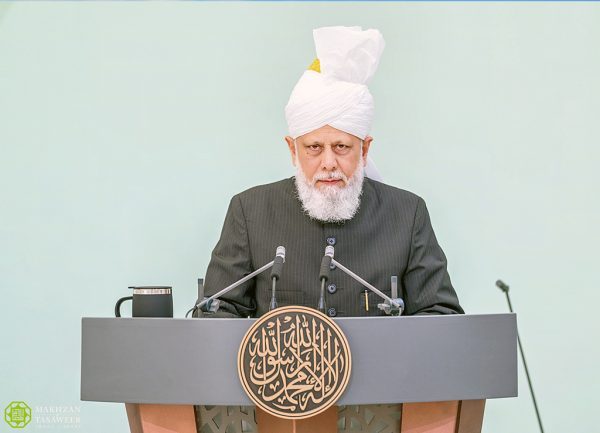
After reciting Tashahhud, Ta‘awwuz and Surah al-Fatihah, His Holiness, Hazrat Mirza Masroor Ahmad (aba) said that he would present incidents from the life of the Promised Messiah (as) that demonstrate his kindness and generosity.
His Holiness (aba) said that the Promised Messiah (as) would give like the raining of clouds, and his generosity only increased during the month of Ramadan. He would give to the needy in secret, and he never hesitated in giving to others no matter how valuable something was.
Being Ever-Ready to Help Others
His Holiness (aba) said that even before his claim to being the Promised Messiah, when he was completely unknown, he helped Abdul Ghaffar Kashmiri as he was getting married by giving him two pieces of expensive jewellery. This was not an isolated incident; rather, similar incidents occurred often. Never was it the case that someone needed help and he refused to render it. Indeed, he would perceive the needs of others, without them even verbalising it, and would endeavour to help them in any way he could.
His Holiness (aba) said that at the time of Hazrat Mirza Bashiruddin Mahmud Ahmad’s (ra) wedding, a traditional musician came to the front door and began playing a drum, as was customary in the area at the time of weddings. She was doing this to earn some money. When the Promised Messiah (as) heard the drum being played, he sent someone to tell her to stop playing and instructed that, regardless, she should be given some money. The musician also expressed that the winter months were approaching and she would feel cold. Thus, the Promised Messiah (as) instructed that she be given a blanket as well.
The Promised Messiah’s (as) Habit of Gifting Others
His Holiness (aba) said that the Promised Messiah’s (as) attire was quite simple, and he had no particular taste or desire in this regard. In his latter years especially, he would often receive clothes as gifts which he would wear. Otherwise, he would buy his own clothes, particularly his own turbans. However, the Promised Messiah (as) would often wear something and, soon after, give it away to someone upon their request for an article of his clothing as a form of blessing. As such, the Promised Messiah (as) would often need new clothes as the ones he had would be given away.
His Holiness (aba) said that a young man would often bring notes from Lekh Ram – an opponent of Ahmadiyyat – to the Promised Messiah (as). This young man had long-standing ties with the Promised Messiah (as) and his family, so whenever he came with a note, he would always give him some sort of gift, whether fruit, something sweet, or similar items. He would recount the Promised Messiah’s (as) kindness, which he always showed with a smile. Even Lekh Ram had grown accustomed to this and would ask what the young man had brought this time from the Promised Messiah (as). Once, when the Promised Messiah (as) had given the young man some excellent apples, Lekh Ram also partook, whereupon the young man said in jest that he should not eat anything that came from the home of someone he opposed. Despite this, Lekh Ram ate the apple.
His Holiness (aba) said that the Promised Messiah (as) often had bottles of musk. Once, someone said they needed musk, and the Promised Messiah (as) placed what he had before him and said they could take as much as they needed. He took only a little, to which the Promised Messiah (as) said that this was nothing and that he should take more. Musk was very expensive at the time and remains so today, yet the Promised Messiah (as) did not hesitate one bit in giving him more.
His Generosity to His Friends
His Holiness (aba) said that the Promised Messiah (as) was extremely kind and generous to his friends. Once, someone told the Promised Messiah (as) that his wife had fallen ill with meningitis. The Promised Messiah (as) prescribed some medicine and told him to come back after an hour to give him an update. The Promised Messiah (as) said that no matter how late at night it was, he should not worry about waking him up. So that man would periodically return to inform the Promised Messiah (as) of his wife’s condition, which was not initially improving, and the Promised Messiah (as) would continue prescribing medicine. There came a stage when the final stages of the disease began to manifest, upon which the Promised Messiah (as) said that they had employed all worldly means and that now all that was left was to pray. The Promised Messiah (as) – out of his immense kindness – said that he would fall into supplication and would not get up until the condition of the man’s wife improved. The man went home and informed his wife that the Promised Messiah (as) was praying for her. Taking comfort in the Promised Messiah’s (as) prayers, the man himself fell asleep. When he woke up the next morning, he found his wife arranging some dishes. When he asked her how she was feeling, she said that two hours after he had fallen asleep, she felt much better and by the grace of Allah was cured. Such was the immense kindness and affection which the Promised Messiah (as) showed to his friends.
Showing No Hesitation in Assisting Those in Need
His Holiness (aba) said that Hazrat Mufti Muhammad Sadiq (ra) wrote to the Promised Messiah (as) expressing that his household was facing difficulty in terms of cooking food. Upon this, the Promised Messiah (as) instructed the kitchen to send two excellent dishes daily to the home of Hazrat Mufti Muhammad Sadiq (ra).
His Holiness (aba) said that once, on the occasion of Jalsa Salana (Annual Convention), there was a depletion of funds. At that time, there was no formal donation payable towards the Annual Convention, and so, the Promised Messiah (as) would cover the expenses from his own pocket. The in-charge of the kitchen expressed to the Promised Messiah (as) that they did not have the means to prepare the evening meal to serve the guests. The Promised Messiah (as) instructed that he should retrieve some jewellery from the Promised Messiah’s (as) wife to be sold and that the amount should be used to serve the guests. A couple of nights later, the same situation arose again. The Promised Messiah (as) said that he had given whatever he had, and now the only recourse was to pray to God. The next morning, the Promised Messiah (as) received several money orders at the same time from people who were unable to attend the convention. Worldly people take solace in the fact that they can draw from the money they have saved up at any time; however, the Promised Messiah (as) found greater security and trust in God, Whom he knew would always provide.
His Concern for Others at Times of Drought
His Holiness (aba) said that once, during a time of drought and famine, the Promised Messiah (as) instructed that food should be prepared in the kitchen every day and that no one should be turned away. A few days later, the money and means ran out, whereupon the Promised Messiah (as) appealed to the Community, saying that such crucial days come only once in a while, and prayed for people to come forward and offer sacrifices. As a result, some money was collected, enough to continue providing food during the famine. The Promised Messiah (as) said that he would read in the newspaper about other countries experiencing famines and people dying of hunger. This pained him a great deal. His Holiness (aba) said that in some countries such conditions exist even today, and people are dying of hunger. By the grace of God, when such conditions arise, and the Community learns of them, it sends money to help those in need. People, at the individual level, also send whatever aid they can. His Holiness (aba) prayed that may Allah continue to enable people to help those afflicted by droughts and famines.
His Openhearted Giving to Others
His Holiness (aba) said that Hazrat Hafiz Ali (ra) recounted his experience that whenever the Promised Messiah (as) would receive any money from somewhere, he would call him and give him money without counting it. The Promised Messiah (as) would tell him to take whatever he could, for who knew when he would have any money again. Hazrat Hafiz Ali (ra) often helped the Promised Messiah (as) with various household tasks and looking after guests.
His Holiness (aba) said that once, the Promised Messiah (as) sent someone with a list of things to purchase. The person who was sent took longer than expected, which caused the Promised Messiah (as) to grow worried, and the Promised Messiah (as) asked about his well-being. After this, the man sought to give the Promised Messiah (as) a receipt for the purchases he had made and also had some change from them that he wanted to return. Upon this, the Promised Messiah (as) very kindly remarked that there was no need to settle any account; rather, he should keep the remaining amount and utilise it for his personal needs.
His Kindness to Even Those Who Turned to Theft
His Holiness (aba) said that once, a woman stole some rice from the home of the Promised Messiah (as). People saw her and raised a clamour at which time the Promised Messiah (as) was working in his room. When he heard the commotion, he went outside and saw a poor woman with tattered clothes holding rice in her hands. The Promised Messiah (as) said that she seemed to be hungry, and so he told the people that they should give her some more rice and let her go on her way whilst adopting God’s attribute of covering the faults of others. The Promised Messiah (as) was following the guidance of his master, the Holy Prophet (sa), who said that if someone stole in a state of extreme hunger and poverty, their transgression should be overlooked and they should not be treated as a thief.
His Holiness (aba) prayed that may Allah send blessings upon the Holy Prophet (sa) and his servant, the Promised Messiah (as).


Add Comment