
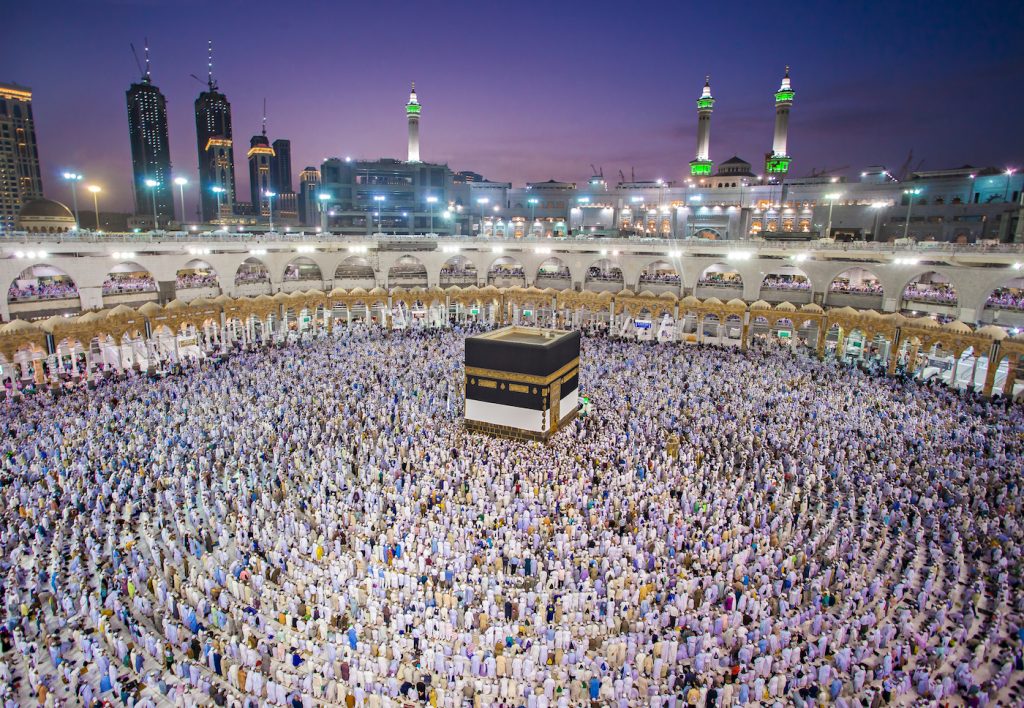
© Shutterstock
Tariq Mahmood, Toronto, Canada
It seems odd to think that, every year, millions of people fly across the world to circle around a black cube.
That might be the extent to the average person’s knowledge about Hajj – if they even know what it is. However, Hajj is one of the five most important tenets in Islam, and it involves much more than going around the Ka’bah (the black cube you may have seen in pictures).
What is the Hajj and the Ka’bah?
The word Hajj means ‘he went or betook himself to an object of respect and reverence’. Thus, the Hajj refers to any sort of pilgrimage, but in the Islamic context, it specifically refers to a spiritual journey to Makkah and its surroundings (in modern-day Saudi Arabia) during the lunar month of Dhu al-Hijjah (which literally means ‘the month which possesses Hajj’). The lunar calendar also has 12 months, but they are shorter than the solar months; thus, the days of Dhu al-Hijjah change every year.
The Ka’bah is, without a doubt, the holiest site of Islam. It is the building towards which every Muslim in the world prays five times a day, and is the focal point of Hajj. The Ka’bah is believed by Muslims to have existed for millennia. [1] We’ll explain more about that later.
The Prophet Abraham (as) Revives the Practice of Hajj
Islam believes it was the Prophet Adam (as) who was the original architect of the Ka’bah and therefore the first pilgrim. [2] But after it fell into disuse, it was the Prophet Abraham (as) who raised the walls of the Ka’bah from its ruins, thus laying the foundations for the Hajj as we now know it. The Fourth Caliph of the Ahmadiyya Muslim Community, Hazrat Mirza Tahir Ahmad (rh), explains:
‘The institution of pilgrimage can be traced back to the time of Abraham (as). But there are very clear statements in the Qur’an describing it as an ancient institution, starting from times immemorial when the first House of God was built in Makkah…Abraham (as) raised it from the ruins which he discovered under divine guidance, and about which he was commissioned by God to rebuild with the help of his son Ishmael(as).’ [3]
It’s quite fascinating that many of the rites of Hajj are based on the life of the Prophet Abraham(as), his wife Hagar (as) and their son, the Prophet Ishmael(as). For example, one of the rites of the Hajj is to run between two mountains, namely Safa and Marwah, seven times. This is a reference to when Hagar (as) and the Prophet Ishmael (as) (who was then an infant) were dropped off in Arabia by the Prophet Abraham (as) (based on the commandment of God), and Hagar (as) couldn’t find water. Thus, she ran between the two mountains as her infant child cried. As a sign of divine assistance, God caused a spring to erupt at the feet of the infant Ishmael (as). It is this spring which is now known as the well of Zamzam.
After this, however, some Pagan tribes began to associate all sorts of odd rituals with the pristine spiritual journey of Hajj. They corrupted its true purpose and deified mere humans. Thus, the spiritual revolution brought by the Holy Prophet (as) once again revived the actions of Hajj performed by the Prophet Abraham (as), but also added many new spiritual aspects in order to reinforce and perfect the Hajj.
Does Everyone Have to Perform Hajj?
Muslims who are able to afford the Hajj must perform it at least once in their lives. Hajj is not obligatory for the sick, young children, or those who cannot afford to go. Conditions must also be safe and secure to perform the Hajj. Throughout history, the Hajj has been cancelled due to treacherous paths or discord between nations. Sometimes this meant that the organisers themselves restricted Hajj, or those who wished to undertake the journey desisted from doing so because of wars or the risk of catching disease. Therefore, a person must ensure it is safe to travel to Hajj.
Why Is Everyone Dressed in White?
The circuits of the Ka’bah are perhaps the most famous images associated with the Hajj. Countless people use this icon to represent Islam; in fact, people often refer to any place that attracts others as a ‘mecca’, a figurative word derived from the very same quality that the city of Makkah possesses.
Men dress themselves in simple, unsewn garments, called ihram, in order to adopt simplicity. Both kings and beggars wear the same clothing, a remarkable reminder that all humans are equal. Regarding another aspect of this, the Second Caliph (ra) of the Ahmadiyya Muslim Community further states:
‘Ihram reminds one of the Day of Resurrection. Like the shroud of a dead body, the pilgrim is covered only with two unsewn sheets, one for the upper part of the body and the other for the lower; and he also has to remain bareheaded. This condition is to remind him that he has here, as it were, risen from the dead.’ [4]
Why Do Men Shave Their Heads?
Allah the Almighty commands Muslim men to shave their heads during the Hajj in the following words:
‘And complete the Hajj and the Umrah for the sake of Allah: but if you are kept back, then make whatever offering is easily available; and do not shave your heads until the offering reaches its destination.’ [5]
Allah also states: ‘You will certainly enter the Sacred Mosque, if Allah will, in security, some having their heads shaven, and others having their hair cut short.’[6]
These verses demonstrate that a Muslim man must shave or trim his hair after sacrificing an animal, while women only need to cut a small part of their hair.
Many people reason that Allah commands such an action so that there is humility and sincerity in a Muslim’s actions, and they understand that the Hajj has not exalted them above others, but rather allowed them to be humble, and earn Allah’s pleasure through modesty and humility.
Why Are Animals Sacrificed?
The animal sacrifice on Eid references a significant and marvellous event that took place in Makkah thousands of years before the Holy Prophet Muhammad (sa)! According to Islam, Allah the Almighty commanded the prophet Abraham (as) to leave his wife Hagar (as) and son Ishmael (as) in the deserts of Arabia.
The Prophet Abraham (as) did so with a heavy heart and made this sacrifice in the name of Allah. However, when Ishmael (as) had become a teenager, Abraham (as) saw a dream that he was sacrificing his son. Abraham (as) took this as a sign that Allah the Almighty wished for Ishmael (as) to be sacrificed; thus, Abraham (as) made his intentions clear to his son, who responded: ‘Indeed, fulfil your dream, for I present myself to fulfil the command of God.’
As Abraham (as) was about to slaughter his son, an angel came and told Abraham (as) that he had already fulfilled the dream, and that he should slaughter a ram instead. Thus, in remembrance of this, the custom of sacrificing animals on the occasion of Hajj was established. It reminds us that we should be willing to sacrifice what we love for the sake of God, so that we may attain nearness to Him. [7]
Why Does Everyone Go Around the Ka’bah?
The Ka’bah has been described by God as the first house of His worship. The Holy Qur’an states, ‘Surely, the first House founded for mankind is that at Becca, abounding in blessings and a guidance for all peoples.’ [8]
In this verse, Becca refers to Makkah. Thus, Muslims circumambulate the Ka’bah because Allah the Almighty has appointed it as the nucleus of Islam, so they remember Him with greater fervour and emotion near His house of worship. They remind themselves that their only focus should be God; just as a planet orbits the sun, just as subjects are tied to their king, a Muslim makes God his primary obligation.
Do Muslims Throw Rocks at Satan?
In Islam, there are three stones that represent Satan during the Hajj. They are named: Jamarat al-Dunya, Jamarat al-Wusta, and Jamarat al-Aqabah. Muslims do not believe that these stones are actually Satan; rather, they throw pebbles at the stones as a symbolic gesture: as they perform the rites of Hajj, they do so by rebuking Satan. Hazrat Mirza Bashiruddin Mahmud Ahmad (ra) states:
‘The casting of pebbles at these pillars is also symbolic of Satan being pelted. Evil thoughts should be driven out of one’s mind just as God has driven away Satan from His presence.’ [9]
What Do Muslims Gain from Hajj?
This question lies at the crux of the Hajj: Why do Muslims go to Makkah to perform the Hajj? There are a plethora of reasons why the Hajj is a rewarding and necessary journey.
Of course, the primary motive is to fulfil the command of God and to build a stronger connection with Him. But for Muslims, there are also other benefits to Hajj.
Hajj reminds Muslims of the root of their religion; they walk the same paths that the Holy Prophet Muhammad (sa) traversed and have a chance to completely immerse themselves in a Godly action, away from the distractions and bustle of the world.
He or she then has a chance to reflect: am I a good person? How can I be better? What have I done wrong, and how can I seek forgiveness? How can I treat those around me better, and how can I contribute to something meaningful? All of these questions enter his or her mind, as they walk around the Ka’bah, or lie under the open sky in Muzdalifah.
It’s an overwhelming feeling: the weight of the world causes a Muslim to implore God’s help. Here, they fervently pray to God for strength, forgiveness, and above all, the chance to be more righteous, not just towards the Creator, but towards the creation as well.
In that profound moment, a Muslim should feel close to the Creater, while all around them, millions of people are also doing the exact same thing: praying to the same God, promising and striving to be better.
Day after day, different aspects of their lives dawn upon them. When they physically pelt the great stones (which represent Satan), they are reminded of their own sins. They vow to eschew their evil ways and turn a new leaf. Every single action is simply a physical manifestation of a deep spiritual significance. Every step taken while circumambulating the Ka’bah symbolises the steps Muslims take towards God, whether it’s seeking forgiveness for sins, or asking God to help fight ego and create humility. As Muslims live in true simplicity during these days, sleeping under open skies, walking for miles every day, they strengthen themselves, thereby strengthening their connection with God. This is what they gain: a true treasure which forever changes them.
Conclusion
I am reminded of the reflections of Malcolm X when he went for Hajj. For most of his Muslim life, Malcolm X was part of the Nation of Islam and tended to demonise white people. However, after returning from Hajj, Malcolm X said:
‘There are Muslims of all colours and ranks here in Makkah from all parts of this earth…I have eaten from the same plate, drank from the same glass, slept on the same bed or rug, while praying to the same God…with fellow Muslims whose skin was the whitest of white, whose eyes were the bluest of blue, and whose hair was the blondest of blond—yet it was the first time in my life that I didn’t see them as ‘white’ men.’ (10)
This is a marvellous lesson of Hajj: one which was taught by the Holy Prophet (sa) himself.
When standing in front of the largest gathering of Muslims during his life, some months before he passed away, he emphatically declared, ‘Allah has made you brethren one to another, so be not divided. An Arab has no preference over a non-Arab, nor a non-Arab over an Arab; nor is a white one to be preferred to a dark one, nor a dark one to a white one.’ [11]
As Muslims meet others of different ethnicities, cultures, countries and temperaments, a reality dawns on them: when Islam has united them, they aren’t so different after all.
This is why Muslims perform Hajj, and this is how they do it. So the next time you hear about Hajj, Makkah or Arabia, remember the beautiful sight of Hajj: the great unifier of humanity.
About the Author: Tariq Mahmood is an Imam of the Ahmadiyya Muslim Community in Canada and serves as Secretary of The Existence Project Team for The Review of Religions.
Endnotes:
1. Hazrat Mirza Bashiruddin Mahmud Ahmad (ra), The Five Volume Commentary, See note under 2:128.
2. Rizwan Safir, “History of the Ka’bah,” The Review of Religions, November 13, 2014. Accessed: May 26, 2024. https://www.reviewofreligions.org/11343/history-of-the-kabah/
3. Hazrat Mirza Tahir Ahmad (rh), An Elementary Study of Islam, Chapter: Hajj – The Pilgrimage (Tilford, Surrey: Islam International Publications Ltd., 2010), 41.
4. Hazrat Mirza Bashiruddin Mahmud Ahmad (ra), The Holy Qur’an With English Translation and Commentary, Vol. 1 p. 330.
5. The Holy Qur’an, 2:197.
6. The Holy Qur’an, 48:28.
7. Hazrat Mirza Bashir Ahmad (ra), The Life & Character of the Seal of Prophets, Vol. 1 (Tilford, Surrey: Islam International Publications Ltd., 2018).
8. The Holy Qur’an, 3:97.
9. Hazrat Mirza Bashiruddin Mahmud Ahmad (ra), The Holy Qur’an With English Translation and Commentary, Vol. 1 p. 330.
10.https://www.nytimes.com/1964/05/08/archives/malcolm-x-pleased-by-whites-attitude-on-trip-to-mecca.html#:~:text=%E2%80%9CDuring%20the%20past%20seven%20days,kings%2C%20cabinet%20members%2C%20potentates%20and
11. Muhammad Zafrulla Khan, Muhammad: Seal of the Prophets (London, UK: Routledge and Kegan Paul, 1980). https://www.alislam.org/book/muhammad-seal-prophets/farewell/.
Add Comment