
Summary prepared by The Review of Religions
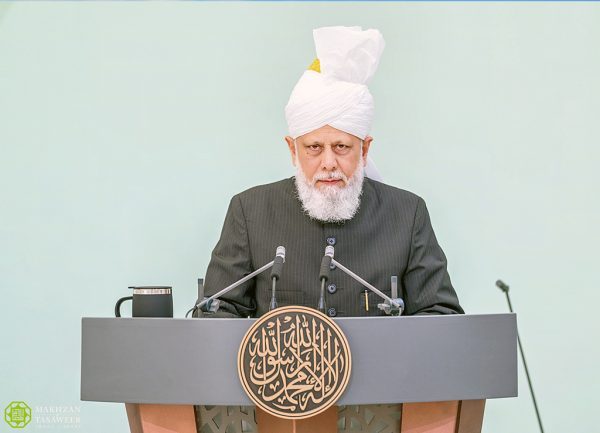
After reciting Tashahhud, Ta‘awwuz and Surah al-Fatihah, His Holiness, Hazrat Mirza Masroor Ahmad (aba) said that he would continue mentioning the incident of Hazrat Ka’b bin Malik (ra) and other companions who remained behind from the Expedition of Tabuk.
Safeguarding Against the Harm of Others
His Holiness (aba) quoted Hazrat Mirza Bashiruddin Mahmud Ahmad (ra), who presented the incident with reference to a Hadith. After presenting the incident, Hazrat Mirza Bashiruddin Mahmud Ahmad (ra) advised the Ahmadiyya Muslim Community, highlighting the fact that those who had been under disciplinary action in Madinah would not be allowed to speak with others, nor would others be allowed to speak with them. Hazrat Mirza Bashiruddin Ahmad (ra) highlighted this at a time when there was a disorder spreading in Qadian, and those under disciplinary action would find their way into Ahmadi homes and try to influence them. Hazrat Mirza Bashiruddin Mahmud Ahmad (ra) warned that such people are like snakes and would only cause harm to those who harbour them, while those who are protected by God can never be harmed.
Render Services Purely for the Pleasure of Allah
His Holiness (aba) quoted Hazrat Mirza Bashiruddin Mahmud Ahmad (ra), who highlighted the fact that Hazrat Ka’b bin Malik (ra) had previously taken part in all the battles alongside the Holy Prophet (sa). However, after his mistake in staying back from the Expedition of Tabuk, he was made to face a social boycott. It was in this state that Hazrat Ka’b (ra) received a letter from the king of Ghassan, who tried to play on his emotions for being treated this way and offered him to come and join him. However, even then, Hazrat Ka’b (ra) refused. Hazrat Mirza Bashiruddin Mahmud Ahmad (ra) said that today, the case has become that in the Community, if someone is asked about a matter, they reply by saying that their services should be taken into account. However, there is a difference between upholding the organisational structure and actually doing the work. If one makes a mistake, no matter who they are, they must be asked about it. Ultimately, one must render service to the faith in order to cause Satan to flee; however, one should not render service in order to be praised or appreciated.
His Holiness (aba) said that the Expedition of Tabuk and the return journey were so successful that news of Islam’s success began spreading, and the flag of Islam started being raised throughout Arabia.
The Expedition of Hazrat Khalid bin Walid (ra) towards the Banu Abd al-Madan in Najran
His Holiness (aba) said that after returning from the Expedition of Tabuk, there was an expedition called the Expedition of Hazrat Khalid bin Walid (ra) towards the Banu Abd al-Madan in Najran. This expedition took place in 10 AH. The Holy Prophet (sa) instructed Hazrat Khalid (ra) to invite the people there to Islam three times. Hence, that is exactly what Hazrat Khalid (ra) did, and after his preaching, they accepted Islam. From there, Hazrat Khalid (ra) sent a letter to the Holy Prophet (sa) and informed the Holy Prophet (sa) that after three days of propagation, the tribe accepted Islam. Hazrat Khalid (ra) said that he was staying among the people and teaching them the faith, and he would await further instructions from the Holy Prophet (sa). In response, the Holy Prophet (sa) said that Hazrat Khalid (ra) should bring a few people of the tribe with him to Madinah to meet the Holy Prophet (sa). When this group met the Holy Prophet (sa), they pledged allegiance to him. The Holy Prophet (sa) asked them if they were the same people who would cause their enemy to flee? They did not initially respond, and the Holy Prophet (sa) repeated this question four times until finally they responded, saying they were indeed. They then expressed their gratitude to God for having guided them.
The Final Expedition During the Lifetime of the Holy Prophet (sa)
His Holiness (aba) said that the final expedition which the Holy Prophet (sa) dispatched during his lifetime was the army of Usamah (ra). The background of this expedition is recorded as follows. When the Holy Prophet (sa) returned from the Farewell Pilgrimage, there was still a threat from the Byzantines, as the Christians were still very proud of their strength. The retribution for the deaths that took place during the Battle of Mu’tah was also still pending. Hence, the Holy Prophet (sa) appointed an army under the leadership of Hazrat Usamah (ra) to attack Syria. The army’s preparations became complete two days prior to the demise of the Holy Prophet (sa). The Holy Prophet (sa) dispatched the army with instructions to ensure a decisive victory, while not desiring warfare, but only taking up arms if an attack was waged against them. The Holy Prophet (sa) also granted Hazrat Usamah (ra) a flag.
His Holiness (aba) said that all the elder companions were also part of this army. Some people began raising questions about how such a young person could be made the leader over such eminent companions. This discourse displeased the Holy Prophet (sa), who reaffirmed his decision to make Hazrat Usamah (ra) the leader of the army on account of his virtue and ability. In the meantime, the Holy Prophet’s (sa) illness at the time was increasing; however, the Holy Prophet (sa) insisted that Usamah’s (ra) army should continue. When the Holy Prophet’s (sa) illness increased further, Usamah (ra) went to see the Holy Prophet (sa). The Holy Prophet (sa) insisted that Hazrat Usamah (ra) should proceed with his army. However, just as he was setting out, he received word that the Holy Prophet (sa) was nearing his final moments, Hazrat Usamah (ra) and his army returned.
His Holiness (aba) once Hazrat Abu Bakr (ra) became the First Caliph, he instructed that Hazrat Usamah’s (ra) army should continue forth with its mission. At the time, a disorder was brewing in Madinah, and some felt that the army should not be sent out; rather, it should remain in Madinah for its protection. However, Hazrat Abu Bakr (ra) said that his first instruction as the Caliph could never be to restrain the very army which the Holy Prophet (sa) had dispatched himself. While dispatching the army, Hazrat Abu Bakr (ra) reminded Hazrat Usamah (ra) to fulfil all the instructions that he had been given by the Holy Prophet (sa).
His Holiness (aba) said that this completed the series of sermons on the battles and expeditions from the life of the Holy Prophet (sa). His Holiness (aba) said that there are other aspects of the life of the Holy Prophet (sa) which he may highlight in the future.

Funeral Prayers
His Holiness (aba) said that he would lead the funeral of the following deceased members:
Azizur Rahman Khalid
Azizur Rahman Khalid, a missionary who recently passed away in the USA. He served as a missionary in various African countries and in various capacities in Pakistan. His grandson, Hamza Ubaidullah, is also a missionary, and Azizur Rahman Khalid would recount to him the struggles that he faced early on as a missionary, particularly the struggle of finding food. His Holiness (aba) said that he spent some time with him whilst living in Ghana, and His Holiness (aba) found him to be very hardworking, simple, and selfless. He is survived by two sons and three daughters. His Holiness (aba) prayed that may Allah grant him forgiveness and mercy and elevate his station.
Edi Hamaidi
Edi Hamaidi of Indonesia. He passed away in Madinah whilst there in the course of performing Umrah. He was passionate about spreading the message of Islam Ahmadiyyat. He was regular in attending the mosque and offering prayers. He recited and studied the Holy Qur’an daily. He was regular in offering the tahajjud (pre-dawn voluntary prayer). He received the honour of being buried in Jannah al-Baqi’ in Madinah. His Holiness (aba) commented that clerics in Pakistan do not allow Ahmadis to bury their deceased in their own Ahmadi cemeteries, yet Allah made it so that Edi Hamaidi could be buried in Jannah al-Baqi’, where they would never dare to desecrate a grave. These clerics will soon meet their end. Edi Hamaidi had a deep-rooted love for Khilafat. He is survived by four daughters and ten grandchildren. His Holiness (aba) prayed that may Allah grant him forgiveness and mercy and elevate his station.



Add Comment