
Summary prepared by The Review of Religions
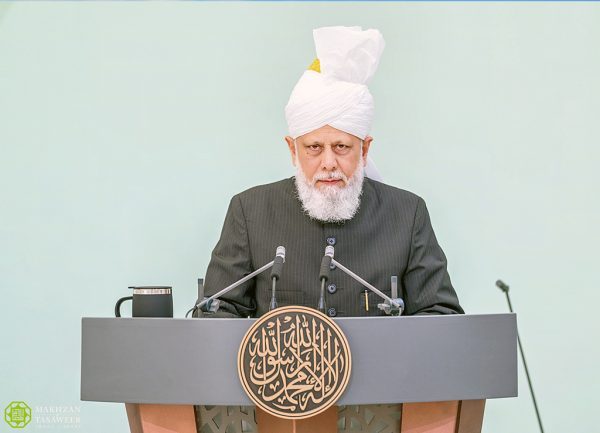
After reciting Tashahhud, Ta‘awwuz and Surah al-Fatihah, His Holiness, Hazrat Mirza Masroor Ahmad (aba) recited the following verse of the Holy Qur’an:
‘Call unto the way of thy Lord with wisdom and goodly exhortation, and argue with them in a way that is best. Surely, thy Lord knows best who has strayed from His way; and He knows those who are rightly guided.’ (The Holy Qur’an, 16:126)
His Holiness (aba) said that in this verse of the Holy Qur’an, along with other verses, God has enjoined not only to propagate His message but to do so in the best manner and to advise others so that people also gain benefit. Propagation carried out in this manner is often successful and bears fruit. Hence, this principle should always be borne in mind.
Guidance for Propagating the Message
His Holiness (aba) said that with the prevalence of social media, some people think that propagation has become very easy. While there are those who go out and physically meet people and propagate the message in person, there are certain places and countries which do not allow this. Hence, those with a passion for propagating the message will do so on social media. While this is also good, there are certain conditions and a certain decorum that are necessary for propagation. Otherwise, the impact of propagation will become the opposite of that which is intended and have a negative impact, allowing opponents to raise allegations.
His Holiness (aba) said that some people think that they have great knowledge when stepping out into the field of propagation; however, when they are unable to convince others, they become dejected. However, there is nothing to become dejected about. The Ahmadiyya Muslim Community certainly has sound arguments; it is a separate matter if someone is unable to clearly and effectively convey those arguments. As a Community, whatever the Ahmadiyya Muslim Community says is backed by evidence and wisdom, following the teachings of the Holy Qur’an and the Holy Prophet (sa). So, everyone should remember that when propagating the message, it must be done in the best manner.
His Holiness (aba) said that once, the Promised Messiah (as) gave excellent guidance when it comes to propagating the message. He said that simply knowing the language of the people is not enough to propagate the message effectively; rather, one must also deepen their religious knowledge. This guidance is very important, as it also applies today to propagation on social media. It is not enough to simply know the language or have access; instead, one should study and gather the various allegations that are raised and learn their answers. If they are unable to understand, then they should ask the relevant department within the Community.
His Holiness (aba) further quoted the Promised Messiah (as) who said that another necessary component of propagation is that the one who undertakes the task of propagating the message must also have a personal connection with God, so that their efforts are supported by the holy spirit. The above conditions are necessary in order to be successful in propagating the message.
Propagating with Wisdom
His Holiness (aba) said that whilst propagating the message, it is necessary to bear in mind that Islam is the singular religion and the Holy Prophet (sa) is the singular prophet who came for the entire world and for all people. Yet, to date, the world’s Muslim population remains less than one-fourth of the whole world’s population. What is the reason for this? It is because the message has not been propagated with wisdom and in a proper manner. Some Muslims think that they will propagate the message through jihad, whereas jihad is only permissible in the event of the enemy attacking first. The Holy Prophet (sa) only received permission for jihad when the disbelievers had taken up the sword first in order to wipe out Islam. Thus, God said:
‘Permission to fight is given to those against whom war is made, because they have been wronged — and Allah indeed has power to help them.’ (The Holy Qur’an, 22:40)
His Holiness (aba) said that when God granted this permission, it was because cruelties were being perpetrated against Islam. However, in today’s world, such religious wars do not exist. Even if Muslims are facing cruelties, they are not initiated in the name of religion. Hence, God and the Holy Prophet (sa) deemed the greatest form of jihad to be that of the Holy Qur’an. So, bearing in mind that the Muslim population is less than one-fourth of the world’s population, we, as the Ahmadiyya Muslim Community, who are the followers of the Promised Messiah (as), must establish personal connections with God and learn the religion so that we may propagate it in the proper manner.
His Holiness (aba) said that we should also bear in mind the various instructions that the Holy Prophet (sa) gave when it comes to propagation. For example, the Holy Prophet (sa) instructed to speak to people according to their level of understanding and knowledge. Today, this would practically mean that, if we wish to explain the advent of the Promised Messiah (as) to a non-Ahmadi Muslim, we should do so through the Holy Qur’an, the sayings of the Holy Prophet (sa), and other books by Muslim scholars.
His Holiness (aba) said that the Holy Prophet (sa) also instructed to avoid being prayed against by those who have been wronged. In other words, when propagating the message, one must always exhibit the highest moral standards and should always set the highest standard of fulfilling the rights of others, so that those who are wronged do not pray against such a person but pray in favour of such a person. Then, Allah the Almighty will place blessings in their efforts.
The Meaning of Wisdom & Goodly Exhortation
His Holiness (aba) said that whilst explaining ‘goodly exhortation’, the Promised Messiah (as) explained that one must always respond to questions or allegations gently and calmly. Even when others speak harshly to us, they do so because they have nothing to say that is intellectually sound or backed by evidence. If we respond in the same harsh manner, it will give the impression that we don’t have a sound response either. Hence, no matter what, we must always employ gentleness and calmness when propagating the message.
His Holiness (aba) said that some opponents allege that the Promised Messiah (as) used harsh language in certain instances. First of all, it should be known that this is not true and the Promised Messiah (as) did not employ harshness. If the Promised Messiah (as) ever gave a strong response, he explained that in certain instances the opponents adopt great harshness and sought to spread disorder, as a result of which wisdom dictated that a stronger response be given so that the ill-mannered and wayward passions of the opponents may be suppressed. The Promised Messiah (as) further clarified that such instances of strong responses were not the result of personal passions or anger; rather, such responses were under the clause ‘and argue with them in a way that is best.’ Furthermore, such instances were only when opponents had crossed all limits in using foul language against Islam and the Holy Prophet (sa). At the same time, the Promised Messiah (as) explained that he employed the use of stronger responses in very specific circumstances. Yet, at the same time, he enjoined his Community to always employ gentleness and kindness when propagating the message.
His Holiness (aba) said that the Promised Messiah (as) enjoined that when speaking to the followers of other religions or even non-Ahmadi Muslims, one must always show kindness and never become impassioned to the point of speaking harshly in any way.
His Holiness (aba) said that similarly, the Second Caliph (ra) explained that one must always employ wisdom as instructed by the Holy Qur’an. This is because, without wisdom, one becomes impassioned to the point where their message is rendered ineffective and contrary to the desired outcome. Wisdom also denotes combating ignorance. Hence, when propagating the message, employing wisdom means speaking in a manner that not only removes the ignorance of others but is also in a manner that others can understand according to their own level of knowledge. Sometimes, people will try to convey their message through ostentatious speech, which others may not understand, but are simply influenced by the manner of speech. However, especially in settings with larger gatherings, using language that is easy to understand increases the likelihood that more people will understand the message and focus on it rather than merely listen to words.
His Holiness (aba) said that the Second Caliph (ra) further explained that sometimes people exaggerate certain things or convey the wrong message when propagating. However, there is no need for exaggeration; all that is required is to focus on the teachings of the Holy Qur’an and the Holy Prophet (sa). God states in the Holy Qur’an:
‘He who goes astray cannot harm you when you yourselves are rightly guided.’ (The Holy Qur’an, 5:106)
Therefore, one should not think that by saying something not rooted in truth, one may resort to saying something that is not true. Instead, one should maintain the truth and leave the guidance of another person to God.
His Holiness (aba) said that the Second Caliph (ra) also explained that wisdom also denotes saying that which is appropriate according to time and place. Hence, rather than saying something which one knows will incite the anger of the person they are speaking to, they should instead speak about that and in a manner which will allow the person they are addressing to hear them in a calm manner.
His Holiness (aba) said that today, it is the duty of the Ahmadiyya Muslim Community to convey the true message of Islam to the world. We must convey to others that the religion is not based solely on argumentation, but rather on various forms of advice and guidance that one should implement. Employing wisdom, rather than inciting false passions, we should speak in a manner and convey points that will resonate with the person who is listening to us.
His Holiness (aba) said that God states in the Holy Qur’an:
‘Surely, thy Lord knows best who has strayed from His way; and He knows those who are rightly guided.’ (The Holy Qur’an, 16:126)
In other words, one should continue propagating the message with wisdom. At the same time, one should not become discouraged if it seems that their efforts are ineffective or that they know nothing. The onus also lies on the person being addressed. God states that our duty is to propagate the message, and ultimately God is the One Who will guide people.
Aligning One’s Deeds with Their Words
His Holiness (aba) quoted the Promised Messiah (as) who said that in the Holy Qur’an God states, ‘Why do you say what you do not do?’ (The Holy Qur’an, 61:3). In other words, there may be those who hear the arguments and become convinced, but then are turned away by the actions of those who conveyed the arguments because the two do not align. Therefore, it is necessary for one who is propagating the message to practise what they preach. A true believer should never develop a difference between their words and actions. Rather, aligning one’s actions with their words is extremely important and indeed effective. The most effective way to convey Islam’s teachings is to demonstrate them through our actions. Therefore, one should not be proud simply by verbally propagating the message; instead, true propagation requires showing, through one’s own examples and actions, the true and beautiful teachings of Islam and the revolutionary change they bring about in a person’s life.
His Holiness (aba) further quoted the Promised Messiah (as), who explained that the purpose of propagation is not just to directly combat or debate the detractors of our faith. Rather, the ultimate objective is to convey the beautiful teachings of Islam to the masses. It is also necessary to remember that every lock has a key – there is a certain manner in which to speak depending on the circumstance and situation. There is not just a single standard way to convey the message in every instance; one must analyse and adapt according to the person and situation when propagating.
His Holiness (aba) said that the Second Caliph (ra) gave the example of Joseph (as) and the wise manner in which he propagated his message. When he was imprisoned, there were two other captives with him. Rather than speaking in a way that might scare them away, he told them he would speak with them briefly and finish his discourse before the food arrived. Hence, taking advantage of the opportunity which had presented itself when the two other prisoners had asked him about the interpretation of a dream, Joseph (as) knew that they were awaiting his answer, so before giving them an answer, he briefly conveyed his own message as they intently listened, and then gave them a response to their question.
His Holiness (aba) said that the Second Caliph (ra) also gave the example of the Holy Prophet (sa). In the initial stages, when he was propagating the message of Islam to the Makkans, they would not listen. Therefore, once, the Holy Prophet (sa) arranged a dinner at which he intended to convey his message. However, as he tried to do so, people left. Upon this, the Holy Prophet (sa) arranged another dinner, and this time he conveyed his message before the food arrived, knowing that everyone would be waiting for the food and would sit to listen. Hence, this shows us that we must employ wise ways of conveying our message whilst ensuring not to make it a burden on others.
His Holiness (aba) said that non-Ahmadi Muslims allege that Ahmadis do not take part in, or refuse the concept of jihad. However, jihad as it exists today is different. Today, our jihad is to propagate the message of Islam Ahmadiyyat and help people around the world to come and understand the true teachings of Islam. Hence, it is false to say that Ahmadis do not partake in jihad; it must be understood that the manner in which jihad is undertaken today has indeed changed. The Promised Messiah (as) declared that today is the time for jihad with the pen – for spreading the message of Islam through discourse and intellectual means.
His Holiness (aba) said that other Muslims accept that the latter-day Messiah is to come, yet they also refuse the message when they are told that the Messiah has come. Engaging in debates focused on lexical analyses of specific words or phrases will not yield any benefit. Instead, we should tell them that our only purpose is to establish the superiority of Islam throughout the world, as the Holy Prophet (sa) was commissioned as a prophet for the entire world. Until we bring the world under the flag of Islam, how can we claim to have done anything of significance? Our jihad will only be fruitful when we are successful in this endeavour, as this is what really matters. On the other hand, is the jihad which other Muslims seek to undertake of any benefit? Certainly not. Hence, every Ahmadi should undertake the jihad of the pen with wisdom, not the sword.
Immense Responsibility of Missionaries
His Holiness (aba) addressed the missionaries of the Community, saying that they have a great responsibility entrusted to them. Not only must they tend to the moral training of the Community, but they must also help people become attached to God. In doing so, they must also help people increase their knowledge, thus preparing them for the true jihad explained by the Promised Messiah (as). It is then that missionaries will be those who fulfil their oath.
His Holiness (aba) quoted the Second Caliph (ra), who addressed missionaries and said that a missionary should purify their souls and then endeavour to establish the same in the Community. A missionary should develop the habit of offering the pre-dawn voluntary prayers (tahajjud) and direct the Community’s attention towards worship. Missionaries should conduct a deep study of the Holy Qur’an and draw the Community’s attention towards studying it as well. Missionaries should remain engaged in the remembrance of Allah and draw the Community’s attention towards this as well. Missionaries should also have a personal library, as this develops the habit of reading. These days, there is a wealth of knowledge and literature of the Community on alislam.org, which can also be accessed. A missionary should have complete trust in Allah and consider Him the source of all things, because we obtain all things from Allah. Missionaries should also have good relations with others. In doing so, our field of propagation will expand. A missionary should also have the resolve to bravely combat evil and to develop the same resolve in the Community. A missionary should have the habit of consistency. It should not be that one only has the passion for worship and propagation for a few days. Thus, when missionaries develop consistency, the same consistency will develop within the Community. When these qualities develop, then we can bring about a revolutionary change in the world.
His Holiness (aba) said that we have a great responsibility to fulfil, in which the missionaries play a vital role. His Holiness (aba) prayed that may Allah enable everyone to fulfil these responsibilities.



Add Comment