
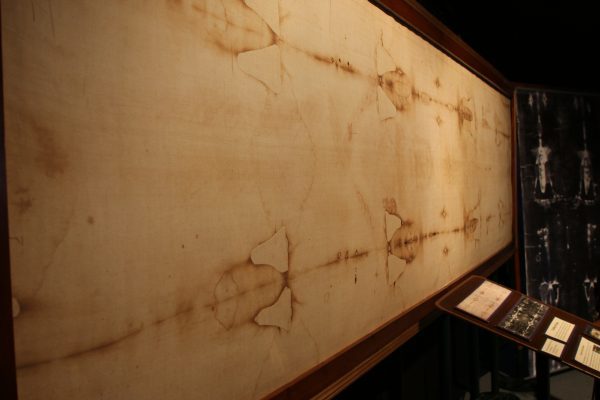
A replica of the Shroud of Turin displayed at The Review of Religions exhibition held at the UK Annual Convention of the Ahmadiyya Muslim Community.
Tariq Mahmood, Toronto, Canada
To the Muslims he is a noble prophet, to the Jews he is a false claimant, and to many Christians he is God; such is the contested history of Jesus (as), son of Mary (as). Search the internet and you will find hundreds, if not thousands of false narratives, conspiracy theories, and claims regarding Jesus (as): was he born to a virgin? What did he do from the age of 12 to 30? Did he even exist at all?
Among the myriad of calumnies lies a straight path to the truth – one which must be tread by the true followers of Jesus (as). That journey takes us to Turin, Italy, home to a shroud which claimants say was the burial cloth of Jesus (as) himself. This cloth is known as the ‘Shroud of Turin’, and it may uncover details about the most important moment of the life of Jesus (as): his supposed death.
Resurgence of Relevance
The Shroud of Turin has received newfound interest and massive media ‘buzz’, sparked by famous show-hosts such as Piers Morgan, who recently released a new episode of ‘Uncensored’ wherein he invited Shroud of Turin expert Jeremiah Johnston (among others) to debate the authenticity of this shroud. In addition to this, Tucker Carlson, a former conservative FOX News broadcaster turned podcaster – who has interviewed everyone from Palestinian nuns to UFO conspiracy theorists to the president of Iran – also had Jeremiah Johnston on the show to discuss the Shroud of Turin. That’s not all: in the last year, the HISTORY channel has made a documentary regarding the Shroud, the cloth has been mentioned on the Joe Rogan podcast several times, and dozens of podcasts have amassed millions of views discussing this very artefact.
So what is the shroud, and why is it significant?
The History of the Shroud
This relic is alleged to be the very same burial cloth of Jesus (as), that was wrapped around his body after the crucifixion; in fact, the Gospel of Mark specifically mentions that Jesus (as) was wrapped in a linen cloth, a common practice amongst the Jews [1]. Although there are other cloths that have claimed the exact same history, the strength of this claim was truly bolstered in 1898, when a photographer by the name of Secondo Pia took a photo of the Shroud. When he examined the negatives, it revealed a shockingly detailed image of the shroud, hidden from the naked eye.
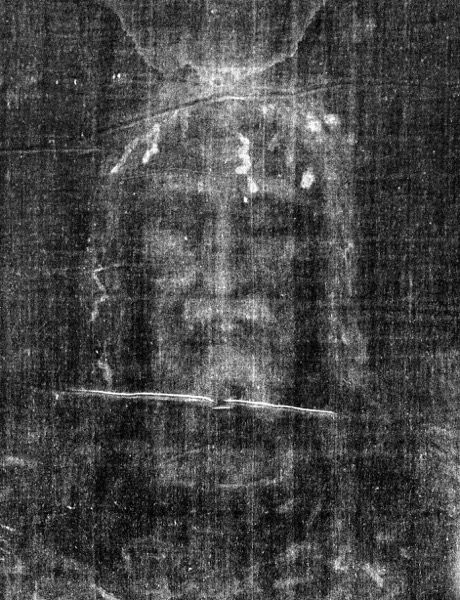
Now, sceptics of the Shroud of Turin are quick to mention that the recorded history of this relic (as in, accounts from written history) only goes back to the 13th or 14th century. It is noteworthy, however, that mention of a burial cloth of this type has been recorded in history for much longer. Dr Jeremiah Johnston, historian and avid proponent of the Shroud, has sought to combat this scepticism and claims that the Shroud was known by many different names prior to being named the ‘Shroud of Turin’. He notes that history also speaks of the ‘Image of Edessa’, and that both relics are actually the same cloth.[2] Edessa is a city in Eastern Turkey, where the cloth was believed to be located for about 900 years. A powerful piece of evidence to support this transfer comes from historian Ian Wilson, who details a possible timeline of the Shroud from the time of Jesus (as) up until the modern day.
Wilson – among other historians – has pointed out the fact that recorded history notes a very powerful narration: that a cloth ‘imprinted with Jesus’s likeness’ was taken from Jerusalem to Edessa, which proved to be key in King Agbar V’s conversion to Christianity – who was the king of Edessa at the time.[3] Although this timeline is not confirmed or conclusively proved beyond doubt, it does lend support to the theory that the Shroud has more recorded history than just what we find in European accounts after the 13th century.
Furthermore, Johnston also mentioned a key finding that supports the theory that the Shroud of Turin was more than a 700-year-old forgery: pollen spores on the cloth that could help trace the route of the Shroud between Jerusalem and Italy. Of note was pollen that was found on the Shroud of Turin from Jerusalem, Edessa, Constantinople, Greece, up to France, and then Italy. The latter part of this timeline at least matches the recorded history of the Shroud, when the House of Savoy (who possessed the Shroud) migrated their seat of power from Chambery in France to Turin, Italy.
How Do We Know the Shroud Belonged to Jesus (as)?
This question sits in the minds of proponents and sceptics alike. In fact, Dr Joseph Accetta, who was on the original team that researched the Shroud, and who is a sceptic himself (although he is a devout Christian), lists that one of the chief questions we must answer is whether ‘the cloth ensconced the body of Jesus Christ’.[4]
As it turns out, the Shroud of Turin itself presents a great deal of evidence that it truly wrapped the body of Jesus (as). For example, we know that the Romans would flog their victims with something called a flagrum (a whip which had three tips). The Shroud of Turin clearly shows such marks, left from blood that came out of these wounds. In fact, there are roughly 200 wounds on the back of the person in the Shroud, and 172 on the front. The majority of these wounds likely came from flogging Jesus (as). Thus, the blood stains match a person who was whipped just as Jesus (as) was.
Furthermore, marks on the head and forehead region tell of punctures to the head. This lines up with the biblical account that a crown of thorns was put on the head of Jesus (as).[5] The Shroud also shows that the person on the cloth was impaled with nails in his wrists and feet. Interestingly, people had long thought that the nails would have been driven through the palms, but critics suggested that a person could not be crucified by their palms.
The Shroud of Turin corroborates this conclusion, and shows that the wrists were nailed.[6] A gash on the abdomen between ribs five and six also corresponds to the Gospel of John, in which it is written that a roman soldier pierced Jesus (as) with a spear, which resulted in blood and water gushing forth.[7] This Biblical verse supports the belief of the Ahmadiyya Muslim Community that Jesus (as) was actually alive when he was taken down from the cross, so that he could fulfil his prophetic mission. If he was not alive, blood would not gush, rather it would slowly leak out, as is the case with blood after livor mortis (the stage of death after rigor mortis in which blood begins to pool in parts of the body because of gravity). However many Christians believe that the blood only leaked, and the fluid was present due to pulmonary edema (when the lungs fill up with fluid).
Thus, the person who was wrapped by this cloth was:
1. Flogged.
2. Made to incur puncturing wounds on the head.
3. Crucified with nails.
4. Speared in his abdomen.
5. Survived all this.
This perfectly aligns with the historical account of Jesus (as) according to the Ahmadiyya perspective.
Furthermore, the blood found on the cloth also proves that it came from a human, not an animal or a dye. The blood flow patterns on the Shroud also align with our human body, with flow traces aligning with veins and arteries.
Here, many Christian proponents of the Shroud also state that it has both premortem blood (before death) and postmortem blood (after death). Whilst premortem blood can conclusively be proved due to the reaction with cells around it and the way in which it pools, there is difficulty when distinguishing postmortem blood from agonal blood (when dying). In fact, in cases where there is severe trauma, blood often pools and behaves similar to that of a deceased person, whilst the person may still be alive. For now, more research must be conducted on whether there was any blood from a person who had died, or whether we are able to prove that coagulation of the blood or separation of the plasma could be analysed 2,000 years after the fact at all!
Studying all these wounds and marks on the Shroud, the mathematician Bruno Barberis concluded that the odds of this cloth belonging to anyone other than Jesus (as) are roughly one in 200 billion.[8]
In addition, significant testing has been done on the Shroud of Turin. For example, Dr Jeremiah Johnston states that over ‘102 disciplines’ have examined the Shroud.[9] We find that even the initial STURP team experimented on the Shroud using a wide variety of methods. The majority of these disciplines either proved that it was the Shroud of Jesus (as) or remained inconclusive, aside from one.
No method of testing is more famous and more widely known than carbon dating. Here is where the Shroud of Turin faces its greatest allegation.
Was the Shroud Proven False by Carbon Dating?
In the 1980s, a shocking revelation cast the authenticity of this relic into doubt: carbon dating showed that the Shroud was actually from 1260-1390. This implied that it was a 13th-century forgery. Additionally, this date also aligned with the record history of the Shroud: thus, both the dating of the Shroud and recorded history had shown that this could not have been the burial cloth of Jesus (as).
However, immediately after the results came out, scholars pointed out that there seemed to be errors with regard to the carbon dating.
For one, only three research labs were allowed to test the cloth as opposed to the seven that were originally chosen. The labs that were rejected also stated that three labs were not enough to conclusively rule out the margin for error:
‘The director of the Rochester Laboratory, one of the four not selected, wrote a seven-point letter to Nature criticising the new protocol. Point one reads: “The involvement of seven laboratories has been reduced to three. This eliminates the possibility of detecting a mistake made in the measurements by one or more of the three laboratories. As Tite knows, such mistakes are not unusual.”’[10]
Furthermore, only a small corner of the cloth was used to represent the entire Shroud. Recent evidence was released by the British Museum that once again conclusively proved that the sample was taken for a very specific section.
This corner not only seemed to have water stains, but also sustained fire damage, as the Shroud of Turin had survived three different fires. The cloth that was sampled was also found to have cotton, even though the entire cloth is made of pure linen. This was proved by Raymond Rogers, an expert in thermodynamics and one of the original members of the STURP team, who actually set out to prove that the Shroud was a hoax. But in 2005, after analysing the pieces of the Shroud that he had in his possession, he was left astonished. As the Shroud researcher Barrie Schwortz put it:
‘He calls me a couple of hours later and he says “Boy, you know, they were right. There is cotton here! There is no cotton in the rest of the Shroud. There is cotton interwoven here; they must be right.”’[11]
This essentially proved that the portion of the Shroud used to sample the carbon dating was actually a repaired portion of the Shroud, likely repaired by nuns after it had been damaged one way or another.
This fact definitively calls the carbon dating into question, even by sceptics. In fact, Dr Joseph Accetta himself admitted that there seemed to be errors surrounding the process of carbon dating.[12]
Furthermore, other methods of dating were carried out, which contradicted the conclusions from the carbon dating, such as wide-angle X-ray scattering. This method of dating – done by comparing the Shroud to a piece of cloth from 70 CE – concluded that the cloth had been decomposing for around 2,000 years. Furthermore, some research scholars argue that the absence of vanillin in the linen shows that the cloth is at least some thousands of years old, not 700 years as sceptics suggest.[13]
Believers in the cloth therefore argue that, with the plethora of evidence in support of the Shroud of Turin, and the scarcity of credible evidence that it is forged, one should certainly believe in its authenticity.
Can a Cloth Survive This Long?
A great deal of scepticism actually comes from our own mind; it immediately may seem implausible that a linen cloth survived so long without turning into dust, and this author admits that he too approached the Shroud of Turin with similar scepticism. However, there is another example of cloth that has survived: the Tarkhan Dress. This Egyptian relic is also made of linen, and has been accurately dated to be 5,000 years old, or more than 3,000 years older than the date given for the Shroud of Turin.[14] Thus, it is not impossible to uncover a piece of linen cloth that is 2,000 years old, although the mind may approach it with scepticism.
Are There Physical Discrepancies in the Shroud?
Dr Johnston has tackled a common but important question: what of the apparent physical deformities in the Shroud? For example, the arms are very long, and some of the fingers are longer on one hand. Doesn’t this prove that it was just an artistic representation or forgery?
This may seem odd to anyone who perhaps hadn’t noticed the suffering and torture endured by the man who is imprinted upon this cloth. For example, his shoulders likely separated while he was on the cross, thus making it seem like the arms were longer. Furthermore, the loss of blood (and wounds on the body) could have resulted in certain body parts shrivelling and others swelling up, thus making some fingers seem smaller than others. However, many pro-Shroud researchers also refute this allegation by simply reminding the questioner of the overwhelming proof that the Shroud came from a human, such as the blood flow marks, evidence of blood, and matching of the Shroud with historical accounts.
What Do Ahmadi Muslims Believe Regarding the Shroud of Turin?
To Ahmadi Muslims, this cloth lends support to the belief that Jesus (as) actually survived the crucifixion, and as a noble prophet of God, continued his mission to the lost sheep of the House of Israel. Ahmadis do not believe that Jesus (as) died and came back to life, nor do we believe that Jesus (as) ascended to heaven in bodily form; rather, we believe that Jesus (as) fulfilled his prophetic mission and died a natural death on earth.
To Ahmadis, the Shroud of Turin points to the fact that Jesus (as) was alive when he was wrapped in this cloth, and had never died. It is certain that more research is required to determine whether the Shroud conclusively supports one belief or another, but some experts have expressed that Jesus (as) was alive after the crucifixion. For example, Rodney Roare testifies that he showed images of the Shroud of Turin to various forensic experts at the FBI, who concluded that, ‘The forensic scientists argued that the body in the Shroud was absolutely dead by pre-seventeenth century standards but in a deep coma by present-day ones.’[15] Others such as Kurt Berna have cited definite proof that, in order for blood stains to appear from the crown of thorns being removed, blood needed to have been pumping, which meant Jesus (as) must have been alive.[16]
Conclusion
It seems that after a period of time when the Shroud of Turin was forgotten and ignored by the world, it has now come into the spotlight again. Nonetheless, a great challenge lies ahead, in trying to prove whether the Shroud of Turin is conclusively real or definitively forged. Perhaps with this much attention, both sceptics and supporters will push for another carbon-14 dating study to be done, this time removing all the alleged biases which were rife in the earlier attempt to prove the age of the Shroud.
To Christians, within this cloth lies the hope that the resurrection of Jesus (as) can somehow be proved, so that the divinity of Jesus (as) becomes irrefutable. For others, this cloth may serve to prove once more the falsity of certain key beliefs within Christianity. And still, to a select few, the Shroud of Turin may just be another piece in the puzzle, as they try to figure out what really happened those 2,000 years ago.
All that we know for certain is that the investigation of the Shroud of Turin can only benefit us as we uncover the real story of Jesus (as).
About the Author: Tariq Mahmood is a missionary of the Ahmadiyya Muslim Community in Canada and serves on the editorial board of The Review of Religions.
ENDNOTES
1. The Bible, Mark 15:46.
2. https://youtu.be/rKMQY49py4w?si=XRDaoS338lrv2y5g, 53:02.
3. The Turin Shroud: The Illustrated Evidence, Ian Wilson & Barrie Schwortz, 2000 – pp.151-152, taken from https://www.reviewofreligions.org/2451/the-shroud-of-turin/
4. https://www.youtube.com/watch?v=uR_Tx3s7SIc
5. The Bible, Mark 15:17.
6. The Turin Shroud: The Illustrated Evidence, Ian Wilson & Barrie Schwortz, 2000 – pp.58-59, taken from https://www.reviewofreligions.org/2451/the-shroud-of-turin/
7.The Bible, John 19:34.
8. https://www.youtube.com/watch?v=rKMQY49py4w
9. https://www.youtube.com/watch?v=rKMQY49py4w
10. Gove H.E. “Radiocarbon-dating the Shroud,” Nature. 1988;333:110. doi: 10.1038/333110c0.[DOI] [Google Scholar], taken from: https://pmc.ncbi.nlm.nih.gov/articles/PMC7597180/#B13-entropy-22-00926
11. Turin Shroud: The New Evidence – Discovery HD, April 2009
12. https://www.youtube.com/watch?v=uR_Tx3s7SIc
13. https://shroudofturin.uk/research-evidence/dating-evidence/vanillin
15. The Turin Shroud is Genuine, Rodney Hoare, 1994 – pp.68-69, taken from: https://www.reviewofreligions.org/2451/the-shroud-of-turin/
16. Kurt Berna, Jesus did not Perish on the Cross (Jesus Nicht am Kreuz gestorben) (Zurich, Switzerland, 1975) – Extracts from the account of Dr Theodor Hirt – pp. 46-69.


Add Comment