
Summary prepared by The Review of Religions
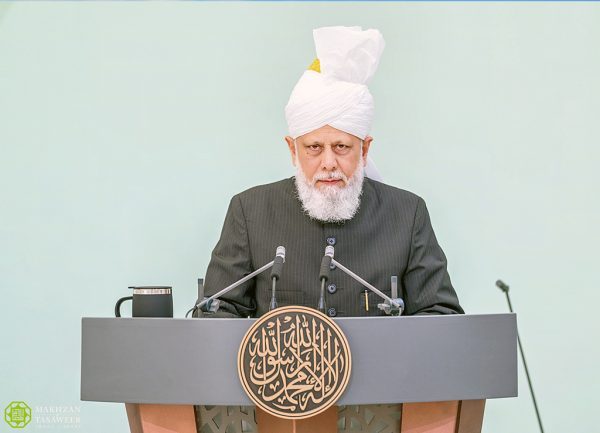
After reciting Tashahhud, Ta‘awwuz and Surah al-Fatihah, His Holiness, Hazrat Mirza Masroor Ahmad (aba) said that in the previous sermon, he mentioned the example of the Holy Prophet (sa) and his love for God. In this era, through complete obedience to the Holy Prophet (sa), we find a glimpse of that love through his ardent devotee, the Promised Messiah (as).
His Holiness (aba) quoted the Promised Messiah (as) that he was naturally drawn towards God, and this was a result of God’s favour upon him. Furthermore, at various instances, the Promised Messiah (as) highlighted the fact that anything he attained was as a result of his complete obedience to the Holy Prophet (sa). This is what opened the doors of God’s love and bounties being showered upon him.
Allah’s Support in Times of Difficulty
His Holiness (aba) quoted the Promised Messiah (as) who said that everything he did, every relationship he had, even with his family, was for the sake of Allah. Furthermore, the Promised Messiah (as) said that true believers remain steadfast in times of difficulty because they trust that God will ultimately help them. They trust that even if every person were to leave them, they will never be abandoned by God. The Promised Messiah (as) said that no matter if he were left alone in the world and were made to face the severest cruelties from the enemy, he had complete trust that God is with him and he would ultimately prevail.
His Holiness (aba) continued quoting the Promised Messiah (as) who writes:
‘O ye foolish and blind ones! Was there ever a righteous one before me who was ruined so that I should be ruined? Was there ever a truly faithful one who was destroyed by God in humiliation, so that He should destroy me? Listen carefully and remember that my soul is not liable to destruction and that my nature is not prone to failure. I have been bestowed such courage and veracity against which mountains are as nothing. I am not afraid of anyone. I was alone and was not unhappy at being alone. Will God then desert me? Never. Will He destroy me? Never. My enemies will be humiliated, and those envious of me will be put to shame, and God will bestow victory upon His servant in every field. I am with Him, and He is with me. Nothing can break our relationship. I swear by His honour and glory that I hold nothing dearer in this world and in the hereafter than that the greatness of His religion may be manifested, His glory may shine forth, and His Word may be exalted. By His grace, I am not afraid of any trial, even if I am confronted not with one but with ten million trials. I have been bestowed strength in the field of trials and in the jungle of agonising persecutions.
I am not one whose back you will see on the day of the battle; I am the one whose head you will see in the midst of dust and blood.
He who does not wish to follow me is free to leave me. I do not know how many terrible and thorny deserts I may yet have to traverse.’
Allah’s Protection for His Loved Ones
His Holiness (aba) said that once, while investigating the death of Lekh Ram (who was a staunch opponent of the Promised Messiah (as)), the police superintendent made his way to Qadian with a warrant for arrest, ready with handcuffs. Someone worridly informed the Promised Messiah (as) of this, upon which the Promised Messiah (as) simply smiled and said, on happy occasions, people wear bracelets of gold and silver, and so if he were to be falsely arrested, then he would perceive as though he had worn iron bracelets for the sake of God. However, he said that this would never happen because God’s protection was absolute. Ultimately, this held true, and the Promised Messiah (as) was caused no harm.
His Holiness (aba) said that at another instance, the Promised Messiah (as) said that if he were to be informed that he would be humiliated and that he would face failure, then by God, his love for God and service to His faith would not diminish in the slightest, because he had already experienced God resulting in complete love and certainty in God.
His Holiness (aba) said even outside of prayer, the Promised Messiah (as) could be heard making heartfelt supplications to God, saying, ‘O my beloved Allah.’ The Promised Messiah (as) also took great pride in upholding the honour of God. Once, someone came to the Promised Messiah’s (as) home to offer condolences upon the passing of a member of the Promised Messiah’s (as) family who, in fact, was an opponent of the faith and an atheist. As this person offered condolences and said that Mirza Imamuddin was a good man, the Promised Messiah (as) could not bear it and sternly asked how she could say such things about an opponent of God? Mirza Imamuddin openly mocked God, and the Promised Messiah’s (as) honour for God could not bear for such a person to be praised in his own home.
Developing One’s Love for God from Childhood
His Holiness (aba) said that the Promised Messiah (as) loved God from the time of his childhood. Once, someone approached the Promised Messiah’s (as) father and said that he’d heard that he had a young son; however, he had never seen him. The Promised Messiah’s (as) father said that indeed he did have a young son, and it was true that he was seldom seen. If one wished to see him, then they should look for him in some corner of the mosque, because he is a ‘masitar’ (a person dedicated to the mosque). Someone else also said that the Promised Messiah (as), even in his childhood, was so devoted to God and dedicated to prayer that if the prayer carpets in the mosque were to be rolled up while he was praying and he was rolled up in them, no one would ever know because he would not even move. Such was his state of devotion and attention even at that young age, whilst praying before God.
The Promised Messiah’s (as) Sense of Honour for God
His Holiness (aba) said that there was a man who accepted Ahmadiyyat; however, prior to his acceptance, the Promised Messiah (as) had been displeased with him for 20 years. The reason for this was that his son had passed away, and when the Promised Messiah (as) visited him to offer his condolences, the man expressed in his grief that God had wronged him. Hearing this perturbed the Promised Messiah (as) a great deal, to the extent that he did not even wish to see that person. Later, God enabled that man to become rid of such concepts and come to the truth.
His Holiness (aba) said that once, the Promised Messiah (as) was experiencing light-headedness, and so a specialist was brought to see him. The doctor examined the Promised Messiah (as) and said that he would cure him in two days. The Promised Messiah (as) went back inside and wrote a note to Hazrat Hakim Maulvi Nooruddin (ra) saying, ‘I will never be treated by this doctor again. Does he think he is God?’
His Desire to Please God
His Holiness (aba) said that when the Promised Messiah’s (as) young son Sahibzada Mirza Mubarak Ahmad passed away, people went to the mosque to visit the Promised Messiah (as) to offer their condolences. They observed, however, that the Promised Messiah (as) seemed happier than usual. When the passing of his son was brought up, the Promised Messiah (as) said that he had already been informed by God that this boy would either pass away early or he would be very devoted to God. So, God called him to Himself. The Promised Messiah (as) said that if he had a thousand sons and all of them were to pass away, yet God was pleased and it was in fulfilment of His will, then nothing would make him happier.
His Holiness (aba) said that once when someone was going to perform Hajj, the Promised Messiah (as) wrote him a letter and requested that when he would first see the Holy Ka’bah, he should pray to the Most Gracious God to be pleased with him to forgive his shortcomings, to enable him to attain God’s pleasure, to live and die with the love of God, and to fulfil that which God had commissioned him to do by proving the superiority of Islam.
His Holiness (aba) quoted the Promised Messiah (as), who writes that if it meant achieving the love of God, then he would be prepared to bear any and every hardship and difficulty. The Promised Messiah (as) states:
‘How unfortunate is the man, who even now, is unaware that there is a God who has power over all things. Our paradise lies in our God. Our highest delight is in our God, for we have seen Him and found every beauty in Him. This wealth is worth procuring, though one might have to lay down one’s life to procure it. This ruby is worth purchasing, though one may have to lose oneself to acquire it. O ye, who are deprived! Hasten to this fountain as it will satiate you. It is this fountain of life that will save you. What am I to do? How shall I impress the hearts with this good news? What sort of a drum am I to beat in the streets in order to make the announcement that this is your God, so that people might hear? What remedy shall I apply to the ears of the people so that they should listen?
If you become one with God, rest assured that God too will be yours. God Almighty shall remain awake for you as you sleep. God shall watch over your enemy and frustrate their designs, while you are unmindful of him. You still do not know the extent of God’s powers. Had you known, not a single day would you have grieved over the world. Does he who owns a treasure weep, cry and become sorrowful unto death over the loss of a single coin? Had you been aware of this treasure and knew that at every time of need God is able to fulfil your requirements, why would you look to the world so restlessly? God is a precious treasure; appreciate Him accordingly, for He is your Helper at every step. You are nothing without Him, nor do your resources and your schemes amount to anything.’
His Holiness (aba) said that may Allah enable us all to love God in this manner.

Prayers for the New Year
His Holiness (aba) said that the new year began yesterday; may this new year be one of immense blessings. May Allah frustrate the plots and ploys of the opponents and grant the Community continued success. At such times of celebration, it is also important to remember our brothers who are falsely imprisoned. Ahmadis in Pakistan, such as Mubarak Sani, who has been sentenced to life in prison, are currently in jail and enduring hardships. Yet, they enter this new year with thanks and no complaints. They are wearing iron bangles for the sake of God. May Allah create the means for their freedom.
His Holiness (aba) said that may all Ahmadis truly understand what it means to love God even in the face of difficulties and hardships, and may we only ever increase in our love for God.
His Holiness (aba) prayed for all the oppressed in the world to be freed from injustices and for there to be peace in the world.
Funeral Prayers
His Holiness (aba) said that he would lead the funeral prayers of the following members:
Rehana Basma
Rehana Basma wife of Syed Ahmad Nasir. She was the great-granddaughter of the Promised Messiah (as). She spent time in Kenya, where her husband was stationed. There, she served the Women’s Auxiliary Organisation in various capacities. Two of her sons, Syed Tahir Ahmad and Syed Muzaffar Ahmad, are life devotees serving the Community. She had profound love for the Holy Qur’an, and she developed the same love in her children. She always supported others and also encouraged her children to offer financial contributions. She was regular in offering the pre-dawn voluntary prayers and offering the five daily prayers regularly and on time. She was also very hospitable, which has also been attested to by the Fourth Caliph (rh), who said that when visiting her home, she would go out and ensure to bring hot water for him to perform ablution. She ensured to uphold the honour of the Community. His Holiness (aba) prayed that may Allah grant her forgiveness and mercy.
Iffat Haleem
Iffat Haleem former National President of the Ahmadiyya Women’s Auxiliary Organisation in Liberia, wife of Dr Abdul Haleem. She was regular in offering prayers, fasting, and reciting the Holy Qur’an. She had a profound love for Khilafat. She fulfilled her duties with great responsibility. She was very charitable and took care of the poor and needy. She would arrange for classes to learn the Holy Qur’an. She was very hospitable and would host guests for extended periods of time. She was extremely loving and caring. She is survived by her husband and two adopted children. His Holiness (aba) prayed that may Allah accept her prayers for these children, and grant her forgiveness and mercy.
Abdul Aleem al-Barbari
Abdul Aleem al-Barbari of Egypt. He was a virtuous, sincere and devoted Ahmadi. He loved God to the extent that it seemed as though he was created only to remember God. His wife attests that he was an excellent husband. He accepted Ahmadiyyat along with his daughter in 2008 upon watching MTA. Initially, his wife opposed him a great deal; however, she too eventually accepted Ahmadiyyat. He continued facing opposition from his brothers; however, he remained steadfast in his faith. Many non-Ahmadis participated in his funeral prayer. He had ensured to tell his son prior to his demise that his funeral must be led by an Ahmadi. His son is also looking into Ahmadiyyat. His Holiness (aba) prayed that may Allah grant him forgiveness and mercy.

Add Comment