
Summary prepared by The Review of Religions
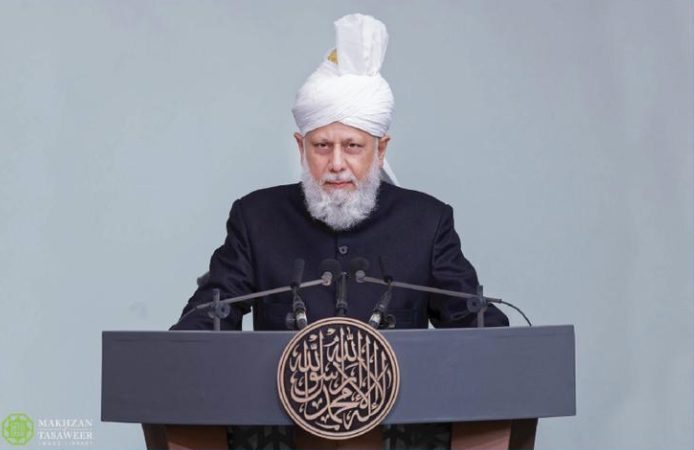
After reciting Tashahhud, Ta‘awwuz and Surah al-Fatihah, His Holiness, Hazrat Mirza Masroor Ahmad (aba) said that there are countless incidents about the Holy Prophet’s (sa) love for God. In fact, his entire life was like an ocean of love for God.
The Holy Prophet’s (sa) Displeasure at Insults to God Almighty
His Holiness (aba) said one example of the Holy Prophet’s (sa) love for God was during the Battle of Uhud. It is recorded that on the day of Uhud, the Holy Prophet (sa) appointed a battalion of archers and urged them not to move from their posts, whether the Muslims seemed to be winning or losing. However, ultimately, when the Muslims overcame the disbelievers in the battle, the battalion of archers became enticed by the idea of the spoils of war, and so they left their posts to gather them. At that time, God proverbially turned away from the Muslims, and what seemed like victory took a turn for the worse as the disbelieving army circled back and waged an attack, resulting in the martyrdom of 70 Muslims.
At this time, Abu Sufyan called out, asking about the Holy Prophet (sa). The Holy Prophet (sa) instructed the companions around him to remain silent. Similarly, Abu Sufyan called out, asking about Hazrat Abu Bakr (ra) and Hazrat Umar (ra); however, the Holy Prophet (sa) again instructed them not to say anything. Upon this, Abu Sufyan said that this certainly meant that they had all died, otherwise they would have responded. Hazrat Umar (ra) could not bear to remain silent and replied, saying that the Holy Prophet (sa) was indeed alive. In response, Abu Sufyan raised a slogan glorifying the idol Hubal. The Holy Prophet (sa) could not bear this and, upon this, instructed the companions to respond by saying, ‘Allah is the Most High, Most Exalted’.
Abu Sufyan replied, saying, ‘We have Uzza, and you have no Uzza.’ The Holy Prophet (sa) instructed the companions to respond by saying, ‘Allah is our Helper, and you have no helper.’ In other words, when it came to the honour and glory of God, the Holy Prophet (sa) did not care about his own life; rather, where he had previously instructed the companions to remain silent, in the matter of God, he instructed that they should not remain silent but respond and glorify God.
His Holiness (aba) quoted Hazrat Mirza Bashiruddin Mahmud Ahmad (ra), Second Caliph of the Ahmadiyya Muslim Community, who writes:
‘Those Muslims who made a ring round the Prophet but were driven back, ran forward again as soon as they saw the enemy withdrawing. They lifted the Prophet’s body from among the dead. Abu ‘Ubaydah bin al-Jarrah caught between his teeth the rings which had sunk into the Prophet’s cheeks and pulled them out, losing two teeth in the attempt.
After a little while, the Prophet returned to consciousness. The guards who surrounded him sent out messengers to tell Muslims to assemble again. A disrupted force began to assemble. They escorted the Prophet to the foot of the hill. Abu Sufyan, the enemy commander, seeing these Muslim remnants, cried aloud, “We have killed Muhammad.” The Prophet heard the boastful cry but forbade the Muslims to answer, lest the enemy should know the truth and attack again, and the exhausted and badly-wounded Muslims should have again to fight this savage horde. Not receiving a reply from the Muslims, Abu Sufyan became certain the Prophet was dead. He followed his first cry by a second and said, “We have also killed Abu Bakr.”
The Prophet forbade Abu Bakr from making any reply. Abu Sufyan followed by a third, and said, “We have also killed ‘Umar.” The Prophet forbade ‘Umar also to reply. Upon this, Abu Sufyan cried that they had killed all three. Now, Umar could not contain himself and cried, “We are all alive and, with God’s grace, ready to fight you and break your heads.” Abu Sufyan raised the national cry, “Glory to Hubal. Glory to Hubal. For Hubal has put an end to Islam.” (Hubal was the Meccans’ national idol.) The Prophet could not bear this boast against the One and Only God, Allah, for Whom he and the Muslims were prepared to sacrifice their all. He had refused to correct a declaration of his own death. He had refused to correct a declaration of the death of Abu Bakr and of ‘Umar for strategic reasons. Only the remnants of his small force had been left. The enemy forces were large and buoyant. But now the enemy had insulted Allah. The Prophet could not stand such an insult. His spirit was fired. He looked angrily at the Muslims who surrounded him and said, “Why stand silent and make no reply to this insult to Allah, the Only God?” The Muslims asked, “What shall we say, O Prophet?” “Say, ‘Allah alone is Great and Mighty. Allah alone is Great and Mighty. He alone is High and Honoured. He alone is High and Honoured.’
The Muslims shouted accordingly. This cry stupefied the enemy. They stood chagrined at the thought that the Prophet, after all, had not died. Before them stood a handful of Muslims, wounded and exhausted. To finish them was easy enough. But they dared not attack again. Content with the sort of victory they had won, they returned, making a great show of rejoicing.
His Holiness (aba) said that the Holy Prophet (sa) would not allow so much as a hint of associating partners with Allah come about. Once, during a conversation, someone said to the Holy Prophet (sa), ‘Whatever you and Allah desire.’ The Holy Prophet (sa) said, ‘Have you set me up as a partner with God? You should only say, “Whatever Allah wills.”’
His Aversion to Making Graves a Place of Worship
His Holiness (aba) said that the Holy Prophet (sa) was also concerned about the fact that graves should not become a place of worship. It is unfortunate that today we see Muslims prostrating at the graves and shrines of their clerics and leaders. However, it is recorded that while the Holy Prophet (sa) was in his final illness, the Holy Prophet (sa) prayed that Allah curse those who previously made the graves of their prophets. Thus, the Holy Prophet (sa) taught the serious aversion to worshipping at graves.
His Deep Understanding of the Unity of God
His Holiness (aba) said that once, the disbelievers asked the Holy Prophet (sa) to tell them about the lineage of God. Upon this, God revealed, “Say He is Allah the One, the Independent and Besought of all. He begets not, nor is He begotten.’ The Holy Prophet (sa) took every possible opportunity to speak about the unity of God and convey this message to others.
His Holiness (aba) said that when it would rain, some disbelievers would be prone to saying that it rained due to a certain star. Once, when it rained, the Holy Prophet (sa) said that whoever said that it was raining due to the grace of God was from among his people, and those who said that it rained due to a star were not from among his people and did not believe in God. Upon this, people attested that no one other than the Holy Prophet (sa) had such a deep understanding of God’s unity and greatness.
His Holiness (aba) said that once, the Holy Prophet (sa) was asked what takes a person to heaven and what takes a person to hell. The Holy Prophet (sa) said that one who does not associate partners with God will enter heaven, and those who associate partners with God will enter hell. The same principle applies today. Those who depend solely on worldly means, on their own abilities, on their family or on their children are associating partners with God. Worldly means will be of no benefit in the hereafter; rather, it will only be God’s grace that will be of benefit. In order to benefit from it, God instructed everyone to follow the example of the Holy Prophet (sa).
His Desire to Make the Greatest Sacrifice for God
His Holiness (aba) said that the Holy Prophet (sa) once said that God has promised that one who sets out in His cause will either be victorious or enter paradise if they are martyred, so long as they have firm faith in God and His Messenger (sa) and it was this firm faith that drove them to set out in this cause. Then the Holy Prophet (sa) said that if he could, he would be martyred and return to this world only to be martyred again, and do so over and over again solely for the sake of God.
His Holiness (aba) said that when the Holy Prophet (sa) was on the way to Badr, there was a man who met the Muslim army along the way who was renowned in Arabia for his bravery and proficiency in battle. Despite being a disbeliever, he offered to join the Muslim army. The companions were overjoyed at the prospect of receiving this reinforcement in their army. The Holy Prophet (sa) asked if he believed in God. He replied that he did not. The Holy Prophet (sa) said that he should leave, and they would not take any help from him. As the Muslim army advanced, the same man met the Holy Prophet (sa) again; however, the Holy Prophet (sa) told him once again to leave. At a further distance, the same man met the Holy Prophet (sa) again, and on this occasion, he declared that he now believed in God. It was only then that the Holy Prophet (sa) permitetd for him to join the Muslim army. Thus, no matter the circumstances, belief in the Unity of God must always be kept at the forefront.
His Constant Remembrance of His Lord
His Holiness (aba) said that the Holy Prophet (sa) would always be engaged in the remembrance of Allah. It is recorded that there are four things that a person should say that are better than all other statements, and if one begins something by saying one of these statements, then it will be blessed. Those four statements are: SubhanAllah (Holy is Allah), Alhamdolillah (All praise belongs to Allah), La ilaha ilallah (There is no god but Allah), and Allahu Akbar (Allah is the greatest).
His Holiness (aba) said that once someone went to the Holy Prophet (sa) and said that the rules of Islam had become too much for him and that he could not keep up with all of them. He asked the Holy Prophet (sa) to narrow down a few which he should focus on. The Holy Prophet (sa) said that he should constantly remain engaged in the remembrance of Allah. In another narration, it is recorded that the Holy Prophet (sa) said that the best statement is to say there is no god but Allah, and the greatest prayer is to say that all praise belongs to Allah.
His Holiness (aba) said that whenever the Holy Prophet (sa) would receive any good news, he would immediately fall into prostration to thank God. It is also recorded that the Holy Prophet (sa) said that before going to sleep, one should perform ablution just as one does before offering prayer, and then should lie on their right side and pray, ‘O Allah, I have given myself to You, I have entrusted my matters to You, and have made You my support. I fear You and love You. I have no refuge besides You, nor any place of salvation. Salvation rests with You Alone. I believe in the Book which You have revealed and upon the Prophet You have sent.’ The Holy Prophet (sa) said that these should be a person’s last words before falling asleep, so that if they were to pass away in their sleep, these would be their final words.
His Holiness (aba) said that when he lay down, the Holy Prophet (sa) would place his right hand under his right cheek as he said, “My Lord, may my life and my death be for Your sake alone.’ When he would wake up, the Holy Prophet (sa) would say, ‘All praise belongs to Allah who gave us life after death and to Him shall we return.’ In other words, the Holy Prophet (sa) ensured that before going to sleep, he had settled his affairs by praying that may his life and death be only for the sake of God, and when he awoke, he would thank God for blessing his life and allowing him to wake back up. The Holy Prophet (sa) said that it is most pleasing to God that at the time of one’s passing, they are engaged in the remembrance of Allah.
His Holiness (aba) said that today, Muslims erroneously think that the most noble deed is to go out and wage war and smite down disbelievers. However, the Holy Prophet (sa) once told his companions that even better than going out to fight in the cause of Allah is to remain engaged in the remembrance of Allah at all times. This is the greatest form of jihad. The Holy Prophet (sa) said that nothing can save one from the punishment of God like the remembrance of God can.
His Holiness (aba) said that Hazrat A’ishah (ra), the wife of the Holy Prophet (sa), records that in his final moments, God gave the Holy Prophet (sa) the option to go to Him or to remain in the world, upon which the Holy Prophet (sa) said, ‘Allah is the greatest of companions.’ These were the Holy Prophet’s (sa) final words.

Add Comment