
Summary prepared by The Review of Religions
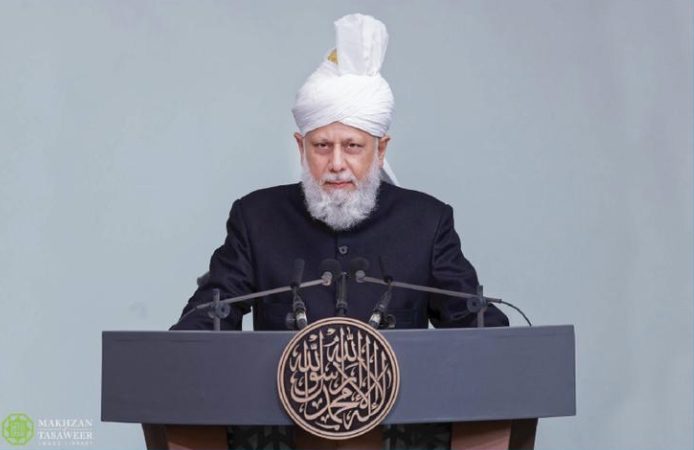
After reciting Tashahhud, Ta`awwuz and Surah al-Fatihah, His Holiness, Hazrat Mirza Masroor Ahmad (aba) said that in previous sermons he had presenetd incidents pertaining to the example set by the Holy Prophet (sa) in leading a simple life. Today, His Holiness (aba) said that he would present incidents of the true servant of the Holy Prophet (sa) – the Promised Messiah (as) – and how he too lived a simple life.
His Holiness (aba) quoted the Promised Messiah (as) who writes:
‘It has been revealed to my humble self that on account of my meekness, humility, trust in God, sincerity and the Signs and [heavenly] light, I resembles the Masih in his previous life; and that the nature of this humble one and the nature of the Masih greatly resemble each other, as if they are two pieces of the same jewel or two fruits of the same tree. The harmony between us is of such a great extent that there is very little that the spiritual eye can distinguish between us.
There also exists an overt resemblance which is that the Masih [Messiah] was the follower and servant of the faith of a perfect and high-standing Prophet, i.e. Musa [Moses] and his Gospel is a branch of the Torah, and this humble one too, is one of the lowliest servants of that majestic Prophet who is Sayyidur-Rusul [the Chief of all Messengers as] and the Crown of all Messengers. If they are Hamid [One who praises Allah], he is Ahmad [One who praises Allah to the utmost] and if they are Mahmud [One who is praised], he is Muhammad [One who is praised to the utmost]—may peace and blessings of Allah be upon him.’ (Barahin-e-Ahmadiyya Part IV, English Translation, pp. 374-375)
Simplicity in Everyday Matters
His Holiness (aba) said that once, the Promised Messiah (as) was going for a walk when a discussion began on the topice of the demise of Jesus (as). As the conversation continued, the Promised Messiah (as) reached an orchard where he took a seat. In the course of the conversation, someone said to the Pomised Messiah (as) that now even some Christians accept the death of Jesus (as) so the conversation could perhaps be put to rest. The Promised Messiah (as) replied by saying that it cannot be said that the topic does not keep coming back up and needs to be addressed. The Promised Messiah (as) would walk rather fast, and his companions would rush to try and keep up, in the course of which sometimes their feet would hit the Promised Messiah’s (as) staff, however the Promised Messiah (as) would not make any remark and would continue walking.
His Holiness (aba) said that the sometimes when the Promised Messiah’s (as) blessed wife would accompany him on a walk, other women would also join her. At some point when the Promised Messiah (as) would take a seat in a garden, the women too would be seated on the grass. During this time, the Promised Messiah (as) would give them various advice and guidance. It was said to be a very simple and informat gathering.
His Holiness (aba) said that one morning, the Promised Messiah (as) went out for a walk, and he said about one of the companions accompanying him that he recited the Holy Qur’an very beautifully. As they were walking, the Promised Messiah (as) asked him to recite a portion of the Holy Qur’an. With great simplicity, the Promised Messiah (as) sat at the edge of a field and listened to the recitation. Once it was over, the Promised Messiah (as) ciontinued walking.
Following the Holy Prophet’s (sa) Example in Simplicity
His Holiness (aba) siad that while on walks, the Promised Messiah (as) did not mind if anyone overtook him and walked in front of him. Even as dirt and dust would be kicked up as they walked in front of him, the Promised Messiah (as) would not mind. Similarly, if every someone inadvertently nicked into the Promised Messiah (as) as he was walking, he would not mind or make any comment. There were many instances when an outsider would visit the mosque and on account of unfamiliarity, would mistakenly think that Hazrat Hakim Maulvi Nooruddin (ra) was the Promised Messiah and would meet him first, however the Promised Messiah (as) would not say anything to them. This was something that the Promised Messiah (as) learned and implemented from the example of his master, the Holy Prophet (sa).
His Holiness (aba) said that one of the salient features of the Promised Messiah’s (as) life was that he did not partake in any sort of embellishment or ostentation. Once, the Promised Messiah (as) journeys to Dera Baba Nanak to view the cloak of Guru Baba Nanak. Once there, the Promised Messiah (as) sat under a tree with his companions. The Promised Messiah (as) sat there amongst his companions like everyone else, without any special place made for him to sit. When the local townspeople went to meet the Promised Messiah (as), the though that Mualvi Muhammad Ahsan (ra) was the Promised Messiah (as) and began meeting him. They did not realise they were mistaken until he directed them to the Promised Messiah (as). Thus, the Promised Messiah (as) did not prefer to have any special place to sit but would sit among the others as though he were one of them.
The Profound Impact of the Promised Messiah’s (as) Simplicity
His Holiness (aba) said that once, someone visited the Promised Messiah (as) to pledge allegiance to him. The Promised Messiah (as) invited him inside and seated him upon the comfortable part of the charpoy while he himself sat on the very edge of the charpoy where rops were tied to tighten the surface of the charpoy. This man was astonished that he was but an ordinary vistor, yet he was given a comfortable place to sit, whereas the Promised Messiah (as), despite his lofty status, sat on the very edge which was most uncomfortable.
His Holiness (aba) said that during the days of the debate with Abdullah Atham, Colonel Altfal Ali Khan wished to speak to the Promised Messiah (as) in private and so it was arranged. When he emerged from his meeting with the Promised Messiah (as), tears flowed from his eyes. When asked what happened, He said that while seated inside, the Promised Messiah (as) was seated on the ground and only his knee rested upon the mat. The Promised Messiah (as) thought that the Colonel may not prefer to sit on just the mat, and so the Promised Messiah (as) laid his own sheet over the mat to make it more comfortable for the Colonel. The Colonel said to the Promised Messiah (as) that though he was a Christian, he did not have any reservations about sitting on the Promised Messiah’s (as) mat and so he removed the sheet and sat down. He then began speaking to the Promised Messiah (as) about his difficulties, like the fact that he drank too much, and while he wished to accept Islam, he was concerned about the difficulty of abandoning his bad habits. The Promised Messiah (as) advised him to continuously seek forgiveness from God and to offer the five daily prayers.
His Holiness (aba) said that once Hazrat Mufti Muhammad Sadiq (ra) was sitting with Hazrat Hakim Maulvi Nooruddin (ra) at his clinic. It was then that the Promised Messiah (as) walked alone to the clinic as well, with some books in his hand. The Promised Messiah (as) took a seat beside the other two. The Promised Messiah (as) said that he had brought some extra copies of his book Surma Chashma-e-Arya so that they could be distributed as he deemed fit. Hazrat Mufti Muhammad Sadiq (ra) asked for a copy and the Promised Messiah (as) immediately gave him one.
The Promised Messiah (as) Came to Turn Animals into Humans
His Holiness (aba) said that the Promised Messiah (as) would not prefer to be given any sort of special protocol. It is said that when prominent leaders would visit somewhere, out of respect for them rather than their carriage being pulled by horses the local youth would pull their carriage once they arrived in the city. The Promised Messiah (as) was far greater in status than any other worldy leader. Once, while the Promised Messiah (as) was visiting Lahore, some youth decided that they would give the Promised Messiah (as) similar treatment and would pull his carriage. However, when the Promised Messiah (as) saw this, he instructed the horses to be brough back and said, “I have not come to turn humans into animals, rather I have come to turn animals into humans.’ In other words the Promised Messiah (as) said that his mission was to revive spirituality and moral conduct within humans.
His Holiness (aba) said that he woould continue presenting similar incidents in the future.
Funeral Prayers
His Holiness (aba) said that he would lead the funeral prayers of the following:
Al-Haj Sheikh Yusuf Usman Kambulaya who was a missionary in Tanzania. He is survived by seven children and several grandchildren. His father was among the first to accept Ahmadiyyat in Tanzania. Al-Haj Sheukh Yusuf Usma Kambulaya was devoted to serving the faith. He truly served the faith until his last breath, despite his ailing health and advanced age. His family says that he was a kind father who raised his children well and they are all now serving the Community in various capacities. He possessed many moral qualities. He loved God, the Holy Prophet (sa), the Promised Messiah (as), and the insitution of Khilafat. He was a practical example of ‘Love for all, hatred for none.’ Once, on the occasion of Eid, his allowance had been delayed and he was facing some difficulty. However right before Eid, someone gave him a gift of money which covered all of his expenses. He attributed this to keeping faith and trust in God, and that God never abandons his true servants. His Holiness (aba) said that this is an example for all life-devotees. Two years prior to his demise, he underwent a serious operation and was admitted to the ICU. It was in this state that he continued his work of translating a book of the Promised Messiah (as). He was advised to rest, but he said that he must continue working, for he believed he had been given more life in order to complete this task given to him by the Khalifah of the time.
His Holiness (aba) said that Al-Haj Sheikh Yusuf Usman Kambulaya’s son had a business which rented a space in a building from a building owned by the Roman Catholic church. Due to a dispiute, the Bishop in-charge of the building sought to evict the business. However, he constantly saw dreams in which he was advised against taking action against this company. So rather than evicting the company, he went to investigate the matter further, upon which he learned that the Al-Haj Sheikh Yusuf Kambulaya was the father of the man who owned the company. He realised why he was seeing these dreams, because this man was honourable and devoted to faith. His Holiness (aba) prayed that may Allah elevate his station and continue granting the Community such hard working and devoted servants.
Amatul Shafi wife of Captain Mahmud Ahmad Khan, granddaughter of Hazrat Mirza Shariif Ahmad, Hazrat Nawab Amatul Hafiz, and daughter of Sahibzada Clnl Mirza Daud Ahmad and Zakia Begum. She served in various capacities at the local level in Karachi. Her marriage was announced by the Third Caliph (rh) in which he imparted a great deal of guidance. She cared a great deal for her relations and served her in-laws. The Fourth Caliph (rh) said that she attained heaven by serving her second mother as well. She selflessly helped others. One of her grandsons is a missionary – His Holiness (aba) prayed that may Allah enable him to fulfil his duties of devotion with sincerity. His Holiness (aba) prayed that may Allah grant forgivenes and mercy to the deceased.
Abdul Rafiq Jidran of USA. He is survived by a son, four daughters and eight grandchildren. His father and elder uncle were boith martyred in Pakistan in 1999. He served as a devotee under the Nusrat Jahan Scheme under which he served in Ghana. He served there at the same time when His Holiness (aba) was serving in Ghana. His Holiness (aba) commented that he observed him to be very loyal, hardworking and sincere. He was a very good friend. His Holiness (aba) prayed that may Allah grant him forgiveness, elevate his station, and enable his children to carry on the legacy of his virtues.
Salima Tabassum wife of the late Mirza Abdul Hamid from Mirpurkhas, Sindh. She is survived by two sons, two daughters and many grandchildren. Her son is serving as a missionary in Spain and could not attend his mother’s funeral due to being in the field of service. She had a special connection with God. She was at the forefront of service to the Community. His Holiness (aba) prayed that may Allah grant her forgiveness, elevate her station and enable her children to carry on the legacy of her virtues.
Add Comment