
Summary prepared by The Review of Religions
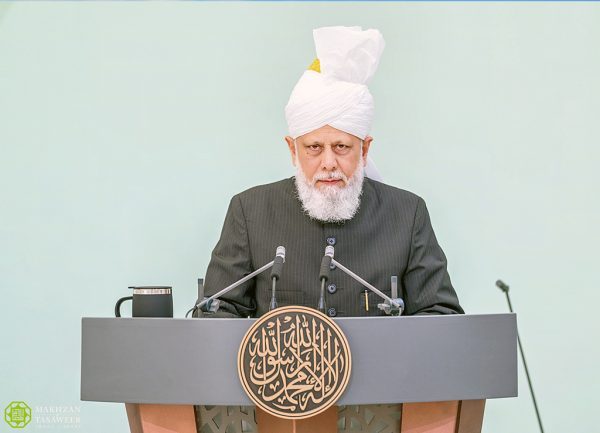
After reciting Tashahhud, Ta‘awwuz and Surah al-Fatihah, His Holiness, Hazrat Mirza Masroor Ahmad (aba) said that whilst describing the grace which God bestowed upon him from his early years, the Promised Messiah, Hazrat Mirza Ghulam Ahmad (as) writes:
‘‘Some thirty years ago, my respected father – may God bless him with His mercy – fell ill near the end of his life. On the day he was destined to breathe his last, I received the revelation at noon:
“By the heavens and the Morning Star.”
Simultaneous with it, I was made to think that it indicated his demise and its meaning is: ‘I swear by the heavens, and I swear by the tragic incident which shall befall after sunset.’
It was a message of condolence from God Almighty to His humble servant. I understood thereby that my father would die after sunset. Many people were informed of this revelation. I swear by Allah the Almighty – in whose hands my life rests and to lie against whom is an act of Satan and of an accursed one – that it happened accordingly. On that day, my father’s real illness, which was renal colic, had been cured. Only slight dysentery remained, and he could go to the toilet on his own strength, without any assistance. When the sun set, on return from the lavatory, as soon as he sat down on the bedstead, death’s rattle started. In the same condition of death rattle, he said to me, ‘See what this is.’ Then he lay down. Before this, I had never had the occasion to see anyone speak during the death rattle and talk clearly and firmly in the state of a death rattle.
After this, exactly as the sun set, he passed away from this transitory world…This was the very first of all the revelations and was the first prophecy that God disclosed to me. God informed me at noon that this was going to happen, and it came to pass after sunset. It is an honour for me, and I will not forget that God Almighty condoled with me at the time of my father’s demise and swore by the death of my father the way He swore by the heavens. Those who have a satanic spirit rampant within them would wonder how it could be that God Almighty confers such honour on someone that, by declaring his father’s death to be a great shock, He should swear by it. But, once again, I swear by the God of Honour and Glory that this incident is true and that it was God, indeed, who informed me about it by way of condolence and said:
“By the heaven and the Morning Star.”
And it came to pass accordingly…As I have just written, when I was apprised of the news that my father would pass away after sunset, I, being human, was distressed upon hearing this news. Moreover, most of the means of our livelihood were contingent upon his life. He received a pension from the British Government as well as a large sum of gratuity, which was contingent upon him being alive. Therefore, the thought crossed my mind as to what would happen after his demise. The anxiety surfaced in my heart that perhaps we would face days of deprivation and hardship. All this concern flashed across my mind in a fraction of a second, quite like lightning. At that very moment, I felt drowsy and received the second revelation:
“Is God not sufficient for His servant?”
My heart was strengthened by this revelation from Allah as a gravely painful wound is instantly healed with a balm. The fact is that it has been verified repeatedly that divine revelation has an intrinsic quality to grant comfort. At the root of this quality lies the certainty which one acquires regarding God’s revelation. Alas! What kind of revelations do these people have that, despite their claim of being the recipients of revelation, they also confess that their revelations are only conjectural affairs and they do not know whether they are satanic or divine? The harm of such revelations is greater than their benefit. But I swear by God that I believe in these revelations of mine just as I do in the Holy Quran and other Scriptures. Just as I believe with certainty and conviction that the Holy Quran is the Word of God, so do I believe the Word that descends upon me to be the Word of God, for I behold the refulgence and light of God with it and I find Signs of God’s providence accompanying it.
In short, I immediately understood that God would not let me be wasted when I received the revelation:
“Is not God sufficient for His servant?”
After this, I wrote down the revelation and handed it to Malawamal, who is a Hindu, a Khatri by caste, a resident of Qadian, and is still alive. I related the entire incident to him and dispatched him to Amritsar so that, through the good offices of Hakim Maulawi Muhammad Sharif of Kalanaur, he may get it engraved in a stone and get a stamp made. I selected this Hindu gentleman for this task with the sole intention of making him a witness to this grand prophecy, and so that Maulawi Muhammad Sharif should become a witness too. As a result, through the agency of the respected Maulawi, the signet ring was prepared at the cost of five rupees and delivered to me. It is still with me. Its tracing is: I received this revelation at a time when our means of livelihood and comfort were wholly dependent upon my father’s meagre income. Not even a single person from the outside knew me, for I was an unknown individual lying in obscurity in a desolate village like Qadian. After this, God, in keeping with His prophecy, turned the world towards me and helped me financially with such successive victories for which I do not have the words to express my gratitude. Considering my dire condition, I did not expect that even ten rupees a month would come. But God Almighty, who raises the poor from dust and reduces the arrogant to dust, helped me so much so that I can say with confidence that, until now, about 300,000 rupees, or perhaps even more, have already come.
This income may be estimated from the fact that the monthly expenditure for the Langar Khanah [public kitchen] alone has been running at 1,500 rupees on average for so many years, and other categories of expenses like the school, etc. and the printing of books are besides it.
Hence it is worth noting, indeed, with what clarity, might, and glory this prophecy has been fulfilled.’ (The Philosophy of Divine Revelation, pp. 265-268)
The Promised Messiah’s (as) Firm Adherence to the Truth
His Holiness (aba) said that even non-Ahmadis attested to the Promised Messiah’s (as) trust in God. Once, someone was attempting to defame the Promised Messiah (as) in a gathering. One of the lawyers from a court case of the Promised Messiah (as) was also present in that same gathering. He stood up and narrated that during a case, he had advised the Promised Messiah (as) to make a statement which was not founded in truth. He said he had seen many renowned people change their statements in court, while the Promised Messiah (as) never abandoned the truth. He had even explained to the Promised Messiah (as) that the defendant’s statement was not made under oath, and so he could make a statement even if it were not true. However, the Promised Messiah (as) said that God has not given permission for a defendant to lie.
The lawyer said that the Promised Messiah (as) would be placing himself in undue difficulty by not making the prepared statement. The Promised Messiah (as) responded by saying that placing himself in undue difficulty would be to make a false statement and displease God thereby. The Promised Messiah (as) said that he had never placed his trust in the lawyer’s capabilities; rather, his trust has always remained in God. He said that the statement he made in truth would be more impactful than the prepared statement rooted in falsehood. The Promised Messiah (as) said that even if he was convicted, he would be happy that he never stopped doing that which pleased God and maintained trust in Him at all times.
The First Piece of Advice to Members of His Community
His Holiness (aba) said that the Promised Messiah (as) once said that these days, people define civility as being the chase after the world and becoming enslaved to worldly means. However, in the sight of God, civility means placing one’s trust completely in God and holding in one’s heart the greatness and grandeur of God. In fact, the Promised Messiah (as) would advise those who entered his community that the first change one should make in life is to make true belief in God and to trust Him in all matters while adhering to His commands.
His Holiness (aba) quoted the Promised Messiah (as) who said:
‘You are not prohibited from having recourse to the necessary means and appropriate remedies, but you are forbidden to rely upon them. Ultimately, the will of God will prevail. Complete trust in God, if one has the strength for it, is greater than all else.’ (Our Teaching, p. 6)
Remembering the True Source of Benefit When Utilising Means
His Holiness (aba) further quoted the Promised Messiah (as) who said:
‘My belief about healing diseases through prayer is such that I cannot express it to the degree that it is in my heart. The physician tries but stops at a certain point and becomes disappointed, but God opens the way beyond that through prayer. Knowing God and relying on God means having expectations and hope beyond the limits people have set; otherwise, a person dies in this state while yet alive. It is from here that the recognition of Allah the Exalted begins.’ (Malfuzat, English Translation, Vol. 7, p. 244)
His Holiness (aba) explained that the Promised Messiah (as) taught that one ought to employ whatever means necessary and available to them; however, the difference lies in not placing trust in those means. Instead, one’s trust should be completely placed in God, and the fact that it is He who renders any means useful and effective. It is recorded that whenever the plague spread, the Promised Messiah (as) would employ available means, such as having his house cleaned and fumigated, among other treatments. He would explain that using the means God provides is an expression of gratitude to God for providing them. It is after employing the use of those means that one then adopts trust in God that He will render those means useful.
His Holiness (aba) said that a few years before the Promised Messiah (as) passed away, he came down with a bad cough. Hazrat Mirza Bashiurddin Mahmud Ahmad (ra) was tasked with bringing him his medicine. He would also try to give the Promised Messiah (as) dietary suggestions. The cough would become so severe at times that it would seem it was difficult for him to breathe. One day, someone brought some fruit as a gift for the Promised Messiah (as). From the fruit, the Promised Messiah (as) picked out a banana. The Promised Messiah (as) asked Hazrat Mirza Bashiruddin Mahmud Ahmad (ra), ‘How is it to eat a banana while one has a cough?’ Hazrat Mirza Bashiruddin Mahmud Ahmad (ra) replied that it was not advisable. The Promised Messiah (as) smiled, peeled the banana and began eating it. Hazrat Mirza Bashiruddin Mahmud Ahmad (ra) insisted that he should not eat it, however the Promised Messiah (as) continued eating it and then said that God had revealed to him that his cough had been cured. From that moment, his cough no longer remained. He had been treating the cough with medicine for a month to no avail, yet as he ate the banana, his cough was removed. This example showed that ultimately, such things rests solely in the hands of God.
His Holiness (aba) said that he would continue speaking on this subject in the future.

Funeral Prayers
His Holiness (aba) said that he would lead the funeral prayers in absentia of the following:
Muhammad Ataur Rahman
Muhammad Ataur Rahman of India. He is survived by his wife, a daughter and three sons. One of his sons, Hafeezur Rahman, is a missionary serving in Bosnia. Due to being in the field of service, he was unable to attend his father’s funeral. There are various other life-devotees in the family as well. At the time of accepting Ahmadiyyat, the deceased’s family faced a great deal of opposition and hardships. He remained devoted to serving the faith despite his worldly occupations. He travelled to Qadian, where he would learn and render various services. He loved the Qur’an and strove to follow its teachings. He was also able to preach the message of Islam Ahmadiyyat far and wide and helped establish various chapters of the Community. He would make financial sacrifices of his own in the service of the Community and to save the Community’s funds. His efforts were also appreciated by the Fourth Caliph (rh). He was once invited to the home of someone with whom he had long-standing family ties. As he was eating, someone made a mocking comment against the Promised Messiah (as). Without care for anyone else, he immediately left the gathering. He always placed his trust in God and was prepared to render any sacrifice for the mission of the Holy Prophet (sa) and the Promised Messiah (as). He was obedient to Khilafat and possessed many virtuous qualities. His Holiness (aba) prayed that may God grant him forgiveness and mercy.
Khadijah Siddiqah Ponto of Indonesia. She is survived by three sons and two daughters. She served previously as the National President of the Ahmadiyya Women’s Auxiliary Organisation in Indonesia. She had a passion for serving the Community. She had a deep love for Khilafat and always remained obedient to it. She treated everyone in the same manner, which was kind and compassionate. Whenever she served in any capacity, she always gave great importance to consulting others and would not make arbitrary decisions. She was very kind to her relatives. She was disciplined and kind. She had a missionary in the family to whom she showed a great deal of respect. She explained that she showed him such respect out of respect for the Community and also to continually remind the missionary of the great responsibility that he has. His Holiness (aba) attested that he found her to be very sincere and devoted to serving the Community. He prayed that may Allah have mercy on her.
Abdul Jalil of Indonesia. He is survived by two sons and two daughters. He had a passion for propagating the message of Islam Ahmadiyyat. For many years, his home served as a prayer centre for offering the Friday prayer. Once, as a result of opposition, he was imprisoned in the way of Allah because of his faith. While in prison, he had difficulty finding a way to pray. However, he continued preaching the message of Ahmadiyyat. Finally, one of the guards had sympathy and gave him some newspapers which he could use to pray on. He was always given to service and showed respect to missionaries. He also tended to the upbringing of his own children. He was seen as an exemplary individual by those around him. It was through his preaching efforts that a new branch of the Community was established in Indonesia. He also donated a piece of land to the Community for the purpose of building a mosque. He was regular in offering the obligatory prayers as well as voluntary prayers. He was also regular in offering financial sacrifices. His Holiness (aba) prayed that may Allah grant him forgiveness and mercy.



Add Comment