
Summary prepared by The Review of Religions
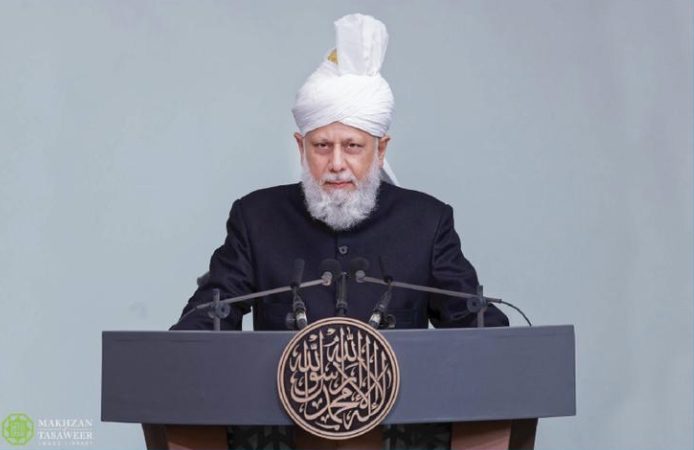
After reciting Tashahhud, Ta`awwuz and Surah al-Fatihah, His Holiness, Hazrat Mirza Masroor Ahmad (aba), continued narrating incidents from the life of the Promised Messiah (as), demonstrating how he lived a life of simplicity.
Sacrificing His Comfort for the Sake of His Work
His Holiness (aba) said that it is recorded that the Promised Messiah (as) was writing a book in a room in which the temperature became very hot. Some people suggested that a fan should be brought into the room. The Promised Messiah (as) said that if a fan were brought, it was possible that, due to the comfort, he would become drowsy and would not be able to continue his literary work. Thus, the Promised Messiah (as) did not choose comfort, lest it detract from his work, and instead chose simplicity.
His Holiness (aba) said that once during extreme heat, some people were sitting alongside the Promised Messiah (as). One of the companions with the Promised Messiah (as) suggested that a fan should be brought to cool the room. Once again, the Promised Messiah (as) replied that there was no difficulty in having a fan installed and someone operate it; however, the cool breeze could potentially make the Promised Messiah (as) feel sleepy and thus cause a pause in his literary work. Therefore, the Promised Messiah (as) opted not to have a fan installed in the room.
His Holiness (aba) said that it is recorded that the Promised Messiah (as) did much of his writing on the cot in his room, upon which his paper and ink rested. It is said that this cot served as the Promised Messiah’s (as) desk, chair and library. The Promised Messiah (as) was a personification of the Qur’anic words, ‘I am not of those given to affectation.’
His Selfless Manner of Giving Precedence to Others
His Holiness (aba) said that the Promised Messiah (as) would not mind lying down on the floor. Once, in the month of June, the Promised Messiah (as) was walking about when one of his companions was lying on a charpoy and eventually fell asleep. When he awoke, he found the Promised Messiah (as) lying on the floor next to the charpoy. Astonished, he asked the Promised Messiah (as) how he could remain on the charpoy while the Promised Messiah (as) was lying on the ground. The Promised Messiah (as) smiled and said that he was standing guard so that whenever the children around made noise, he would quiet them down so as not to disturb his sleep.
His Holiness (aba) said that around 1906 or 1907, the Promised Messiah (as) bumped into a nail on a wall, which caused him to bleed. As he was recovering, the Promised Messiah (as) was not leaving his home. A few companions got together and asked permission to visit the Promised Messiah (as), which he granted. When they entered, they found the Promised Messiah (as) seated on his bed. He stood up to greet his guests and shook hands with all of them. Then, the Promised Messiah (as) sat on a smaller charpoy and invited his guests to sit on the larger bed, exhibiting both his hospitality and simplicity.
His Holiness (aba) said that once, one of the scribes who made copies of the Promised Messiah’s (as) writings went to the Promised Messiah (as) with a proof or copy. Meanwhile, a group of people arrived to visit the Promised Messiah (as). As the guests were arriving, the Promised Messiah (as) himself laid a sheet down for the guests to be seated on with him.
His Simple Living at Home
His Holiness (aba) said that the Promised Messiah’s (as) home could have been made of the best materials and his doormats could have been made of the finest silk. Yet his home was extremely simple, to the extent that the bench that the Promised Messiah (as) sat on outside his home was seen to be covered with dust. The Promised Messiah (as) did not care for these material things. When it came to building a home to host guests, the Promised Messiah (as) constantly urged that there was no use in spending extravagantly on bricks and stone; instead, it should be made with simplicity and be just enough to serve its purpose. The Promised Messiah (as) said that he did not have any connection with any property; rather, he saw his home as just the same as any other home. The Promised Messiah (as) then expressed his desire to have a home surrounded by the homes of his people, with windows all around, so that he could remain in constant contact with them.
His Holiness (aba) said that the room in which the Promised Messiah (as) was very small, comprising a charpoy and a small wooden bench. The Promised Messiah (as) would often offer the charpoy to someone else, and himself would sleep on the small wooden bench.
His Joy at Receiving Even the Smallest of Gifts
His Holiness (aba) said that the Promised Messiah (as) would accept even the smallest of gifts, in following the example of the Holy Prophet (sa). Once, someone bought a second-hand coat and presented it to the Promised Messiah (as). He insisted that the Promised Messiah (as) wear it. The Promised Messiah (as) said that he would indeed wear it. The man insisted that the Promised Messiah (as) wear it right away. So the Promised Messiah (as) removed the coat he was wearing and put on the second-hand coat that the man had just gifted him.
His Holiness (aba) said that if the Promised Messiah (as) were ever presented with food he could not eat due to his health, he would not refuse it, but would still accept the gift so as not to injure anyone’s sentiments.
His Simple Manner in Responding to Others
His Holiness (aba) said that Hazrat Mirza Bashiruddin Mahmud Ahmad (ra), the Second Caliph, recounts that when he was younger, and opponents of the Promised Messiah (as) came to his gatherings, the Promised Messiah (sa) would speak very kindly to them. This raised the thought in the young Hazrat Mirza Bashiruddin Mahmud Ahmad (ra) that perhaps the Promised Messiah (as) spoke to them this way because he could not contend with them. However, as the opponents increased their opposition, the Promised Messiah (as) responded with such proficiency that it was as though he were overtaken by some heavenly force. He would respond so beautifully that everyone in the gathering would be stunned.
His Holiness (aba) said that the Promised Messiah (as) was once seated in the mosque speaking to some of his companions. The Promised Messiah’s (as) state was such that there was still henna in his beard; however, the Promised Messiah (as) did not mind and still went out to meet and speak with his companions.
His Holiness (aba) said that once, someone read a letter written by the Promised Messiah (as) that was published in which the Promised Messiah (as) expressed that he was experiencing a skin allergy. Upon reading this, this man was so influenced, as he thought to himself that a person given to affectation would never write in such a simple and open manner. Yet, the Promised Messiah (as) did not mind writing with such openness and simplicity. Thus, his heart began to be drawn to the Promised Messiah (as) because of his simplicity.
His Holiness (aba) quoted the Promised Messiah (as) who wrote:
‘For as many as twelve years, which is quite a lengthy period of time, I remained absolutely unmindful and unaware of the fact that God had so emphatically declared me to be the Promised Messiah in Barahin; I continued to hold the traditional belief regarding the second coming of Hadrat ‘Isa. Then, after as many as twelve years had passed, the time finally came for the reality of the matter to be made clear to me, and Divine revelations began repeatedly to apprise me of the fact that I indeed am the Promised Messiah.
In short, when the revelation of God in this regard reached to their maximum – and I was commanded: In short, when the revelation of God in this regard reached to their maximum – and I was commanded, ‘Proclaim openly that which you are commanded’ – and many Signs were granted to me and my heart was filled with manifest conviction; only then was it that I preached this message to the people. In fact, such planning on the part of Almighty God was to serve as proof of my truthfulness and a Sign of my innocence and simplicity. Had this scheme been initiated by a man with its roots in human planning, I would have claimed to be the Promised Messiah during the very days when Barahin-e Ahmadiyya was published. But God caused me to overlook the [true purport of the] revelation recorded in Barahin-e-Ahmadiyya, and I failed to realise that it called me the Promised Messiah. This happened due to my innocence, and this forms a great proof of my truthfulness.
If this is not true, I urge my opponents to tell me why I did not make the claim for twelve long years, while I had already been declared to be the Promised Messiah in Barahin-e-Ahmadiyya, and why did I write words that clearly contradicted divine revelation recorded in Barahin? Is it not worth considering how events unfolded? Is it not dishonesty on the part of those people that they quote the words of Barahin-e-Ahmadiyya where I have mentioned the second coming of Hadrat ‘Isa [ Jesus] as a commonly held traditional belief, but withhold the fact that the same Barahin-e-Ahmadiyya proclaims me the Promised Messiah? In fact, this was going to be a profound argument in my favour, which Almighty God had already prepared for my sake earlier on in Barahin-e-Ahmadiyya. Even he who is an enemy of mine would testify that while Barahin-e-Ahmadiyya was being written, I did not know that I was the Promised Messiah. This is the reason why I did not make any such claim at that time.
Hence, the revelations that declared me to be the Promised Messiah while I was unaware of it cannot be doubted as human fabrications. If I had fabricated those revelations, I would have exploited them in my favour when Barahin was being written and therefore announced my claim. Besides, how could I have written in the same Barahin that Hadrat ‘Isa, may peace be upon him, would come again into the world? The fact that the two contradictory statements were recorded in the same book and that I did not claim to be the Promised Messiah at that time leaves a fair-minded judge with no other option but to affirm that indeed I remained unmindful of the revelation of Allah that had been recorded in Barahin-e-Ahmadiyya concerning my status as the Promised Messiah. This, in fact, was the reason why I combined two contradictory statements in Barahin.
If Barahin-e-Ahmadiyya had stated only that the very same old ‘Isa, may peace be upon him, would come back into the world, and if it had not spoken about me as the Promised Messiah, an impetuous person might have taken advantage of the statement and raised an objection, asking why the belief recorded in Barahin-e-Ahmadiyya twelve years earlier was renounced later. This too, however, would have been an absurd objection, since Prophets and other recipients of divine revelation are responsible only for the authenticity of the revelation. They cannot be held accountable if their inferences turn out to be false or contrary to the facts, because these are their own views and not the Word of God; though the ordinary people could fall prey to such a mistake. But as things stand, now there is no room left for one to make such an absurd objection, for in the same Barahin-e-Ahmadiyya I had been declared the Promised Messiah twelve years before I actually made the claim. For a reasonable person, this furnishes an evident proof of my truth.
The mention in Barahin-e-Ahmadiyya of the second coming of Hadrat ‘Isa could have misled an ignorant person only if there had not been any mention of myself being the Promised Messiah. But this was so clearly recorded that the maulawis in Ludhiana, such as Muhammad, Abdul Aziz, and Abdullah, had raised objections at that very time, accusing me of naming myself ‘Isa and ascribing all those prophecies that referred to ‘Isa to myself. Responding to the objections, Maulawi Muhammad Husain wrote in his review that the objections were uncalled for, as the same Barahin-e-Ahmadiyya contained my endorsement of the second coming of Hadrat ‘Isa.’ (The Miracle of Ahmad, pp. 12-14)
His Kindness When Dealing with People
His Holiness (aba) said that whenever the Promised Messiah (as) met someone, he would do so with a smile. This made anyone who met him feel as if all the troubles in their life had disappeared. The Promised Messiah (as) would listen to the expressions of even the simplest of people and would give them his full attention. At times, people would go on speaking about completely unrelated matters, yet the Promised Messiah (as) would patiently listen to all that they had to say.
His Holiness (aba) said that once, the Promised Messiah (as) stopped in Amritsar on the way back from Delhi. He was also accompanied by his respected wife. The Promised Messiah (as) was carrying one of his sons while also carrying a heavy bag. When someone offered to help him carry the bag, the Promised Messiah (as) insisted on carrying it himself. Seeing this, some English youth asked if the Promised Messiah (as) could be asked to stand so they could take a picture of him. Without hesitation or question, despite carrying his son and the heavy bag, the Promised Messiah (as) accepted their request and stood up so that they could take a picture of him.
His Holiness (aba) said that guests would sit at the dining table with the Promised Messiah (as) on the upper level of the home and outside in the courtyard, especially when the weather was warmer. The Promised Messiah (as) would eat very little as he spoke with the guests and continued pouring food for them. As such, the Promised Messiah (as) would eat very little while giving most of the food to his guests.
His Holiness (aba) said that the Promised Messiah (as) would often prefer to eat among the people. Once, a youngster came to Qadian to observe the Promised Messiah (as). He saw that the Promised Messiah’s (as) manner of eating was different from all others. While others took big bites, the Promised Messiah (as) took smaller bites and ate with great care so that his hands would remain clean as well. The Promised Messiah (as) would not be in haste; instead, he would chew his food with great care before swallowing it. All the while, the Promised Messiah (as) would be imparting guidance to those around him. The youngster wondered how astonishing it was that despite not having attended any college or university and having lived in Qadian his whole life and lived among simple people, he still adopted such pristine manners. Upon seeing this, he was so moved that he pledged allegiance to the Promised Messiah (as).

Add Comment