
Summary prepared by The Review of Religions
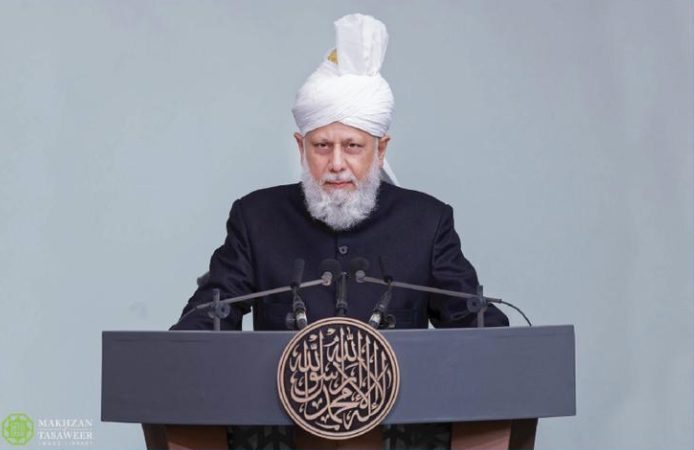
After reciting Tashahhud, Ta‘awwuz and Surah al-Fatihah, His Holiness, Hazrat Mirza Masroor Ahmad (aba) said that in a previous sermon, he had mentioned the Holy Prophet’s (sa) love for God. His Holiness (aba) said that he would continue mentioning incidents on this topic.
His Holiness (aba) said that in his youth, prior to his claim to prophethood, the Holy Prophet’s (sa) love for God was such that he would take to a cave and become immersed in expressing his love for God.
Finding the Love of God in Solitude
His Holiness (aba) quoted the Promised Messiah (as) who writes that the Holy Prophet (sa) found no comfort similar to that which he found in being alone with God as he took to the cave to immerse himself in reflection. It would not have been an easy undertaking, having with him at most a waterskin, yet when engrossed to such a degree in love, the Holy Prophet (sa) found no greater enjoyment and contentment. The Holy Prophet (sa) would spend nights on end in a place where people would otherwise be afraid to go. It goes to show that true love for God begets bravery; hence, a believer is courageous. Some argue that if prophets love being alone, why do they marry and have children? The example is like the difference between a beggar and a friend who goes to someone’s home. When a beggar goes to someone’s home to beg, he may be given some dry pieces of bread so that he does not linger and leave. When a friend visits another friend’s home, he is served excellent food and treated well. This is not something he asks for; he partakes of that which is presented to him. Such is the case with prophets. In reality, they do love being alone with God and conversing with Him. The relationships which they foster in this world are not the result of carnal passions. Instead, these worldly relationships are also to the end of reaching heights in their relationship with God.
His Holiness (aba) said that Hazrat A’ishah (ra) narrates:
‘The commencement of the divine inspiration to Allah’s Messenger (sa) was in the form of true dreams in his sleep. He never had a dream but that it came true like bright daylight. He used to go into seclusion in the cave of Hira, where he used to worship Allah continuously for many nights. He used to take with him the journey food for that stay, and then return to his wife Khadijah to take his food for another period of stay, till suddenly the truth descended upon him while he was in the cave of Hira. The angel came to him in it and asked him to read. The Holy Prophet (sa) replied, “I do not know how to read.” The Holy Prophet (sa) added, “The angel caught me forcefully and pressed me so hard that I could not bear it anymore. He then released me and again asked me to read, and I replied, “I do not know how to read,” whereupon he held me again and pressed me a second time till I could not bear it anymore. He then released me and asked me to read again, but I replied, “I do not know how to read.” Thereupon, he caught me for the third time and pressed me and then released me and said, “Convey thou in the name of thy Lord Who created, created man from a clot of blood. Convey! And thy Lord is Most Generous.”
Then Allah’s Messenger (sa) returned with the Inspiration, his heart beating fast, till he entered upon Khadijah and said, “Cover me! Cover me!” She covered him till his fear was over and then he told her everything that had happened and said, “I fear that something may happen to me.” Khadijah said, “Never! But have the glad tidings, for by Allah, Allah will never disgrace you as you keep good reactions with your Kith and kin, speak the truth, help the poor and the destitute, serve your guest generously and assist the deserving, calamity afflicted ones.”
Khadijah then accompanied him to Waraqa bin Naufal bin Asad bin ‘Abdul ‘Uzza bin Qusai. Waraqa was the son of her paternal uncle, i.e., her father’s brother, who during the Pre-Islamic Period became a Christian and used to write the Arabic writing and used to write of the Gospels in Arabic as much as Allah wished him to write. He was an old man and had lost his eyesight. Khadijah said to him, “O my cousin! Listen to the story of your nephew.” Waraqa asked, “O my nephew! What have you seen?” The Holy Prophet (sa) described whatever he had seen. Waraqa said, “This is the same angel whom Allah had sent to Moses (as). I wish I were young and could live up to the time when your people would turn you out.” Allah’s Messenger (sa) asked, “Will they turn me out?” Waraqa replied in the affirmative and said, “Never did a man come with something similar to what you have brought but was treated with hostility. If I should remain alive till the day when you will be turned out, then I would support you strongly.” But after a few days, Waraqa died, and the divine inspiration upon the Holy Prophet (sa) was also paused for a while.’
Effort is Required to Increase in One’s Love for God
His Holiness (aba) quoted the Promised Messiah (as) who said that God has stated that finding Him and establishing a connection with him is predicated upon making an effort, as God says, ‘And that man will have nothing but what he strives for’ (The Holy Qur’an, 53:40) and ‘And as for those who strive in Our path – We will surely guide them in Our ways.’ (The Holy Qur’an, 29:70).
When we observe the examples of the companions of the Holy Prophet (sa) and the great connections with God they established, we see that they did not establish these connections through mediocre prayers; rather, they did so by striving hard and making magnificent sacrifices, prepared to offer even their lives.
His Holiness (aba) said some think that after making the slightest of efforts, they should be granted great ranks in the sight of Allah. But when we see the example of the Holy Prophet (sa), who was the Seal of Prophets and the greatest of all men, and he did not achieve his lofty ranks in the sight of God with mediocre efforts, then how can anyone else expect to achieve lofty heights without making great efforts in the way of God, as the Holy Prophet (sa) did. Indeed, the Holy Prophet (sa) loved being alone with God, but when a certain point was reached, God said, ‘O thou that has wrapped thyself in thy mantle! Arise and warn.’ (The Holy Qur’an, 74:2-3) After his love for God and his efforts to that end had reached their peak, God instructed him to leave this solitude and go forth to spread His message.
His Holiness (aba) said that this shows that the Holy Prophet’s (sa) relationship with God had much to do with the efforts that he made to that end. This was greatly manifested in his prayers. It is recorded that the Holy Prophet (sa) would become so immersed in prayers and would pray with such fervency that it would sound to those in his vicinity like the sound of water boiling in a pot. Or there was the instance, when, during his final illness, the Holy Prophet’s (sa) state was such that he could not even walk; he placed his hands on the shoulders of two companions who helped him to the mosque for prayers as the Holy Prophet’s (sa) feet dragged on the ground. According to the Islamic law, the Holy Prophet (sa) was not bound to attend the mosque for prayers on account of his illness; his love for God could not keep him from the mosque. In reality, prayer was his sustenance, without which he could not survive. When such was his relationship with prayer, then how could an illness keep him from prayer? In health and illness, the Holy Prophet (sa) was immersed in the remembrance of Allah, and he strove to inculcate the same in his followers.
True Love Comes from Remembrance of God
His Holiness (aba) said that we should analyse ourselves to see whether we do remember Allah in the manner that the Holy Prophet (sa) desired us to? Do we observe prayers regularly as the Holy Prophet (sa) taught us to, or do we become indolent from doing so over the slightest of matters?
His Holiness (aba) said that the Holy Prophet (sa) taught us to remember God at every instance: when sneezing, beginning to eat, finishing eating, upon sleeping, when waking up, after offering prayers, before doing anything important, when performing ablution. In short, the Holy Prophet (sa) associated the remembrance of God with daily activities, thereby highlighting the Holy Prophet’s (sa) immense and constant love for God.
His Holiness (aba) quoted Hazrat Mirza Bashiruddin Mahmud Ahmad (ra), who writes that some who offer a degree of worship start thinking that they have attained some sort of lofty ranks and should be treated as such. The reality, however, is that true believers do not become boastful over their spirituality; rather, they become increasingly humble and often seek to hide their degree of worship. The state of the Holy Prophet (sa) was such that, as a result of his worship, he did not seek to receive more bounties of favours from God; rather, his increased worship only increased his love for God, leaving to a further increase in his worship. In fact, the Holy Prophet (sa), rather than becoming arrogant over his worship, would thank God, saying that he was only able to offer worship because of the ability to worship granted to him by God. Such was the state of the Holy Prophet’s (sa) love for God that he considered the ability to worship God to be a favour of God. And so, the Holy Prophet (sa) would stand longer and longer in prayer to the point that his feet would swell. He did not care for himself or his own well-being; rather, he only cared to worship God. When asked why he endured such difficulties and took upon himself such discomforts that others typically run from, the Holy Prophet (sa) replied, “Should I not be a grateful servant?” It was a matter of fact for the Holy Prophet (sa) that in response to the immense favours bestowed by God, he would naturally desire to increase in his worship of God. Can such an example be found anywhere else? Certainly not.
His Holiness (aba) further quoted Hazrat Mirza Bashiruddin Mahmud Ahmad (ra), who writes that it is also astonishing that the Holy Prophet (sa) was so engaged in offering prayer, all while remaining engaged in extremely busy schedules on a daily basis. He would offer the five daily prayers on a daily basis; he would also meet foreign delegations, he would command the Muslim army, he woudl teach the companions, he would serve a judge for various disputes, he would oversee the treasury, oversee matters pertaining to the state, uphold the teachings of Islam, be present for his wives, help in household chores and many other things. He would do all this during the day, and rather than falling to his bed at the end of the day, he would rest for a short while and in the middle of the night, he would stand out of love for his Lord and offer prayer for so long that his feet would become wounded. Once, when a young man, far more youthful at the time than the Holy Prophet (sa), at the time tried standing alongside the Holy Prophet (sa) for prayer, he was unable to endure the long period of standing and had to leave the prayer, while the Holy Prophet (sa) stood strong in worship. How and why did the Holy Prophet (sa) endure such physical tolls and still offer worship, which in itself was a physical toll in the manner in which he offered it? It was purely out of his love for God.
The Holy Prophet’s (sa) State of Worship in Ramadan
His Holiness (aba) said that this was the state of the Holy Prophet (sa) and his worship throughout the year. However, when it came to the holy month of Ramadan, it is recorded that the Holy Prophet’s (sa) worship would increase even further. Even further, once, when someone asked the Holy Prophet (sa) about his sleep at night, the Holy Prophet (sa) said that though his eyes may be asleep, his heart remained awake throughout the night in the remembrance of God. On account of his immense standard of worship and the example which he established, God instructed the Holy Prophet (sa) in the Holy Qur’an, ‘And that man will have nothing but what he strives for. Say, ‘My Prayer and my sacrifice and my life and my death are all for Allah, the Lord of the worlds.’ (The Holy Qur’an, 6:163)
His Holiness (aba) quoted the Promised Messiah (as), who, in responding to the allegation raised by some against the marriages of the Holy Prophet (sa), said that the Holy Prophet (sa) had nine wives, yet rather than being detracted, the Holy Prophet (sa) would spend entire nights worshipping. Hazrat A’ishah (ra) relates that one night when the Holy Prophet (sa) was with her, she awoke in the middle of the night and realised that the Holy Prophet (sa) was no longer there. She thought that perhaps he had gone to another wife. However, she found the Holy Prophet (sa) in the cemetery, in fervent supplication. Hence, this goes to show that polygamy in Islam is certainly not on the basis of fulfilling carnal passions; rather, it can only be exercised on the sole basis of righteousness, only when true, genuine needs arise. The allegations raised against Islam are only on the basis of those who abuse the permission for polygamy, because there are strict conditions which must be met before a person marries more than one wife; it certainly is not on the basis of base passions.
His Holiness (aba) quoted the Promised Messiah (as), who highlighted the manner in which the worship taught by the Holy Prophet (sa) stands alone from all other faiths. Whereas other faiths meet only periodically for prayer or perhaps once a week, the faith taught by the Holy Prophet (sa) teaches to pray multiple times a day. This is the true manner of increasing in love for God and establishing a true relationship with him.
His Holiness (aba) said that these are the standards of worship and prayer that we must strive to attain, for it is only then that we can be considered true Muslims.
His Holiness (aba) said that our efforts in spreading the true message of Islam will only prove fruitful when we also strive in prayer and work to increase the standard of our worship and our love for God. It is then that our efforts will be blessed.
Prayers for the Success of Jalsa Salana Bangladesh
His Holiness (aba) said that today, the Jalsa Salana (Annual Convention) of the Ahmadiyya Muslim Community in Bangladesh is commencing. There is a great deal of opposition there. His Holiness (aba) urged everyone to remember the Ahmadis there in their prayers; may Allah keep them all under His protection and may their Jalsa be held successfully.



Add Comment