
Summary prepared by The Review of Religions
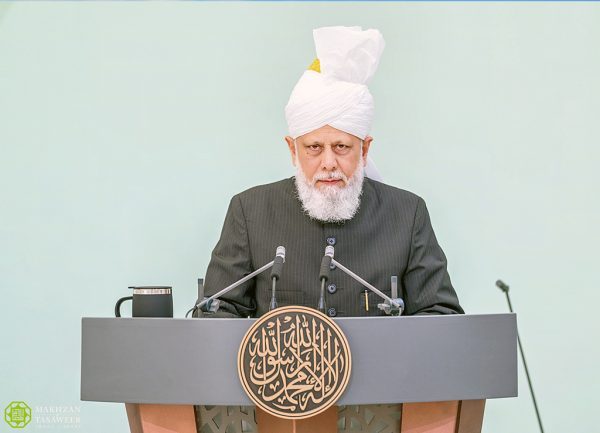
After reciting Tashahhud, Ta`awwuz and Surah al-Fatihah, His Holiness, Hazrat Mirza Masroor Ahmad (aba) said that over the last few sermons, he has been speaking about the lofty standard of trusting Allah established by the Holy Prophet (sa). In this era, the true servant of the Holy Prophet (sa), the Promised Messiah (as), followed this perfect example through his own actions and teachings, and this is what His Holiness (aba) said he would now begin to highlight.
True Contentment Through Complete Trust in God
His Holiness (aba) quoted the Promised Messiah (as) who taught that while some people rely on worldly means alone, those means certainly end or falter at some point, which is why one must always seek help from God. Therefore, after employing the use of worldly means, one must also turn to God so that He may render those means useful.
His Holiness (aba) quoted the Promised Messiah (as) who explained that to be content with God is to place one’s complete trust in Him, to turn to Him, and to have not a single doubt or complaint about Him. Similarly, to attain the pleasure of God, one must attain the loftiest standards of piety and obedience, as did the companions of the Holy Prophet (sa). They created such strong bonds with God that have been presented as examples before us. It is said that Jesus (as) cured the sick, but did this increase his disciples’ faith in God? Certainly, lofty standards of trust in God cannot be found among the disciples simply on the basis of Jesus (as) curing the sick. Such things indeed cannot bring about true trust in God; it is only by establishing a strong personal bond with God that can lead to a true bond with God that yields His pleasure.
His Holiness (aba) quoted the Promised Messiah (as) who writes:
‘Also remember that there is no ointment for the wound of affliction as soothing and comforting as trust in Almighty Allah. The person who puts his trust in Almighty Allah finds solace and satisfaction within himself even in the severest of difficulties and adversities. He does not feel bitterness and torment in his heart. At the very most, the final result of this trouble may be death if that is the immutable decree.
Nonetheless, what would happen from this? The world is not a place where one can live forever anyway. Ultimately, a day and time comes upon everyone when this world must be abandoned. Then, if death is the consequence from it, what harm would it cause? For the believer, this death is even more comforting, becoming the means to unite with the Beloved. This is so because he has complete faith in Almighty Allah and trusts in His omnipotence and knows that the next world for him is that of eternal comfort.
Therefore, a simple calamity, whether it is an illness or any other type of calamity, cannot be the cause of suffering or torment. Rather, that calamity is adjudged a painful chastisement in which there is no faith and trust in Almighty Allah. Such a person does suffer severe torment. If someone fancies that he would not face death, then this notion is false because Almighty Allah has declared this world to be impermanent. For such a person, there will be a very painful Hell in the next world for which he should be prepared.’ (Malfuzat, English Translation, Vol. 7, pp. 384-385)
Understanding Trials and Punishment Through Complete Trust in Allah
His Holiness (aba) said that this also answers the question which people often raise about how to know whether something is a punishment or a trial.
His Holiness (aba) quoted the Promised Messiah (as) who states:
‘Think not that Allah Almighty is weak. Indeed, He is the possessor of immense power. When you put your trust in Him for support in any matter, He shall come to your aid. “And he who puts his trust in Allah — He is sufficient for him.”’ (Malfuzat, English Translation, Vol. 1, p. 11)
His Holiness (aba) quoted the Promised Messiah (as) who said that those who completely place their trust in God are those who then do not become afflicted with worldly worries. Indeed, those who place their complete trust in God are like those who have thousands of treasures in their possession, because their contentment comes nor from any worldly riches but the fact that those who completely devote themselves to God and trusting him are never left destitute. Though they certainly face hardships along the way, God never abandons them.
Divine Support and Complete Trust in God
His Holiness (aba) quoted the Promised Messiah (as) who said that whilst mentioning one of the signs regarding the coming of the Messiah it is stated that he would descend with his hands placed on the shoulders of two angels. This refers to the fact that the coming Messiah’s knowledge and inner spiritual light and recognition of God would be aided by the angels. In other words, his knowledge would not be attained merely by books rather he would be taught directly by God. Furthermore, all of this Messiah’s needs would be tended to and fulfilled by God Himself.
His Holiness (aba) quoted the Promised Messiah (as) who said:
‘I find that the state of my heart is a strange one. When it is extremely humid and the heat becomes immensely intense, people begin to hope with a sense of certainty that rain will soon follow. Similarly, when I find my casket to be empty, I feel a firm sense of certainty in the grace of God that now it will be replenished, and this is exactly what happens.
Then, the Promised Messiah (as) swore by God Almighty and said:
‘When my pouch is empty, the sort of joy and pleasure that I experience in trusting God Almighty at such a time is beyond my ability to explain. My state at such a time is extremely comforting and satisfying, in comparison to when my pouch is full.’ (Malfuzat, English Translation, Vol. 2, 43)
Prayers are the Strength in Times of Difficulties
His Holiness (aba) quoted the Promised Messiah (as) who taught that all difficulties can be overcome and removed through prayer. While a person certainly worries during times of difficulty, they should never abandon their trust in God. In other words, they must never despair, because this is a quality of the disbelievers. Faith removes doubts whereby one certainly faces worries, but those worries are dispelled through faith and prayer.
His Holiness (aba) quoted the Promised Messiah (as) who said:
‘The second aspect of prayer is to reform the self and attain the ability to do virtuous deeds to meet a good end. In this, the degree to which one trusts Allah the Exalted, has faith in Him, and moves forward untiringly, is the degree to which one will attain excellent results and fruits. All difficulties will be removed, and the supplicant will reach the lofty station of righteousness.’ (Malfuzat, English Translation, Vol. 7, p. 74)
Promised Messiah’s (as) Trust in God Over All Worldly Pursuits
His Holiness (aba) said that a Hindu person who knew the Promised Messiah (as) from his childhood attested to the fact that he never inclined towards any sorts of worldly pursuits. Instead he would always confine himself to the mosque. He never spoke ill to anyone, quarelled with anyone and never misbehaved even in play as children often do. From a worldly lens, people would worry as to what would become of him and his future. Even the Promised Messiah’s (as) father would express worry about what would become of his future and how he would earn a living. He would even offer to help him find a job through his connections with various officers and high ranking officials. The Promised Messiah (as) would respond that he was already employed by the One who was the Officer of all officers, the Ultimate Judge of all judges and the One who has power over all things. Still, out of obedience to his father, the Promised Messiah (as) said that he would also look for work. Yet, this was the manner in which the Promised Messiah (as) expressed his trust in God, to the point that even his father attested that his son’s spiritual rank was indeed lofty, and he referred to him as being not a man but an angel. This brought tears even to the eyes of the Hindu man narrating this incident.
His Holiness (aba) said that the Promised Messiah (as) advised that if ever one had to present themselves before a judge or a high ranking official, they should first recite the opening chapter of the Holy Qur’an seven times, and with their finger they should write on their forehead “O You Who are the Mighty” seven times.
This results in one attaining success in their matter. This was a reflection of the Promised Messiah’s (as) distrust in worldly means and complete trust in God.
Complete Conviction Through Trust in God
At another occasion, the Promised Messiah (as) said that even if the worst of the worst were to file a legal case against him, he had complete conviction that ultimately, the decision that God wanted passed would be the final conclusion of the case.
His Holiness (aba) said that once during a court case, it seemed that the magistrate was certainly going to rule against the Promised Messiah (as). All those who were around the Promised Messiah (as) were extremely worried. However, the Promised Messiah (as) boldly said that can anyone ever touch the lion of God? Not only was that magistrate reposted to a different location, but he was also later completely demoted from his position. Then, the new magistrate came and ruled in favour of the Promised Messiah (as). Throughout, at no point, did the Promised Messiah (as) abandon his trust in God.
His Holiness (aba) prayed that may everyone have the ability to follow this example of placing trust in God that was established by the Promised Messiah (as) in subservience to his master, the Holy Prophet (sa).



Add Comment