
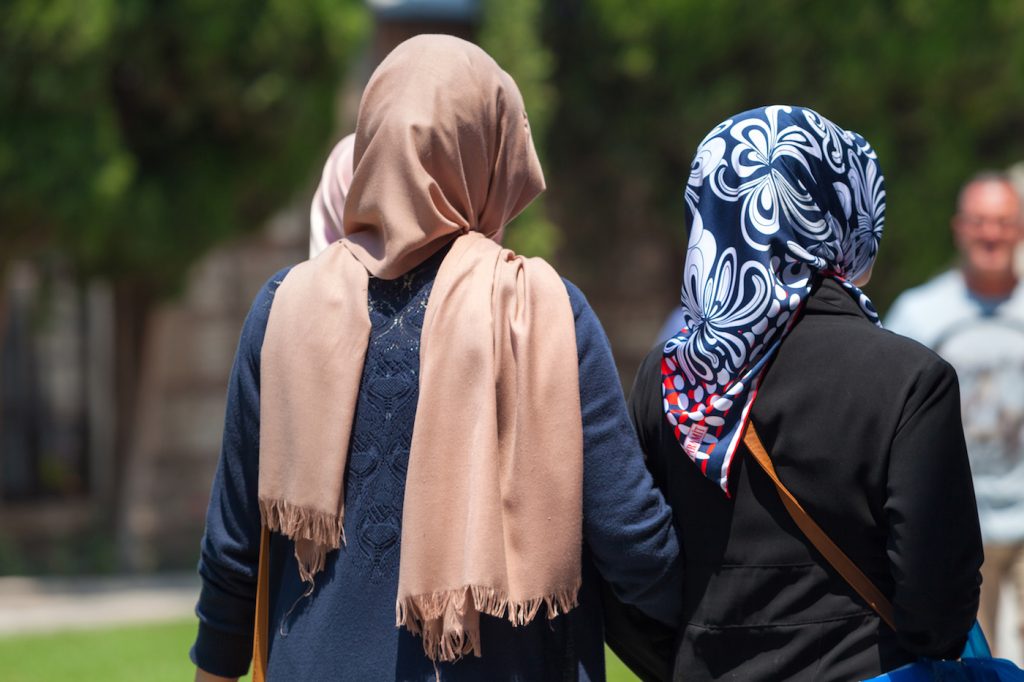
Reehana Shah & Komal Hadi
Another country has joined the growing list of nations infringing on the rights of women in the name of freedom by banning the hijab. The irony? This time it’s Azerbaijan, a Muslim-majority country.
Recently, the Azerbaijan Education Ministry enforced discriminatory uniform rules that barred students and teachers from donning religious garments in school. While not explicitly mentioning the hijab, the government has banned clothing that “violates the principle of secularism.” Consequently, this new rule has restricted some girls from accessing education. Videos circulated on social media show hijab-wearing students crying as they are denied access to classrooms, and boycotts have taken place in schools around the country as students protest the discriminatory policy. Some footage even shows schoolgirls continuing their lessons sitting outside their school gate, [1] while others show hijab-wearing teachers, many of whom have been teaching for decades, bidding an emotional farewell to their classes. [2]
Critically, hijab-wearing educators who have dedicated their lives to teaching and were once valued members of their school communities are suddenly at risk of losing their livelihoods as they are forced to choose between their faith and their careers. Thousands of commentators have questioned how a woman’s choice of dress interferes with her intellect or her ability to teach, and why, in 2026, dress codes are still being imposed on women by governments. Amnesty International’s Eastern Europe and Central Asia Director has stated, “Denying girls access to classrooms because they wear a hijab is discriminatory…The secular character of public education doesn’t justify a blanket restriction on religious dress.” [3]
Unfortunately, the government’s decision to ban hijabs in school is fundamentally at odds with their motive of creating a unified educational environment where everyone is equal. Instead, it is obstructing access to education for young girls, and pushing Muslim women who are teachers out of the workforce by making their employment conditional on adherence to political policy. This raises serious questions about the state’s commitment to equal accessibility to education and freedom of expression. This move has not empowered women. ‘I want to fulfil my responsibilities, educate students and continue my career without my religious beliefs becoming an obstacle to my employment,’ says Gulshan Aliyeva, a teacher with 23 years of experience who is now facing a heartbreaking choice. [4]
This story is not new. The setting and the characters might change, but every couple of years the same old plotline reappears, whereby Muslim women are too quickly labelled as either victims who must be saved from their own beliefs, or villains who can never integrate into society and must therefore be removed. While the goal in this case might have been to promote secularism, without a doubt, it is hijab-wearing Muslim women, especially teachers, who are disproportionately affected. Rather than allowing a woman to determine her own identity and choices, Azerbaijan is telling its educators that they now risk losing their careers, independence, and financial security.
A reminder of this ideology has stood in a public square in the country’s capital, Baku, since the 60’s. The monument of “azad qadın heykəli” or “statue of a liberated woman” shows a woman removing her veil and joining society. The sculptor, Faud Abrahamanov, ‘imagined an eagle that had become entangled in the net. She tears her bonds, finally, free from them.’ [5] This begs the question: why is female liberation only ever symbolised by the rejection of a garment, but never by a woman’s personal choice to wear it?
As members of the Ahmadiyya Muslim Community, we look to guidance from His Holiness, Hazrat Mirza Masroor Ahmad (aba), the Worldwide Head of the Ahmadiyya Muslim Community, and Fifth Successor to the Promised Messiah (as). Over the years, His Holiness (aba) has given very practical and nuanced responses to the subject based on Islamic teachings. His Holiness (aba) has stated that, ‘Whenever I have reflected on this matter, I have never been able to understand what the problem with the veil is that it has become such a threat to governments. Is it such a heinous crime to wear a coat and cover one’s head and chin with a piece of cloth that an entire parliament should sit to pass a law against it?…’ [6]
On a different occasion, His Holiness (aba) has also explained that firing a talented and capable woman because she wears a hijab ‘…is the question of stripping away the rights of a very capable mind.’ [7]
The primary purpose of the hijab is to instill modesty and righteousness in the heart, and both men and women are required to adopt modesty in Islam. The implication for teachers in Azerbaijan, who do not wish to compromise on their religious convictions, is therefore particularly distressing. Islam requires women to wear the hijab after the age of puberty, and women wear it willingly as a sign of their faith and dedication to God. In a country where 95% of the population identifies as Muslim, the public reaction cannot come as a surprise.
It is important to note, however, that young girls of primary school age are not required to wear the hijab, and many of them simply wear it as a choice, often inspired by seeing their mothers or elders in hijab. More importantly, His Holiness (aba) has emphasised that, ‘Children need to be valued for who they are, regardless of race or religion. When young children’s choices are questioned by adults, it can make them feel as if they have done something wrong.” Moreover, ‘No school should take any action that could serve to make any Muslim child feel as though there is something wrong with their religion or culture.’ [8]
Yes, there are Muslim countries that force women to wear the hijab and are rightfully criticised for their violation of human rights. However, by stripping a woman of her choice, Azerbaijan is simply revealing the other side of the same coin; oppression in the name of secularism is still oppression.
About the Authors:
Reehana Shah is a Canadian-American currently living in the United States. She holds a BA Honours in International Studies, Cooperation and Conflict, and Russian Studies, and is a part of the Review of Religions Online Women’s Team.
Komal Hadi holds a Master’s degree in International Journalism from SOAS University of London and is a member of the Review of Religions Online Women’s Team. Her interests include Muslim representation in the media and women’s issues. She also contributes to various publications within the Ahmadiyya Muslim Community.
ENDNOTES
[1] https://x.com/5Pillarsuk/status/2111788782001230279?s=48
[2] https://x.com/slmhktn/status/2110969512900387243?s=48
[5]https://susanives.com/2024/11/25/mondays-monument-statue-of-a-liberated-woman-baku-azerbaijan/
[6] https://www.alhakam.org/lajna-members-of-sweden-meet-hazrat-khalifatul-masih
[7] https://www.alhakam.org/europes-issue-with-muslims-far-right-sentiments-win-in-switzerland
[8] https://www.reviewofreligions.org/13667/editorial-the-hijab-ban-in-schools/



Add Comment