
© Shutterstock
Discover the Chameleon’s Marvels of Colour, Vision, Speed, and Adaptability
Musa Sattar, London, UK – Deputy Science Editor
In the dense forests of Madagascar and the sun-soaked deserts of Africa, a creature of astounding complexity and beauty resides. The chameleon, with its ability to change colours, extraordinary vision, and remarkable tongue, along with many other astonishing features, stands as a living testament to the wonders of the natural world.
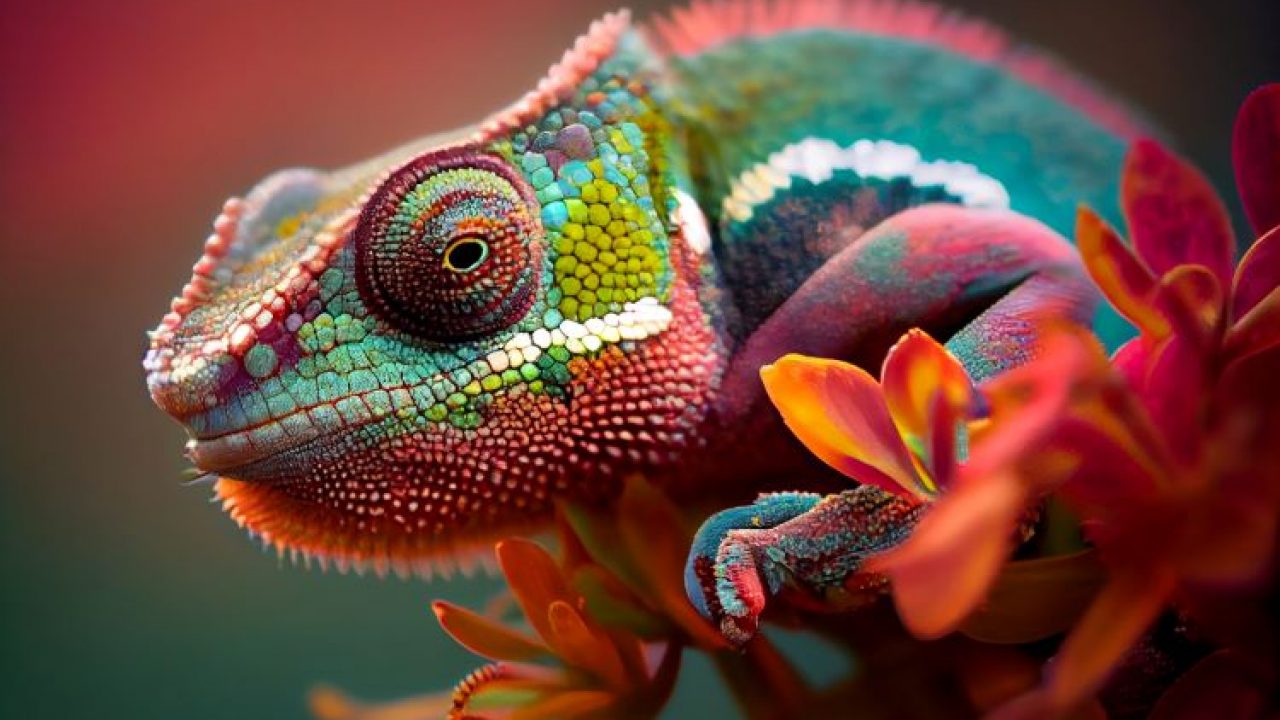
Imagine a creature that can change its skin colour at will. The chameleon does this with an artistry that leaves scientists in awe. Interestingly, these colour changes, are completely reversible and occur within minutes.
So how do they pull off these colourful changes? Its skin contains special cells called chromatophores and iridophores. These cells work together like a painter’s palette, reflecting light to create a spectrum of colours. But the colour changes are not the result of shifts in pigments alone, they are the result of quick changes to light-reflecting nanocrystals found in iridophores, which create structural colour within chameleon skin.
‘These animals [chameleons] can actually actively tune the geometry of these [guanine nanocrystals] in their iridophores, and they can do that reversibly, they can choose to go from green to yellow and back to green within minutes,’ says Michel Milinkovitch, evolutionary geneticist and Professor in the Department of Genetics & Evolution at the University of Geneva.
The chameleon uses this ability not just for camouflage, blending seamlessly into its environment, but also for communication, social interaction and to regulate their body temperatures.
Being ectotherms (cold-blooded animals), they can’t produce their own body heat so they adjust their skin colour to stay comfortable. A cold chameleon will darken to absorb more heat, while a hot chameleon will turn pale to reflect the sun’s heat.
During mating season, males flaunt their brightest hues to attract females and ward off rivals. A shift in colour pattern can also reveal a chameleon’s mood and intention, signalling stress or aggression. Blending into their surroundings is a key survival strategy for chameleons. When hiding from predators, they mimic the colours and patterns of their environment. This ability is so precise that even trained eyes can miss a well-camouflaged chameleon.
© Shutterstock
Chameleons have another unique trait: their bones can glow under ultraviolet light. Their skulls, visible through their scaly skin, emit a fluorescent glow under UV light. However, it’s not their whole skeleton that glows, but specific bony spots called tubercles on their head and spine. They absorb light and re-emit it in a different colour. This type of fluorescence is common in ocean creatures but rare in land animals, making chameleons even more special.
Now consider the chameleon’s eyes. Each eye can move independently, scanning the surroundings with a 360-degree field of vision. This allows the chameleon to spot predators and prey simultaneously. When it locks onto a target, its eyes work in perfect unison, judging distance with precision. Such a complex visual system is beyond the capabilities of any human invention. It’s a feature so perfectly tuned that it’s hard to attribute its origin to mere chance.
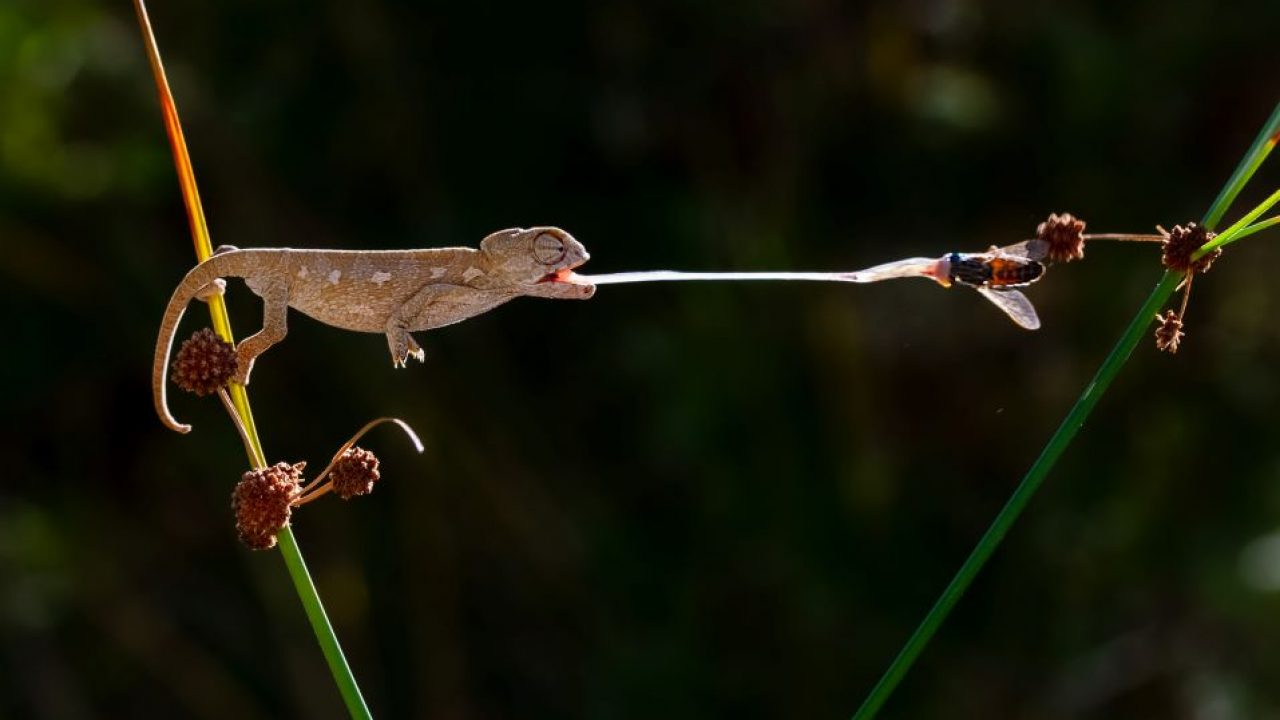
The chameleon’s tongue is another marvel. Stored like a spring inside its mouth, it can extend to twice the length of the chameleon’s body, launching out at immense speed to snatch insects from the air. The tip is covered in a sticky mucus, ensuring that the prey has no escape. The chameleon shoots out the tongue in a flash, grabbing prey that can weigh up to a third of its own body weight from distances over twice its body length. This allows the chameleon to hunt without needing to move. But how does the prey gets stick to the tongue? Mysteriously, it’s in the viscosity of the spit of chameleon, which is about 400 times that of human saliva.
The tiniest chameleons that could fit on the tip of your thumb, surprisingly can deliver most powerful tongue-lashings. Christopher Anderson, a biologist at Brown University called this ‘ballistic tongue projection.’ According to Anderson, ‘All of the chameleons have the same catapult-like apparatus for launching the tongue, but proportional to their size, smaller chameleons have a bigger one than larger chameleons. They are like little sports cars with relatively powerful engines.’ Their tongue can accelerate from 0 to 60 mph in a hundredth of a second, a feat of natural engineering that scientists are still striving to fully understand and replicate.
But the wonders don’t stop there. The chameleon’s feet are uniquely adapted for life in the trees. Like humans, chameleons have five digits on each hand and foot, but these are grouped together, making them look two-toed. They have a unique angle between these groups due to special skeletal elements in their wrists and ankles. These elements fuse during development to form ball-and-socket joints, allowing chameleons to rotate their bodies while climbing. This flexibility, combined with their swivel points, lets them grip a branch and rotate around it without injury—something humans couldn’t do without tearing a ligament. Its tail, too, is prehensile, acting like a fifth limb to secure its position among the foliage. This arboreal lifestyle demands a level of balance and dexterity that is nothing short of extraordinary.
Chameleons are not confined to one type of habitat. They thrive in diverse environments, from rainforests to deserts. Their ability to regulate body temperature through colour change and their adaptable diet highlight their versatility. According to Bavarian State Collection of Zoology in Munich, nano-chameleons are known to be the smallest of about 11,500 known species of reptiles, with a body of just 13.5mm. Dr Mark Scherz, who discovered the smallest chameleon in Madagascar, called it, ‘a spectacular case of extreme miniaturisation.’ This adaptability is a hallmark of intelligent design, suggesting a level of planning and forethought that random processes struggle to explain.
Their role in the ecosystem is equally important. As natural pest controllers, they keep insect populations in check, maintaining the balance of their environment. Their presence is an indicator of ecological health, signalling a thriving and balanced ecosystem. Each of these aspects points to a level of design and purpose that feels beyond the reach of randomness.
Scientists have long been inspired by the natural world, engaging in biomimicry to create new technologies. Yet, despite these advancements, no one has come close to replicating the chameleon’s full suite of abilities. The complexity of its colour-changing skin, the independently movable eyes with their remarkable precision, the speed of its tongue, and the adaptability of its feet and tail all suggest a level of sophistication that feels intentionally crafted.
As we piece together the myriad features of the chameleon, the notion that such a creature could arise from a series of random mutations and natural selection alone seems increasingly implausible. The chameleon, with its flawless integration of form and function, stands as a powerful argument for a Supreme Creator. Its existence is a symphony of design, a masterpiece that hints at a grand designer behind the scenes.
In marvelling at the chameleon, we are left with a profound question: If there is no Creator, who or what is responsible for such magnificent design in nature? This creature, with its numerous adaptations and stunning beauty, challenges us to look beyond the surface and consider the possibility of a purposeful design in the natural world. As we continue to explore and understand the chameleon, we are drawn closer to the awe-inspiring complexity and perfection of nature, and perhaps, to the Creator behind it all.
Further Reading:
https://www.vice.com/en/article/gv5wz4/chameleon-spit-is-a-physics-wonder
https://bmcecolevol.biomedcentral.com/articles/10.1186/s12862-015-0464-4
https://www.nytimes.com/2015/09/22/science/a-beneficial-evolutionary-step-for-chameleons.html
https://www.the-scientist.com/how-chameleons-change-colors-35803
https://www.the-scientist.com/chameleon-skin-mimic-35779
https://www.bbc.co.uk/news/world-africa-55945948
https://www.ncbi.nlm.nih.gov/pmc/articles/PMC4366488
https://phys.org/news/2015-03-chameleon-nanocrystals.html
https://www.vice.com/en/article/gv5wz4/chameleon-spit-is-a-physics-wonder
https://www.iflscience.com/how-chameleons-adapted-tree-climbing-lifestyle-31285
chameleonbreeder.com/podcast/ep-101-expedition-to-madagascar-with-mark-scherz/



Add Comment