
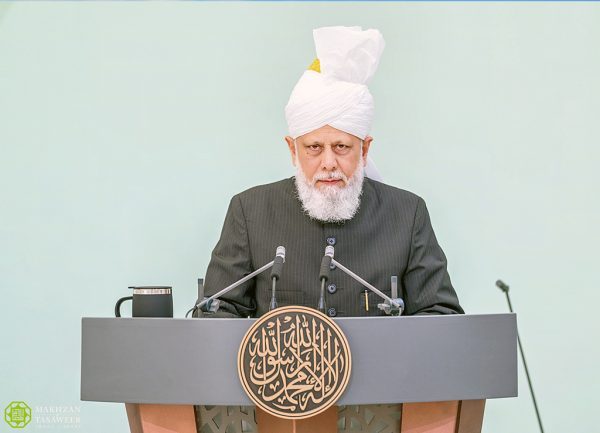
After reciting Tashahhud, Ta‘awwuz and Surah al-Fatihah, His Holiness, Hazrat Mirza Masroor Ahmad (aba) said that he would continue mentioning details of the Treaty of Hudaibiyah.
Were Muslim Women to be Returned to Makkah?
His Holiness (aba) quoted Hazrat Mirza Bashir Ahmad (ra) who writes:
‘It is common for flaws to be left undetected in agreements, which later on become the result of significant outcomes. Likewise, even in the Treaty of Hudaibiyah, a deficiency went undetected, as although the return of Muslim men was clearly stipulated, there was no mention of such women from the people of Makkah, who would accept Islam and join the Muslims. However, shortly thereafter, such circumstances began to reveal themselves as made this flaw evident to the people of Makkah. Only a short time had passed in the settlement of this agreement, when some Muslim women managed to escape the hands of the infidels and reach Madinah. Among them, the first was a daughter of a dead idolater, the chieftain ‘Uqbah bin Abi Mu‘it named Ummi Kulthum. From her mother’s side, she was also the sister of Hazrat ‘Uthman bin ‘Affan. Exhibiting commendable courage, Ummi Kulthum reached Madinah by foot, and presenting herself before the Holy Prophet (sa) expressed her acceptance of Islam. However, two of her close relatives also followed behind to capture her and demanded her return. These people claimed that although the word ‘man’ has been used in the treaty, in actuality, the agreement was general and effected both men and women equally. However, in addition to the words of the treaty, Ummi Kulthum contended for an exception in the case of women because a woman belongs to a weaker gender. Moreover, in comparison to men, she holds a subordinate position to men, so for this reason to return her, would be equivalent to tossing her into the mouth of spiritual death and thus depriving her of Islam. Therefore, to consider women exempt from this stipulated agreement was not only in complete accordance with this agreement, but logically speaking, it was closer to justice and necessary. For this reason, naturally and equitably, the Holy Prophet (sa) gave a verdict in favour of Ummi Kulthum and sent her relatives back. Furthermore, God the Exalted also supported this decision. Consequently, during these days, the Qur’anic verse was revealed that, “When believing women come to you as refugees, examine them, and if they prove to be virtuous and sincere, send them not back to the disbelievers but if they are married women, return to their disbelieving husbands their dowries.” Thereafter, whenever a woman would leave Makkah and arrive in Madinah, she would be thoroughly examined and her intention and sincerity would be thoroughly assessed. Then, as for those women who proved to be well intentioned and sincere and there was no materialistic or personal purpose behind their migration, they would be kept in Madinah. However, as for those women who were married, their dowries were paid to their husbands and after that they were free to marry amongst the Muslims.’
(The Life and Character of the Seal of Prophets (sa), Vol. 3, pp. 147-149)
Return of Abu Basir to Makkah
His Holiness (aba) quoted Hazrat Mirza Bashir Ahmad (ra) regarding another incident. He writes:
‘Among the conditions of the agreement of Hudaibiyah, one condition was that if an individual from among the Quraish becomes Muslim and came to Madinah, the people of Madinah should not grant him protection, instead, they should return him. If however, a Muslim denounces Islam and heads towards Makkah, then the people of Makkah would not return him. At the outset, this condition seemed to be a means of disgrace for the Muslims. It was for this reason that many Muslims were averse, so much so, that even a venerable and remarkably understanding companion like Hazrat ‘Umar (ra), in the emotional situation of that time, was very displeased and restless concerning this condition. However, soon thereafter, it was proven that in reality, this condition was a means of weakness for the Quraish and strength for the Muslims. Just as the Holy Prophet (sa) had stated in the beginning, that if a Muslim became apostate and left Madinah, then he was a rotten limb, whose amputation was actually better. However, in comparison to this, if an individual became Muslim pure-heartedly and left Makkah, whether he find a place in Madinah or not, he would become a means to strengthen Islam, irrespective of where he resided, and ultimately, Allah would clear a way for his deliverance. This perspective quickly proved truthful, because it had not been long since the Holy Prophet’s (sa) arrival back in Madinah, when a man named Abu Basir ‘Utbah bin Usaid Thaqafi, who was a resident of Makkah, and was an ally of the Banu Zuhrah, became Muslim, and escaped from the Quraish and fled to Madinah. The Quraish of Makkah sent two men in his pursuit and implored the Holy Prophet (sa) to hand Abu Basir over, as per the conditions of the agreement. The Holy Prophet (sa) summoned Abu Basir and ordered him to go back. Abu Basir lamented, “I am a Muslim, these people shall give me grief in Makkah and shall coerce me to denounce Islam.” The Holy Prophet (sa) said, “We are bound by the agreement and cannot keep you here. If you are patient for the sake of God, He will open a way for you. We are constrained by the treaty and cannot act in offense to the agreement.” Helpless, Abu Basir left to return with these people but was extremely terrified that upon reaching Makkah, many cruelties would be inflicted upon him and that he would be compelled to hide a blessing like Islam, rather, due to oppression and persecution, perhaps wash his hands of it all together. Therefore, when this party reached Dhul-Halifah, which is situated at a few miles from Madinah en-route to Makkah, finding the right opportunity, he managed to kill one of his attendants, who was also the leader of that party. He was about to take aim at the next, but he fled for his life in such a manner that he reached Madinah even before Abu Basir.
Behind him, Abu Basir also reached Madinah. When this person reached Madinah, the Holy Prophet (sa) was in the Mosque. Upon seeing his fearful state, the Holy Prophet (sa) said, “It seems as if he has been afflicted by some fear or terror.” Panting for breath and trembling, he said to the Holy Prophet (sa), “My companion has been killed and I am also as if in the mouth of death.” When the Holy Prophet (sa) heard of this occurrence, he consoled him. Meanwhile, clutching a sword in hand, Abu Basir also reached there and as soon as he arrived he began to say to the Holy Prophet (sa), “O Messenger of Allah! You handed me over to the Quraish and now your duty has been fulfilled. However, God has granted me deliverance from a cruel people and now you have no responsibility over me.” The Holy Prophet (sa) spontaneously said:
“Woe to his mother (in the idiom of the arabs, these words are used to reproach someone or express astonishment), this man is kindling the fire of war. If only there was someone to control him.”
When Abu Basir heard these words, he understood that in any case, the Holy Prophet (sa) would order him to go back due to the treaty. In relation to this, the words of Bukhari are:
[When he heard that he knew that he would be returned to them]
Upon this, he quietly left from there, and instead of going to Makkah, where he foresaw both his physical and spiritual deaths, he reached Siful- Bahr towards the coast of the Red Sea.
When the other weaker and hidden Muslims of Makkah found out that Abu Basir has setup a separate abode, they slowly began to leave Makkah and reached Siful-Bahr. Among them was Abu Jandal as well, who was the son of the chieftain of Makkah, Suhail bin ‘Amr, and about whom we have already read that the Holy Prophet (sa) sent him back from Hudaibiyah. Gradually, these people approximately reached 70 in number, or as per some narrations, 300.
In this manner, it was as if, in addition to Madinah, a second Islamic sovereignty also came into being, which in terms of religion was under the Holy Prophet (sa), but was separate and independent in terms of government. On the one hand, the existence of an independent political system within the region of Hijaz was dangerous for the Quraish, and on the other, the Muhajirin of Siful-Bahr were deeply wounded by the Quraish of Makkah. For this reason, after only a short while, relations between these Muhajirin of Siful-Bahr and the Quraish of Makkah, took on a form almost identical to that, which initially existed with the Muhajirin of Madinah. Furthermore, since Siful-Bahr was situated very close to the route which ran from Madinah to Syria, for this reason, confrontations between the caravans of the Quraish and these Muhajirin began to take place. This new war took on a very dangerous state of affairs for the Quraish. Firstly, because the Quraish had become very weak after the last war and secondly, their number had drastically decreased. Furthermore, in comparison to them, the Islamic State of Siful-Bahr, which was led by zealous companions such as Abu Basir and Abu Jandal, was full of the fresh fervour of faith and the strength springing from the bitter memories of cruelties committed against them, which knew no opposition.
The outcome was that after a short period in time, the Quraish threw in its arms and becoming distressed by the attacks of the party of Abu Basir, by means of a delegation, they came to the Holy Prophet (sa) and pleaded on account of their relation to him, to call the Muhajirin of Siful-Bahr to Madinah and make them a part of his political system. Moreover, along with this, they happily forfeited the condition of the Treaty of Ḥudaibiyyah which stipulated that, ‘New Muslims of Makkah shall not be granted protection in Madinah,’ to the Holy Prophet (sa) of their own accord. The Holy Prophet (sa) accepted this request, and sent correspondence to Abu Basir and Abu Jandal, that since the Quraish had amended the treaty of their own accord, they could now come to Madinah. When the ambassador of the Holy Prophet (sa) reached Saiful-Bahr, Abu Basir was ill and bedridden and he was becoming weak. Abu Basir clutched the blessed letter of the Holy Prophet (sa) very affectionately, and shortly thereafter, he passed away in this very state. After this, Abu Jandal and his companions buried their brave and gallant leader in Saiful-Bahr and reached the Holy Prophet (sa) with bittersweet feelings of delight and grief. Grief because their brave leader, Abu Basir, who was the hero of this account, remained deprived of paying respects to the Holy Prophet (sa), and delighted due to the fact that they themselves reached the company of the Holy Prophet (sa) and were thus, granted deliverance from the bloodthirsty onslaughts of the Quraish.
The interesting work of Abu Basir and his companions spanned an era right after the Treaty of Hudaibiyah for many months. During the course of this era, many other occurrences also took place, but with the intention of presenting the accounts relevant to the Treaty of Hudaibiyah all together, we have mentioned it along with the Treaty of Hudaibiyah,’
(The Life and Character of the Seal of Prophets (sa), Vol. 3, pp. 150-154)
His Holiness (aba) said that non-Muslim historians often misconstrue historical events and raise allegations as a result. They have done the same when it comes to the Treaty of Hudaibiyah. In this regard, His Holiness (aba) quoted Hazrat Mirza Bashir Ahmad (ra) who writes:
‘There is perhaps not a single notable account in the life of the Holy Prophet (sa) which Christian historians have left without objection and the Treaty of Hudaibiyah also comes under this principle. Putting aside various secondary and insignificant allegations, Christian writers have raised two objections with relation to the Treaty of Hudaibiyah:
The fact that the Holy Prophet (sa) excluded women from the conditions of the Treaty of Hudaibiyah was not permissible in light of the conditions of the agreement because its words were general, wherein both men and women were included.
With relevance to the account of Abu Basir, the Holy Prophet (sa) broke the spirit of the agreement, rather, by indicating to Abu Basir that instead of returning to Makkah he could establish a separate party and run his affairs independently. So, the Holy Prophet (sa) acted against this agreement.
In response to these allegations, first and foremost, it should be remembered that this agreement was with the Quraish of Makkah and the Quraish of Makkah was such a people as were at war with the Holy Prophet (sa) from the very beginning. Furthermore, they were accustomed to criticising and raising objections against even the smallest of things. Even so, they were not a far off foreign people, rather, they were the people of the Holy Prophet (sa), who were well-informed of all the circumstances. Moreover, the complete details of the conditions of the agreement and their complete background was also before their eyes. Hence, if the Quraish of Makkah who were the involved party in this agreement, did not object to this action of the Holy Prophet (sa), and did not consider it to be against the agreement, then how can those people who came 1300 years later, to whom many finer details were hidden, and were not fully informed as to the background of this agreement, have the right to raise an allegation? This is totally illogical that those to whom this entire account occurred, deemed it to be right at the time and remained silent, whereas those who came 1300 years later, made a huge fuss. After all, what is the reason that the Qur’an, Ahadith and the history of Arabia is replete of allegations which the infidels of Makkah and the other infidels of Arabia would level against the Holy Prophet (sa) and Islam, but there is not even the slightest hint of an allegation being raised that the Muslims acted against the Treaty of Hudaibiyah.
Additionally, it is proven by the most authentic testimony that after the Treaty of Hudaibiyah, when the Holy Prophet (sa) sent a letter to the Caesar of Rome inviting him to Islam, it so happened that Abu Sufyan bin Harb, the chieftain of Makkah, was also in Syria. Heraclius, the King of Rome, summoned him to his royal court and asked him certain questions about the Holy Prophet (sa). Among them was also the question, “Has this claimant to prophethood from your people ever broken an agreement?” In response to this question, the words uttered by Abu Sufyan who at the time was the chief of the disbelievers and was the most vehement of the enemies of Islam were:
“Nay, Muhammad (sa) has never proven treacherous in the matter of his covenants. However, in these days, we are at a truce with him, but I do not know how he shall deal until the conclusion of this agreement. Abu Sufyan said that throughout the entire course of this dialogue, except for this phrase, he could say nothing more to produce a possible doubt in the heart of Heraclius against the Holy Prophet (sa).”
This dialogue of Abu Sufyan and Heraclius did not occur immediately after the Treaty of Hudaibiyah. Rather, it must have taken some time for the Holy Prophet (sa) to prepare and then send a letter to Heraclius inviting him to Islam, and then for that letter to reach Heraclius, and then for the assembly of the royal court of Heraclius, and to find Abu Sufyan and summon him to that court, etc. It is conceivable that by then the fleeing of Abu Basir to Madinah and the incidents of Ummi Kulthum and other Muslim women leaving Makkah and reaching Madinah had already taken place. It is for this reason that all historians mention the account of Abu Basir and Ummi Kulthum first and then the account of the letter to the Caesar of Rome later. However, despite this, Abu Sufyan could not raise the allegation of breach of contract against the Holy Prophet (sa), even though his words indicated that it was his desire to raise an objection if possible. Despite this, critics born 1300 years later do not fear God while levelling the allegation of breach of contract against the Holy Prophet (sa). Alas! How unfortunate it is!
Then, if we delve deeper into the details of these allegations, their weakness becomes even more evident. For example, the first allegation is that both men and women were in fact included in this agreement. However, the Holy Prophet (sa) acted tyrannously and declared women exempt. As we have already mentioned, this allegation is false and baseless because the words of the agreement as are recorded in the most authentic narration, clearly mention that only men were the object of this agreement and not both men and women. As we have already seen the words of the agreement as recorded in Sahih Bukhari, they are as follows:
“Any man from among us who comes to you, shall be returned to us, even if he be a Muslim.”
In the presence of these clear and indisputable words, to object that in actuality both men and women were intended in this agreement, is not only unjust, rather it is utter dishonesty. Then if it is asserted that in various historical narrations, the word Rajul or “man” is not used in the words of the agreement, but that general words are used which refer to both men and women, then the answer to this is that firstly, the more authentic narration should be preferred and when the word Rajul or “man” has been used in the most authentic narration, then definitely, it must be deemed the correct word. Additionally, if the words mentioned in historical narrations are studied, they also support the explanation we have provided. For example, in the most well- known and renowned book of history, Sirat Ibni Hisham, the following words are mentioned:
“Any individual from the Quraish who comes to Mhammad (sa) without the permission of his guardian, shall be returned to the Quraish.”
Undoubtedly, in these Arabic words, the word “man” has not been mentioned distinctly, but an individual who possesses even the most elementary knowledge of the Arabic language is aware that in Arabic, unlike various other languages, separate tenses and pronouns are used for men and women. In the above-mentioned passage, the male tenses and male pronouns have been used, from beginning to end. Therefore, as per the principle of the elaboration of the language of treaties, only men should be deemed in this phrase and not men and women collectively. No doubt, in common idiom, the male tense is used to refer to both men and women at times, but it is obvious that the phrase in question is not this kind of a phrase. Quite the contrary, it is the phrase of an agreement, which possesses the rank of law, rather, a rank higher still. For each and every word is penned down after strict contemplation and the choice of words is made after the cross-examination and approval of both parties. Therefore, in the case of such a phrase, the meaning which is most limited and specific should be accepted. Hence, the conclusion derived from this perspective would be that only men were implied in this agreement and not men and women inclusively.
Additionally, as mentioned above, to return a woman who is of the weaker gender, and is generally at the mercy of her husband or male relatives, would mean to cast her back to disbelief and polytheism with one’s own hands, which is not only far from emotions of mercy and compassion, but also equality and justice. No doubt, that by returning a man the risk existed that the infidels of Makkah would subject him to different kinds of torture and grief, but still, a man is a man. Not only can he bear more suffering but as is needed by hiding or fleeing, or by creating a partnership, etc., he can open many ways for his own deliverance; but what can a helpless woman do? In such circumstances, there was the case of forcefully depriving her of Islam or death. In these circumstances, it was completely impossible for a merciful and noble person like the Holy Prophet (sa) to return helpless and vulnerable Muslim women back to the cruelties of the tyrannous infidels. Thus, whatever was done, was not only correct and in complete accordance with the agreement but it was also completely appropriate and correct as per the sound principle of equality and justice, mercy and compassion. Nothing more than deplorable shame came to the lot of those who objected, in that they did not hold back their tongues of criticism, even regarding an arrangement for the protection of oppressed and helpless women.
The second allegation relates to the account of Abu Basir. However, upon reflection, this allegation also proves to be completely weak and feeble. Undoubtedly, the Holy Prophet (sa) concluded an agreement stating that any individual i.e., any man who flees to Madinah from the infidels of Makkah, he shall be returned even if he be a Muslim. However, the question is did the Holy Prophet (sa) act in opposition to this agreement? Not at all! Not at all! Instead, the Holy Prophet (sa) demonstrated such a complete and magnificent fulfillment of this agreement that the world is unable to present its likeness. Just contemplate – becoming convinced of the truth of Islam, he flees from Makkah, and in order to save himself from the persecution of the Quraish and to save his faith, he secretly reaches Madinah. However, his cruel relatives also pursue him and by the power of the sword, they wish to forcefully turn him from the truth of Islam. Upon this, both parties present themselves before the Holy Prophet (sa). In an emotional tone and terrified manner, he says to the Holy Prophet (sa), “O Messenger of Allah! God has inferred upon me the blessing of Islam. The life of grief and danger which lies before me if I return to Makkah is known to you. For the sake of God do not send me back!” However, in opposition to this, the relatives of Abu Basir demand from the Holy Prophet (sa) that it is his agreement with them that any man who comes to Madinah, shall be returned. The grief of Abu Basir, and the indignation of his companions is before the eyes of the Holy Prophet (sa), and his own emotions produce a buffeting in his heart; but this embodiment of honesty and truthfulness, remaining firm upon his covenant in the likeness of a rock says in such beautiful words indeed:
“O Abu Basir, verily you know that we have entered into a treaty with these people and being dishonest to one’s covenant is not permissible in our religion. You should go with these people and if you remain firm upon Islam with patience and steadfastness then God shall Himself open a way of deliverance for you and other helpless Muslims like yourself.”
In light of this instruction of the Holy Prophet (sa), Abu Basir left with the Makkans. On his way back, when he physically overcame those who had imprisoned him and returned to Madinah again, upon seeing him the Holy Prophet (sa) angrily said:
“Woe to his mother. This man is kindling the fire of war. Alas! If there was someone to control him!”
Upon hearing these words, Abu Basir becomes certain that the Holy Prophet (sa) would send him back either way and so secretly left Madinah, and established an abode for himself in a far-off place. Now, if this entire account is justly analysed, how was the Holy Prophet (sa) responsible for this and what allegation could be raised against him? Instead, the truth is that the Holy Prophet (sa) suppressed his emotions and fulfilled the covenant and not only once, but sent Abu Basir back twice. Moreover, the Holy Prophet (sa) sent him back with such magnificent words that the history of the world cannot present its likeness. The Holy Prophet (sa) suppressed his own emotions, he suppressed the emotions of his companions, he suppressed the emotions of Abu Basir, and he fulfilled the covenant at every cost. If then, Abu Basir freed himself from the people of Makkah and went somewhere else, what allegation can be levelled against the Holy Prophet (sa) and what condition of the treaty stipulated the obligation of the Holy Prophet (sa) to return someone who had fled from Makkah, irrespective of where he may be? Alas! How unfortunate it is! The enemies of Islam did not deal justly with Islam on any matter.
Furthermore, if it is alleged that the Holy Prophet (sa) could have dispatched an order to Abu Basir in his established camp to return to Madinah, and since he did not do this, therefore, although the Holy Prophet (sa) did not break the words of the agreement, he did act against its spirit. As such, this allegation is also one of sheer ignorance and the words of the agreement and the spirit of those words reject it. The condition of the agreement that if a Muslim resident of Makkah fled to Madinah, the Holy Prophet (sa) would return him, clearly proves that the purpose of this condition was to ensure that such a person, despite his being Muslim, would not be accepted into the circle of Madinah’s Islamic Government. In other words, although he should be Muslim in terms of belief, the Holy Prophet (sa) would not include him in the government of Madinah. If then, such an individual had been expelled from the Islamic Government as per the conditions of the agreement, how can a demand be made with relation to him that the Holy Prophet (sa) would order him to return no matter where he may be. Therefore, how grave an injustice it is that if the Holy Prophet (sa) was to keep such an individual in Madinah, it was alleged that the Holy Prophet (sa) had an agreement that he would not include him in his Government, even if he be a Muslim. Then, if the Holy Prophet (sa) was to hand him over to the people of Makkah, expelling him from the government of Madinah and sending him out of Madinah, it is alleged that why did the Holy Prophet (sa) not include him in his government and dispatch an order to him? Hence, politically speaking, this allegation is so weak and so feeble and so meaningless, that no sensible individual can pay heed to it. Furthermore, the truth is that this unreasonable condition which was included in this agreement by the infidels, that no Muslim Muhajir would be granted protection in Madinah, was turned into a punishment by God. Moreover, they were told that their Messenger was true to his covenant either way, but that they planted thorns in their own path and cut their own hands by weapons produced by themselves. Furthermore, when they themselves said that any Muslim youth from Makkah who came to Madinah would not be kept in Madinah and that he would be considered expelled from the government of Madinah, how can they then demand from the same mouth that the Holy Prophet (sa) impose the rule of his government upon such people and order them back to Makkah, wherever they may be residing? They presented the condition themselves that the Holy Prophet (sa) may rule the souls of these people and their matters of the hereafter, but should not become the ruler of their government and worldly affairs. Then, when they excluded them from the government of the Holy Prophet (sa) themselves, then what objection can there be upon the Holy Prophet (sa)? In any case, this was a plot of the Quraish of Makkah which was overturned upon their very selves, and either way, the person of the Holy Prophet (sa) was pure and remained pure. The Holy Prophet (sa) fulfilled the words of the covenant and dismissed Abu Basir from Madinah, handing him over to the people of Makkah. Moreover, the Holy Prophet (sa) also fulfilled the spirit of this agreement as was the actual purport of this condition. The Holy Prophet (sa) excluded Abu Basir and his companions from his own government. So, the Holy Prophet (sa) remained truthful in every respect and the infidels became the victims of their own trap. Ultimately, they came to the Holy Prophet (sa) humiliated in that they themselves desired to take this clause out of the agreement.
Then, to assert that by saying, ‘Woe to his mother, this man is kindling the fire of war. If only there was someone to control him’, the Holy Prophet (sa) indicated to Abu Basir that he should make his own party and wage war against the Quraish, is such injustice and such a corrupt mentality, and in light of the situation, is such ignorance! These words are clear proof of the truthfulness of the Holy Prophet (sa) and his abhorrence of unnecessary war. Furthermore, these words proved that the Holy Prophet (sa) was expressing his immunity from and disgust towards this action of Abu Basir, and not that he wished to entice him to wage war by some hidden message.
Then, one may think, as Sir William Muir has concluded, that the last words of the Holy Prophet (sa) could also mean, “If he had but with him a body of adherents!” Some might think that this shows that the wish of the Holy Prophet (sa) was that if Abu Basir was to find a companion, he may be able to ignite the fire of war, and in this phrase there seems to be an indication of instigating war. The answer to this is that firstly, the translation we have done is in complete accordance with Arabic idiom, examples of which are found copiously in Ahadith. In addition to this, if hypothetically the second meaning is accepted, even then, in the context of the expression, the meaning of this phrase would be nothing more than, “If Abu Basir was to find a like-minded companion, he would inflame the fire of war. Thankfully, however, he has no such companions in Madinah.” Therefore, whichever meaning is taken, the context of this expression and its initial parts are sufficient evidence of the fact that the intent of the Holy Prophet (sa) was to rebuke Abu Basir, not to incite him to war. Can an individual who begins his sentence with words of displeasure and reproach such as, “Woe to his mother, he is about to kindle the fire of war,” then immediately utter such words in his mouth, “Yes! indeed, ignite the far of war,”? After all, in the eagerness of raising an allegation, one should not forfeit common sense! Furthermore, the greatest thing to note is what effect these words of the Holy Prophet (sa) had upon Abu Basir and what did he understand from the Holy Prophet (sa)? In relation to this, in this very narration the following words are mentioned:
“When Abu Basir heard these words of the Holy Prophet (sa), he understood that the Holy Prophet (sa) would return him to the people of Makkah in any case,” upon which he secretly fled and left for somewhere else.
Alas! How unfortunate it is that the individual who was directly addressed by these words understood that the Holy Prophet (sa) was displeased by this action of his and that the Holy Prophet (sa) would either way, return him to Makkah; yet the gracious ones who came 1300 years after, have asserted that in reality, the Holy Prophet (sa) enticed Abu Basir to make his own party and wage war. May prejudice be destroyed! There should be a limit to injustice.’
(The Life and Character of the Seal of Prophets (sa), Vol. 3, pp. 154-162)
His Holiness (aba) said that these have always been the double standards of those who claim to be proponents of justice, rather they spread disorder in the world and this is the same disorder we are witnessing today. His Holiness (aba) prayed that may God grant sense to the world, especially the Muslims and safeguard them against the ploys of the antichrist.
Summary prepared by The Review of Religions



Add Comment