
Fazal Ahmad, London, UK
Location: Copenhagen, Denmark
Belief: Protestant Christianity
Era: 1927 CE
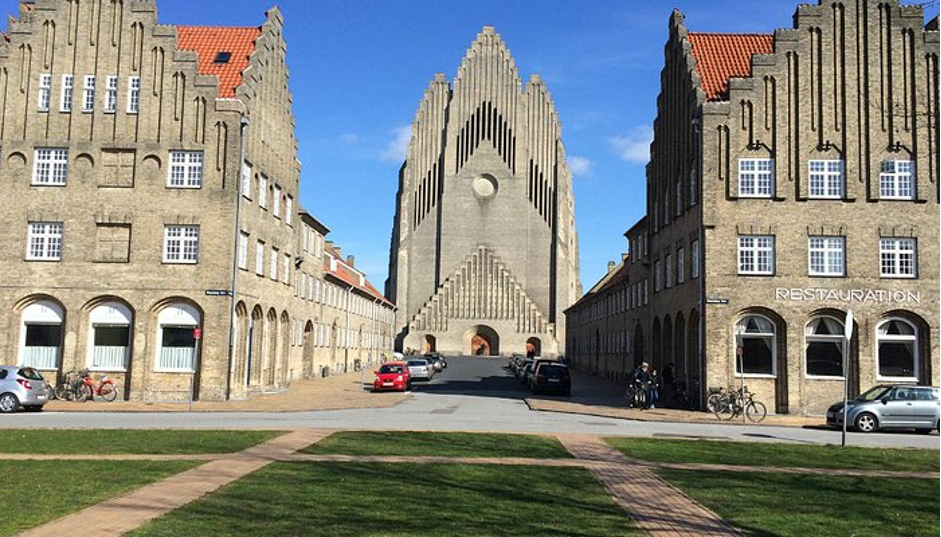
Grundtvig’s Church is an architectural gem located in the Bispebjerg area of Copenhagen, the capital of Denmark. Plans for the church were launched in 1913 but stalled due to the First World War. The church was designed by architect Peder Vilhelm Klint. The foundation stone was eventually laid in 1921, and after five years of construction, the church was inaugurated in 1927.
The architect also designed the housing surrounding the church to fit with the master plan and complement the church’s style. These homes were designed to provide a high quality of life at a lower cost, using the same yellow bricks and red tile roofs for the working-class people of the city.
Interestingly, Christianity arrived in Denmark in the 8th century, during the Viking era, when most of Europe had adopted various Christian sects. One of the first Christian missions to Denmark was in 710, led by Bishop Willibrord from England. Despite early exposure to the new faith, the Vikings still held on to their old Norse deities such as Odin and Thor.
By the time of King Harald Bluetooth, most of the Viking community had accepted Christianity. After the Reformation in mainland Europe, Lutheranism became more popular and was established as the main religion of Denmark.
The church is named after one of the most famous Danish Lutheran philosophers, Nikolaj Frederik Severin Grundtvig (1783 – 1872). Grundtvig was a philosopher, spiritual leader, and prolific poet and writer who left a lasting impact on Danish culture. He believed that Christian theology and ancient Nordic mythology were complementary in the psyche of the people of Denmark. He also advocated for a separation between the church and the secular realm of the state.
The church’s unique design is certainly striking. The West Façade resembles a traditional church organ, topped by a 49-metre-high bell tower. The inside of the church has a Gothic feel, with high, vaulted ceilings and seating for over 1,400 worshippers.
References:
1. “Christianity comes to Denmark,” Nationalmuseet. Accessed: January 15, 2026. https://en.natmus.dk/historical-knowledge/denmark/prehistoric-period-until-1050-ad/the-viking-age/religion-magic-death-and-rituals/christianity-comes-to-denmark/
2. Thomas Viggo Pedersen, Grundtvigs Kirke. Accessed: January 15, 2026. https://www.grundtvigskirke.dk/kirken/about-the-church


Add Comment