
After reciting Tashahhud, Ta`awwuz and Surah al-Fatihah, His Holiness, Hazrat Mirza Masroor Ahmad (aba) said that by the grace of Allah, the month of Ramadan has started. This month of fasting has been granted to us by God in order to strengthen our connection with Him and for us to see to our spiritual reformation.
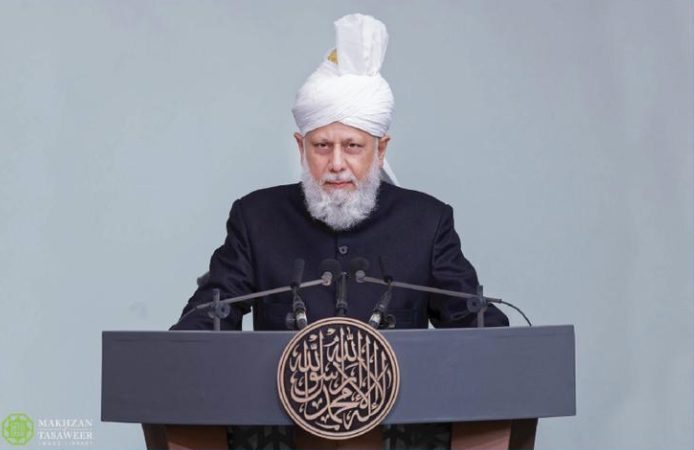
His Holiness (aba) prayed that may Allah enable every Ahmadi to truly benefit from this month. However, everyone must bear in mind that one can only attain true benefit when they seek to uphold and excel in their standards of love for God and His worship even after the month of Ramadan. It is then that we will be able to fulfil the purpose of our creation.
Learning Worship from The Prophets
His Holiness (aba) said that in the previous sermons, he has been mentioning incidents of the Holy Prophet’s (sa) love for God, his devotion to God’s worship, and then the Promised Messiah’s (as) love for God and his standard of worship. His Holiness (aba) said that this series will continue and he would present more incidents from the life of the Promised Messiah (as).
His Holiness (aba) said that it is a blessing that this series of incidents about a master and his servant’s love for God have led into Ramadan, giving us an opportunity to analyse ourselves in light of them so that we may improve our conditions. Thus, we should bear all of these incidents in mind and analyse ourselves against them and seek to improve our own conditions and standards in light of them. It should not be that we simply listen to and enjoy these incidents. Rather, they should be our guiding principle.
Always Thinking of God and His Rights
His Holiness (aba) said that in 1907, Maulvi Muhammad Abdullah was given a scrap of paper to discard, however that piece of paper had been written on by the Promised Messiah (as) and his blessed wife, and so rather than throwing that scrap of paper away he kept it safe with him. Later at some point, he said he lost it, however the person who gave him that scrap of paper, Amatul Rahman, had explained to him the background of what was written on that paper, which made it all the more special and which is why he has related this incident. Amatul Rahman recounted that one day, the Promised Messiah (as) and his wife tried an experiment: they wanted to see if they could close their eyes and write on a piece of paper. The Promised Messiah (as) closed his eyes and wrote, “Man should always fear God and pray to him five times a day.” This was the standard that the Promised Messiah (as) expected from his followers. The Promised Messiah’s (as) blessed wife wrote, “Mahmud is my beloved son, no one should trouble him.” She also wrote, “Mubarak Ahmad asks for biscuits!”
His Holiness (aba) said that even whilst in the relaxed environment of his home, when the Promised Messiah (as) wrote something without giving it much prior thought, it still pertained to imparting guidance. This is what sets those commissioned by God apart from others. He was concerned with establishing the love of God in others.
The Companionship of a Prophet is Like Boarding a Boat
His Holiness (aba) related another incident: the Promised Messiah (as) once intended to undertake a retreat of solitude outside of Qadian and also take the opportunity to see India. Hence, the Promised Messiah (as) decided to go to Sujanpur in Gurdaspur for this retreat of solitude. However, the Promised Messiah (as) was then informed by God that he should undertake this retreat of solitude in Hoshiarpur instead. And so, the Promised Messiah (as) made arrangements for his stay in Hoshiarpur and then set out on his journey on a small cart. Along the way there was a river which needed to be crossed by boat. While on the boat, the Promised Messiah (as) said to one of his companions who was accompanying him on this journey, ‘Remaining in the company of a person completely devoted to God is like embarking upon this boat; there is both the hope of making it to the other side, or the risk of drowning.’ The companions heard this but did not think much of it. However, of the three companions accompanying the Promised Messiah (as), one ultimately became apostate. It was then that the companion to whom the Promised Messiah (as) made this statement, Mian Abdullah Sinauri, understood what this meant.
Forty Days of Solitude in Hoshiarpur
His Holiness (aba) said that once in Hoshiarpur, the Promised Messiah (as) announced his intention to spend forty days in solitude and that after the completion of the forty days, he would remain for another twenty to meet people and answer their questions. He had also instructed the three companions who were with him whom he had assigned various logistical duties that they should only interact with him to the extent that he interacted with them and nothing more. The Promised Messiah (as) would offer his prayers in the upper portion of the home, and for the Friday Prayer, he instructed that a mosque should be located on the outskirts of town where they could offer the Friday Prayer in solitude away from others.
The 20th of February – An Auspicious Day
His Holiness (aba) said that once, Mian Abdullah Sinauri went to place food outside the Promised Messiah’s (as) door, and the Promised Messiah (as) himself initiated a conversation, saying that in those days, God had opened immense bounties for him, and at times God would converse with him for lengthy periods of time. He said that writing these incidents would take up many pages. It was during the same retreat of solitude that the Promised Messiah (as) received the prophecy regarding the Promised Son, which would be fulfilled with great splendour in the person of Hazrat Mirza Bashiruddin Mahmud Ahmad (ra), who went on to become the Second Caliph of the Ahmadiyya Muslim Community.
His Holiness (aba) said that today, 20 February marks the day when this prophecy was announced. And it is the work of God that this incident came before His Holiness (aba) on this day among the series of incidents he has been presenting and that he was able to present this incident and the background of the prophecy on the 20th of February, a day which is marked as the Day of the Prophecy of the Promised Reformer (Musleh Maud).
Those Close to God are Shown Visions
His Holiness (aba) said that an incident took place on the journey back from Hoshiarpur. Along the way, the Promised Messiah (as) stopped to rest for a while. At the place where he stopped was the grave of someone who was known to be a renowned saint. The Promised Messiah (as) went to the grave and raised his hands in prayer for the deceased. Upon leaving from the grave, the Promised Messiah (as) said that as he was praying, he was shown that same saint in a vision sitting before him. He had large eyes and dark skin. The Promised Messiah (as) then found a man from the local area and asked him about the saint. The man said that the saint had lived a hundred years ago and his appearance is described as having large eyes and dark skin – exactly the image which the Promised Messiah (as) had seen in his vision. It is said that those who are extremely close to God are shown such visions.
His Holiness (aba) said that whilst offering prayers during his retreat of solitude, the Promised Messiah (as) was shown a vision in which he was told, ‘Blessed is he who is in it, and who is around it.’ The Promised Messiah (as) explained that ‘who is in it’ referred to himself and ‘who is around it’ referred to his companions who were with him. There is a lesson in this as well. One of the people who was with the Promised Messiah (as) was Fateh Khan, who at the time was extremely devoted to the Promised Messiah (as), however he later faltered and became apostate. Thus, no matter what, one should always pray that they meet a good end.
His Holiness (aba) said that during his retreat, the Promised Messiah (as) said that God spoke to him and said such things that many around him would not be able to understand and if he were to tell them then they would falter.
What did the Prayers of the Promised Messiah (as) Look Like?
His Holiness (aba) said that the manner of the Promised Messiah’s (as) prayer has been described as follows: when standing the Promised Messiah (as) would tie his hands upon his navel, and the middle finger of his right hand would reach just before his left elbow. When supplicating, his forehead would be on the ground between his hands, with his fingers facing the Ka`bah. When he got up from supplication, he would adjust his turban, as it would typically be loose.
His Holiness (aba) said that when the plague initially struck, the Promised Messiah (as) went to stay at an orchard along with his family, as it was best to be in an open area. The companions assigned to stand guard at night record that during their patrol, they would often see the Promised Messiah (as) offering prayers. In fact they said that they did not know when the Promised Messiah (as) would have slept as he was always seen to be offering prayer.
The Importance of Pre-dawn Voluntary Prayers (Tahajjud)
His Holiness (aba) said that whilst offering the pre-dawn voluntary prayer (tahajjud), at times the Promised Messiah (as) could be heard constantly repeating, ‘Guide us to the right path’. Hence, we too should repeat this prayer so that we may remain on the right path. Similarly, it is recorded that the Promised Messiah (as) was once seen offering the pre-dawn voluntary prayer at three in the morning. One of his companions saw him and also offered the pre-dawn voluntary prayer a little distance away, with the thought that he would seek to stand in prayer as long as the Promised Messiah (as). However, the Promised Messiah (as) would stand for so long in prayer that just after two units of prayer the companion grew tired and could no longer stand in prayer. Such was the manner in which the Promised Messiah (as) sought to do justice to worship.
His Holiness (aba) said that once someone asked the Promised Messiah (as) what one should do if they find themselves unable to offer the pre-dawn voluntary prayer? The Promised Messiah (as) said that in that case, at the very least, one should seek forgiveness from Allah by reciting istighfar (prayer for seeking forgiveness from Allah) and to constantly remain engaged in the remembrance of Allah. Doing so would enable one to ultimately begin offering the pre-dawn voluntary prayer. The Promised Messiah’s (as) answer was not a replacement to offering the pre-dawn voluntary prayer, rather his answer was beautiful in that he provided a means which one could employ to help lead them towards offering the pre-dawn voluntary prayer.
His Holiness (aba) said that during the month of Ramadan, one should especially strive to offer the pre-dawn voluntary prayer. Even though the tarawih prayers are offered in Ramadan, they do not serve as a complete substitute for the pre-dawn voluntary prayer. Thus, even those who do offer the tarawih prayer should strive to offer some length of the pre-dawn voluntary prayer, be it two or four units (raka`at).
Remaining in a State of Purity
His Holiness (aba) said that it is recorded that the Promised Messiah (as) would always maintain his ablution. It was observed that whenever he would leave to answer the call of nature, he would always perform ablution thereafter. It is recorded that the Promised Messiah (as) would constantly recite ‘Holy is Allah and to His is the praise, Holy is Allah the Most Great’. Furthermore, it is recorded that in the early days, the Promised Messiah (as) would always be the first person in the mosque. Once, someone thought to make an effort to get to the mosque before him, but despite this effort, when he got to the mosque, the Promised Messiah (as) was already there.
The Spiritual Glow of the Promised Messiah (as)
His Holiness (aba) said that once the Promised Messiah (as) had set out to attend a legal proceeding when it began raining along the way. So, the Promised Messiah (as) went towards the home of a man who lived in that mountainous area which was not too far from the path. The Promised Messiah’s (as) travel companion went ahead to seek the homeowner’s permission for the Promised Messiah (as) to enter, however the homeowner refused. This led to a dispute between the homeowner and the companion, and eventually, the homeowner began cursing at the companion. Upon hearing this dispute, the Promised Messiah (as) stepped forward, and he said that as soon as his eyes met the eyes of the homeowner, before he could even say anything, the homeowner bowed his head and humbly said that the only reason he did not let strangers enter his home was because he had a young daughter, however he told the Promised Messiah (as) that he could enter. The Promised Messiah (as) and this homeowner were strangers to each other, however the Promised Messiah’s (as) countenance emanated such a strong glow as a result of his worship and servitude to God that even this simple man was able to recognise it immediately upon seeing the Promised Messiah (as).
A Devotion to Prayer Like None Other
His Holiness (aba) said that even when engaged in court cases, a time which would certainly be one of worry and stress for anyone, regardless of whether they are the plaintiff or defendant – such matters never deterred the Promised Messiah (as) from offering prayer. In fact, whenever the Promised Messiah (as) was in the midst of a court case, he always ensured to offer his prayers on time, regardless of the fact that he could have been summoned into the courtroom at any time.
Detachment from the Material World in Pursuit of God
His Holiness (aba) said that once during his youth the Promised Messiah (as) wrote a letter to his father. In one part of the letter, he expressed that he saw every few years there would be an outbreak of some form of a pandemic in a part of the world. He expressed that to him this certainly pointed to being a sign of the latter days and end times. The Promised Messiah (as) expressed that as a result, he had become turned away from worldliness. His Holiness (aba) said that we see similar conditions in the world today, and so we should focus a great deal on establishing a strong connection with God.
His Holiness (aba) said that the Promised Messiah (as) indeed abandoned many of the comforts of the world and even wealth which he could easily have kept in his possession, all for the sake of his faith. There is an incident that once in Qadian, a new Muslim who was a farmer expressed to the Promised Messiah (as) that there was a large harvest of crops which he had to distribute and requested permission to leave. The Promised Messiah (as) responded by saying that he himself had abandoned much of the world for the sake of the faith, so he advised the new Muslim that he too should remain in Qadian for a few more days to focus on improving his spiritual condition and then tend to his crops. Thus, the Promised Messiah (as) taught that one must see their own circumstances, whereby they should not become fully immersed in the world, nor should they completely become cut off from the world. No matter what, one must always remain mindful of God and never abandon Him.
Prayers for Ramadan
His Holiness (aba) prayed that may Allah enable us to do justice to offering true worship during Ramadan, and may He enable us to increase in His love so that we may attain full benefit from Ramadan and so that these blessings may continue after Ramadan as well. May Allah enable us to become true reflections of what it means to be a true believer.
His Holiness (aba) made an appeal for prayers especially during the days of Ramadan for those Ahmadis who are tied up in false cases lodged against them on account of their faith. May Allah create ease for them. His Holiness (aba) said to pray for the Muslim world and for the world at large to be saved from any sort of destruction. May Allah protect the innocent against this evil, and if a war is destined to occur then may Allah always protect the innocent and bring the unjust to justice.
Summary prepared by The Review of Religions



Add Comment