
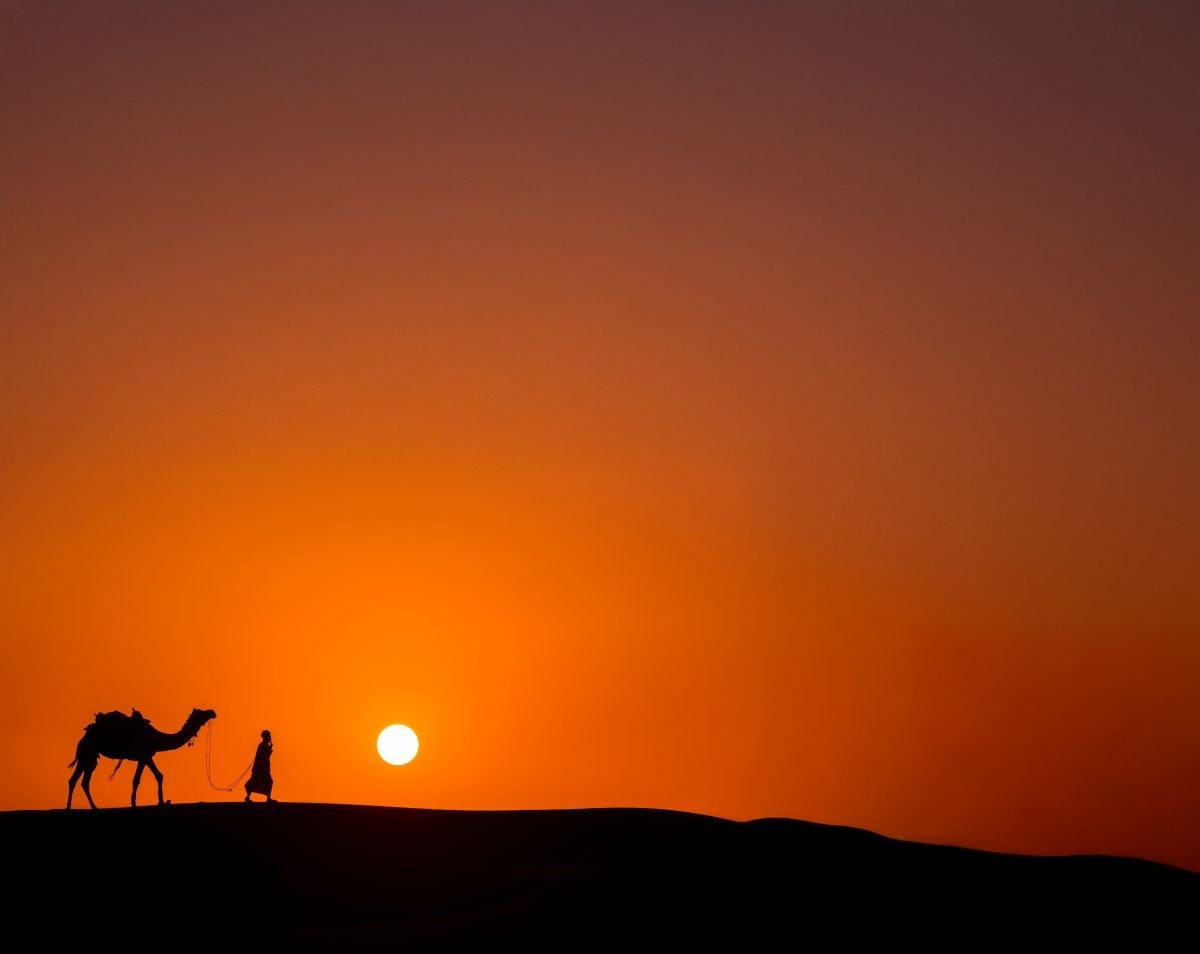
© Shutterstock
Sarmad Naveed, Illinois, USA
At Islam’s advent, people were largely shaped by the harsh conditions, simplicity, and traditions of desert life. Naturally, this was also reflected in their clothing, which represented their identity and status. From the humble wraps of the Bedouins to the more refined robes of the townspeople, clothing in Arabia was more than just protection from the elements; it was a marker of culture and way of life.
The common pre-Islamic Arab was characterised by simplicity and austerity. Often, the only article of clothing a person owned was a single sheet of cloth that would be tied around the waist. On the other hand, the comparatively few wealthy people owned actual shirts, and the highest-ranking members of society would own a robe.[1]
In the times leading up to the era of the Holy Prophet Muhammad (sa), there were slight adaptations in the style of dress. Generally, people would wear an undergarment, a qamis [or shirt], a long dress or tunic and an outer wrap or cloak, while footwear was primarily simple sandals and leather shoes.
Men and women wore similar items of clothing; the distinction in their attire lay in the way in which they wore those items. For example, women would adopt a certain style of wrapping or draping themselves. They also distinguished themselves by the style of shoes they wore, and by adorning themselves with jewelry.
While the objectification of women had been the norm in pre-Islamic Arabia, the advent of Islam saw unparalleled protection of women, teaching them how to adapt their outer coverings in a manner that ensured their modesty and safeguarded them from being objectified. Thus, the Holy Qur’an taught, ‘…and that they draw their head-coverings over their bosoms’[2] and ‘…they should draw close to them portions of their loose outer coverings. That is nearer that they may this be distinguished and not molested.’[3] Thus, Islam simultaneously upheld women’s identity though their attire while also ensuring their due protection.
The qamis which served as the shirt would typically range in length from either the mid-thigh or extend to the full length of the body, with rounded necks, sleeves of various lengths, and occasionally slits down the front.
The real variety in the Arabian dress came in the outer garments worn over the qamis. For example, there was the thawb, a long gown or tunic; the jubba, which was a woolen tunic, often imported from Syria or other areas of the Byzantine Empire; the hulla, a flowing coat; and the more luxurious qaba, which was a buttoned robe typically made of Persian brocade.[4]
The styles and types of fabrics varied depending on the tribe and place. Typically, the wealthier a person was, the finer the fabrics they wore – often imported from places like Syria or Persia. However, with the progress of Islam, modesty became the predominant trend in fashion. This manifested as an outer mantle becoming standard practice, especially when out in public.
The practice of covering one’s head was already customary in Arabia. Both men and women would typically pull the mantle over their head. For men, this also took the form of an imamah or turban, which was typically a cloth wrapped around the head. According to an Arab proverb, the turban was considered the ‘crown of the Arabs.’
The Holy Prophet Muhammad (sa) himself dressed with grace and simplicity. He preferred clothes which were white, calling it the purest of colours, and encouraged others to don the same.[5] Yet his wardrobe was not without variety. He is recorded as having worn a red mantle,[6] green garments,[7] a black turban during the Conquest of Makkah,[8] and a black woolen blanket.[9] On some occasions, he donned a Syrian cloak with tight sleeves reaching his wrists.[10] Despite this diversity, he expressed a particular fondness for the qamis,[11] which closely resembles the modern-day thawb.
Through his teachings, and by setting his own example, the Holy Prophet (sa) exemplified simplicity yet elegance in dress. He also did away with notions of esteem and excellence based on the way a person dressed. For example, the nobles of Makkah often wore longer garments which dragged behind them, a symbol of their wealth and stature. However, the Holy Prophet (sa) taught that on the Day of Judgement, God would not even look towards people whose clothes dragged behind them out of conceit.[12] At the same time, the Holy Prophet (sa) also taught that there is a balance to be struck, as is the hallmark of Islam. For example, once, when someone asked the Holy Prophet (sa) about wanting to wear nice clothes, he replied, ‘God is beautiful, and He loves beauty.’ [13]The Holy Prophet (sa) thus taught that while there was certainly no harm in wearing beautiful clothes or dressing nicely according to one’s means, it should not be a basis for arrogance or superiority.
Teachings like these set the fundamental basis for dress in Arabia – cleanliness, practicality, personality, and above all, modesty.
About the Author: Sarmad Naveed is a missionary of the Ahmadiyya Muslim Community who graduated from the Ahmadiyya Institute for Languages and Theology in Canada. He serves as Online Editor and is on the Editorial Board for The Review of Religions, and also coordinates the Facts from Fiction section. He has also appeared as a panellist and host of programmes on Muslim Television Ahmadiyya (MTA) International such as ‘Ahmadiyyat: Roots to Branches.’
ENDNOTES
1. Hazrat Mirza Bashir Ahmad (ra), The Life and Character of the Seal of Prophets (sa), Vol. 1, p. 67.
2. The Holy Qur’an, 24:32.
3. The Holy Qur’an, 33:60.
4. Yadida Stillman, Arab Dress: A Short History from the Dawn of Islam to Modern Times, pp. 10-12.
5. Sunan Abi Dawud, Hadith 4061.
6. Sahih al-Bukhari, Hadith 5848.
7. Riyad al-Salihin, Hadith 782.
8. Sunan Ibn Majah, Hadith 3586.
9. Sahih Muslim, Hadith 2081.
10. Sahih al-Bukhari, Hadith 363.
11. Sunan Abi Dawud, Hadith 4025.
12. Sahih al-Bukhari, 5783.
13. Sahih Muslim, Hadith 91a.
Add Comment