
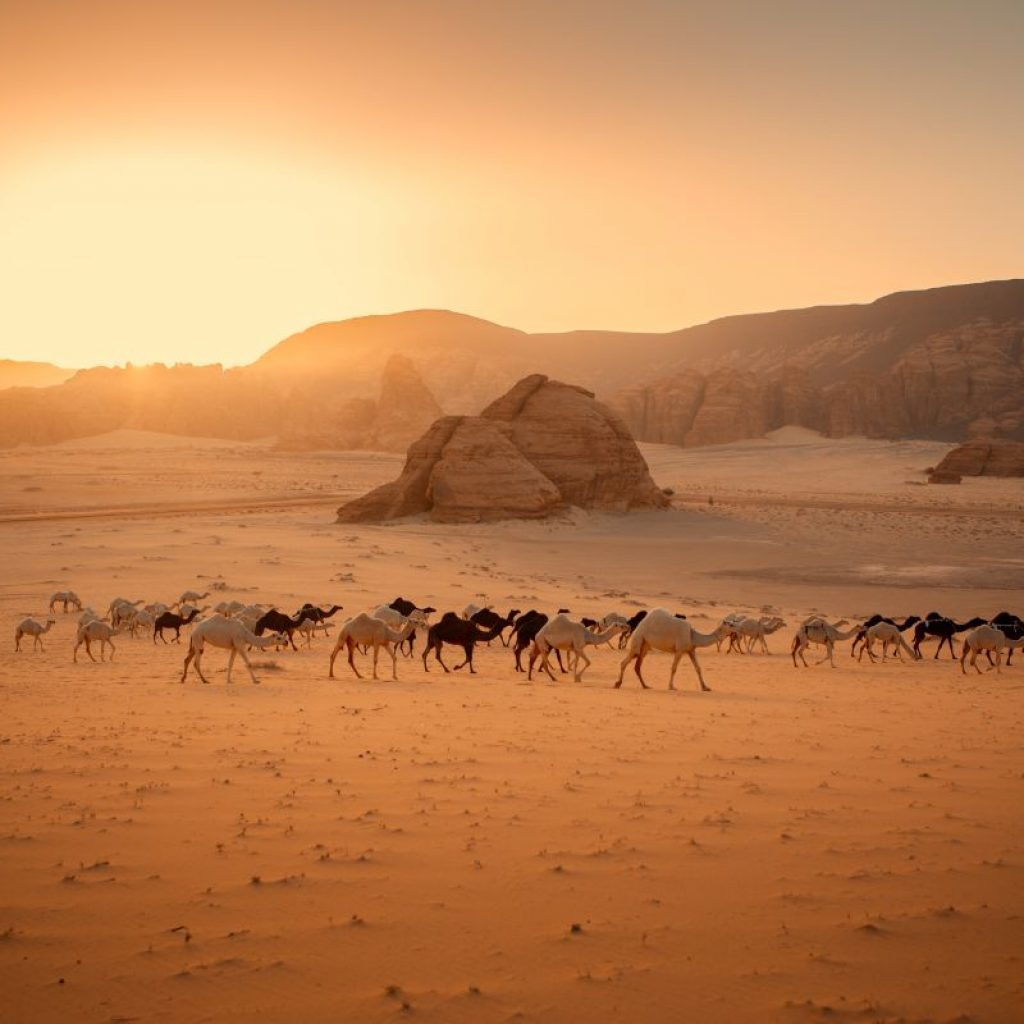
© Shutterstock
Sarmad Naveed, Illinois, USA
True light shines brightest in the darkest of places. This has perhaps never held truer than it did in the case of the darkness that had overcome Makkah and Arabia, the very place set to be illumined by the light of Islam.
Describing the pre-Islamic state of the world at large, the historian J.H. Dennison writes:
‘It seemed then that the great civilisation which had taken four thousand years to construct was on the verge of disintegration, and that mankind was likely to return to that condition of barbarism where every tribe and sect was against the next, and law and order were unknown.’He goes on to describe it as a ‘civilisation like a gigantic tree whose foliage had over reached the world’ which ‘stood tottering’ and was ‘rotted to the core.’[1]
It was against this backdrop of societal depravity that the greatest revolution known in the history of humankind was set to transpire.
Tribal Lifestyle
Pre-Islamic Arabia had no centralised government or unified authority. Every tribe functioned as an autonomous entity under its own chief, often chosen for his leadership and capability.[2]
Allegiance to one’s tribe was paramount; loyalty and honour were fiercely defended – often to a fault – as wars could erupt over the most trivial disputes. One infamous example is the prolonged conflict between the tribes of Banu Taghlib and Banu Bakr, which began when a camel accidentally trampled the eggs of a bird which a tribesman had vowed to protect.[3]
While quick-tempered and warlike, the Arabs also possessed qualities of generosity and hospitality, which were held in high esteem. Such treatment, however, was dependent upon status, and status was often based upon ancestry. Those of noble lineage were revered, while slaves and those of less noble descent were despised.
In this contentious tribal time, Islam brought a teaching which tried to reduce inequality and unfair treatment by comprehensively balancing the scales of what tribal affiliation meant:
‘O mankind, We have created you from a male and a female; and We have made you into tribes and sub-tribes that you may recognise one another. Verily, the most honourable among you, in the sight of Allah, is he who is the most righteous among you.’[4]
Education
Though literacy existed, it was rare; most Arabs could neither read nor write. In a society with a largely oral tradition, eloquence was the highest art form. Poetry served as both entertainment and social commentary, which meant poets were held in high regard. In fact, the Arabs were so proud of their own linguistic prowess that they called non-Arabs ‘Ajami, meaning ‘mute’ or ‘dumb’.[5]
Despite their lack of formal education, the Arabs prided themselves on their sharp intellect and extraordinary memory, preserving their lineage and history through generations of oral narration. Yet formal education and literacy remained elusive.
When the Holy Prophet Muhammad (sa) began his mission, he ignited a movement that elevated knowledge to a spiritual pursuit. He established systems for teaching literacy, assigning those who could read to instruct others. The Holy Prophet (sa) declared that the pursuit of learning was compulsory for every Muslim.[6] His teachings transformed an illiterate nation into a civilisation that would become a beacon of learning for centuries to come.
The Status of Women
The plight of women in pre-Islamic Arabia was dire. They were treated as property, with no voice, no rights, and no control over their lives. Their objectification was further highlighted in Arabian poetry, which often, regardless of the topic, would begin with recounting intimate encounters and describing women in the most demeaning ways.
Men could marry as many women as they wished, inherit their father’s wives, or even marry two sisters at once. Divorce was the husband’s prerogative alone, and physical discipline was considered his right. Women were excluded from decisions regarding their children and barred from inheriting property. In some tribes, daughters were buried alive at birth out of shame.[7]
With the advent of Islam, the Holy Prophet (sa) declared that men and women are equal by virtue of their humanity. He safeguarded women’s rights by granting them inheritance, ownership of property, and the right to seek divorce. A man could no longer spend from a woman’s wealth without her consent. The Holy Prophet (sa) emphasised their dignity, saying that a father who patiently and lovingly raised and provided for his daughters would be shielded from the hellfire.[8] He further elevated the status of women by declaring that half the faith could be learned from his wife A’ishah (ra).
Slavery
Slavery was a global institution long before Islam, and Arabia was no exception. Slaves were regarded as property and symbols of wealth for their masters, who often owned dozens. In fact, the progenies of slaves would also automatically be considered the property of the masters. They were subjected to cruelty and abuse, and those who embraced Islam faced even harsher persecution.[9]
With the rise of Islam came a new dawn of hope. The Qur’an enjoined the freeing of slaves as an act of piety and atonement. The Holy Prophet Muhammad (sa) treated slaves with compassion and equality, addressing them as ‘brothers’ and instructing Muslims to feed and clothe them as they would themselves.[10] Many of the earliest converts to Islam were slaves, drawn by the Holy Prophet’s (sa) message of justice and human dignity. Through his teachings, the systematic liberation of slaves began, gradually dismantling a practice that had defined societies for millennia.
And so, through the teachings of Islam and the Holy Prophet Muhammad (sa), the fragmented, chaotic and darkened life of Arabia was united, purified, and illumined.
About the Author: Sarmad Naveed is a missionary of the Ahmadiyya Muslim Community who graduated from the Ahmadiyya Institute for Languages and Theology in Canada. He serves as Online Editor and is on the Editorial Board for The Review of Religions, and also coordinates the Facts from Fiction section. He has also appeared as a panellist and host of programmes on Muslim Television Ahmadiyya (MTA) International such as ‘Ahmadiyyat: Roots to Branches.’
ENDNOTES
1. J.H. Dennison, Emotions as the Basis of Civilisation, pp. 265-269.
2. Hazrat Mirza Bashir Ahmad (ra), The Life and Character of the Seal of Prophets (sa), Vol. 1 (Islam International Publications Ltd., 2018), 67.
3. Ibid, pp. 71-72.
4. The Holy Qur’an, 49:14.
5. Hazrat Mirza Bashir Ahmad (ra), The Life and Character of the Seal of Prophets (sa), Vol. 1 (Islam International Publications Ltd., 2018), 69.
6. Mishkat al-Masabih, Hadith 218.
7. Hazrat Mirza Bashir Ahmad (ra), The Life and Character of the Seal of Prophets (sa), Vol. 1 (Islam International Publications Ltd., 2018), 76.
8. Sunan Ibn Majah, Hadith 3669.
9. Hazrat Mirza Bashir Ahmad (ra), The Life and Character of the Seal of Prophets (sa), Vol. 2 (Islam International Publications Ltd., 2018), 76.
10. Sahih al-Bukhari, Hadith 30.


Add Comment