
Summary prepared by The Review of Religions
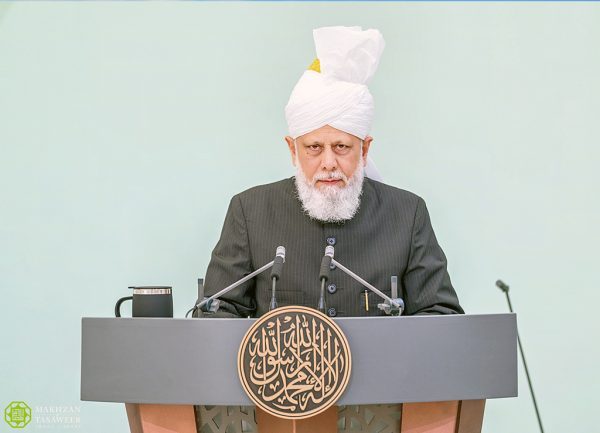
After reciting Tashahhud, Ta‘awwuz and Surah al-Fatihah, His Holiness, Hazrat Mirza Masroor Ahmad (aba) said that he would continue presenting narrations regarding the Holy Prophet’s (sa) generosity.
The Holy Prophet’s (sa) Unmatched Level of Gifting Others
His Holiness (aba) said that once, some people asked the Holy Prophet (sa) for wealth, and he granted it to them. The people kept asking him for wealth again and then again until the Holy Prophet (sa) had nothing left. The Holy Prophet (sa) said he would never hide his wealth from people and that one who refrains from begging will be saved by God. The Holy Prophet (sa) said that one who seeks to become independent from the wealth of the world will be granted independence by God. He said that one who strives hard to be patient will be granted patience by God; and patience is the greatest source of reward.
His Holiness (aba) said that once while on a journey, Hazrat Abdullah bin Umar (ra), son of Hazrat Umar (ra), had a very strong camel who would outpace all the other camels. However, whenever Hazrat Abdullah’s (ra) camel would get ahead of all the others, Hazrat Umar (ra) would scold him and warn him against going ahead of the others. In reality, Hazrat Umar (ra) did not like for anyone to go ahead of the Holy Prophet (sa).
Seeing this, the Holy Prophet (sa) asked Hazrat Umar (ra) to sell the camel to him. At first, Hazrat Umar (ra) said that the camel was the Holy Prophet’s (sa) to take if he so chose, refusing to take any money from him; however, the Holy Prophet (sa) insisted, and so Hazrat Umar (ra) sold the camel to him.
After taking possession of the camel, the Holy Prophet (sa) gifted it to Hazrat Abdullah bin Umar (ra), saying that now the camel belonged to him, he could do with it, and ride it as he pleased. In this way, the Holy Prophet (sa) not only generously gave a gift in a beautiful manner, but also sent the message that this was nothing but a worldly matter, and there was nothing to mind if the camel outpaced the others, even his own. And now, even if the camel did go ahead, then people would at least say that the camel gifted by the Holy Prophet (sa) was the one going ahead.
His Holiness (aba) said that once during a journey, Hazrat Jabir’s (ra) camel became lazy and slow. Upon this, the Holy Prophet (sa) got down from his mount and pulled the camel by its reins and told it to go forward, upon which the camel began moving at a fast pace. The Holy Prophet (sa) asked Hazrat Jabir (ra) whether he was married, to which he replied he was; and so the Holy Prophet (sa) advised him to be kind in his home. Then, the Holy Prophet (sa) asked to purchase the camel, and so Hazrat Jabir (ra) sold it to him. When Hazrat Jabir (ra) returned, the Holy Prophet (sa) instructed that Hazrat Jabir (ra) be given the amount that he sold the camel for. Then, the Holy Prophet (sa) called Hazrat Jabir (ra) and told him that not only could he keep the amount for which the camel was sold, but Hazrat Jabir (ra) could also keep the camel.
His Holiness (aba) said that once, someone went to the Holy Prophet (sa) and asked him for wealth. The Holy Prophet (sa) said that he did not have anything to give at that time; however, he advised that the man could go and buy whatever he wished using the Holy Prophet’s (sa) name, and then whenever the Holy Prophet (sa) received wealth he would pay for the things he bought. Hazrat Umar (ra) said to the Holy Prophet (sa) that he had already given wealth to this man and said that he was not responsible for giving him wealth that he did not yet even have. The Holy Prophet (sa) did not like this comment. A man from among the Ansar [natives to Madinah] said that the Holy Prophet (sa) should give wealth without fear of poverty, as God would provide. The Holy Prophet (sa) smiled and said that this was exactly what he had been commanded by God.
His Concern for the People’s Moral Training
His Holiness (aba) said that not only was the Holy Prophet (sa) generous, but he was also compassionate and tended to the people’s moral training at the same time. Once, a Bedouin asked the Holy Prophet (sa) to provide wealth for his needs, perhaps in the matter of blood money. The Holy Prophet (sa) granted him some wealth. The Holy Prophet (sa) asked the Bedouin whether he had been kind to him, to which the Bedouin replied that he had not.
Some Muslims became angry upon this and were about to seize him; however, the Holy Prophet (sa) stopped them. Then, the Holy Prophet (sa) went home and invited the Bedouin to join him. There, the Holy Prophet (sa) said that he had given him what he asked for, yet he still said he was not kind to him. Then the Holy Prophet (sa) gave him more wealth and asked him whether he had now treated him well. The Bedouin said that he had, and then the Bedouin prayed for the Holy Prophet (sa) and his family. The Holy Prophet (sa) said that the Bedouin’s earlier statement had caused the companions to become displeased. So the Bedouin should go out and say to them what he had just said to the Holy Prophet (sa), so as to ease the companions’ hearts. The Holy Prophet (sa) then said that the example of him and the Bedouin was like that of a traveller and his camel who flees, and it flees further the more people run after it.
Upon this, the owner of the camel tells everyone to leave him and his camel because he is kinder to it and knows it well. Then, the camel’s owner took some grass in his hand and approached the camel. The Holy Prophet (sa) said that had he allowed the companions to seize the Bedouin, then he would have entered the Hellfire; however, he saved him from this.
His Paying of Debts of Those Who Passed Away
His Holiness (aba) said that whenever there was a funeral of a person who had debts, the Holy Prophet (sa) would ask whether he had left any wealth to pay off those debts. If he had, the Holy Prophet (sa) would offer the funeral prayer. If he had not, the Holy Prophet (sa) would not have. Once God had granted victories to the Holy Prophet (sa), he said that he was closer to Muslims than to their own families. And so, he said that if anyone were to die who still owed debts, he would take responsibility for paying them. If that person had left wealth behind, then it would go to his heirs.
His Holiness (aba) said that once, the Holy Prophet (sa) told Hazrat Zubair (ra) that he should have his run his horse as much as it could and all the land it traversed would be his. At one point the horse stopped, and from there Hazrat Zubair (ra) threw the whip that was in his hand. The Holy Prophet (sa) instructed that Hazrat Zubair (ra) should be given land all the way to where his whip had landed.
His Holiness (aba) said that at the Battle of Tabuk, the Holy Prophet (sa) came into possession of a beautiful horse whose voice he especially liked. A man approached the Holy Prophet (sa) and asked him for the horse, which the Holy Prophet (sa) gave to him despite liking it so much.
His Way of Establishing Bonds with Chieftains
His Holiness (aba) said that upon receiving the spoils of war from the Battle of Hunain, the Holy Prophet (sa) first distributed it as a manner of establishing bonds with certain chieftains and prominent people. When Abu Sufyan saw a pile of wealth before the Holy Prophet (sa), he said that the Holy Prophet (sa) had become the wealthiest person in Arabia. Upon this, the Holy Prophet (sa) smiled and gave Abu Sufyan a great deal of wealth. Then, Abu Sufyan asked the Holy Prophet (sa) to also grant wealth to his sons, which the Holy Prophet (sa) did generously. Then, Abu Sufyan said that the Holy Prophet (sa) was extremely kind. He said he had battled the Holy Prophet (sa), and the Holy Prophet (sa) was excellent in warfare. Then he made peace with the Holy Prophet (sa) and said the Holy Prophet (sa) was excellent at making peace.
His Holiness (aba) said that the manner in which the spoils from the Battle of Hunain were distributed answers the allegation that Muslims undertook these battles for the sake of attaining spoils and wealth. Had this been true, then the spoils from the Battle of Hunain would have immediately been distributed among the Muslims. However, the very first people to receive a share from these spoils were not Muslims but chieftains and leaders, in order to build connections with them. Then, the Holy Prophet (sa) did not keep anything for himself, and relatively gave much less to the companions.
His Holiness (aba) said that after the Battle of Hunain, people approached the Holy Prophet (sa) asking for wealth, and he gave it to them until there was nothing left. The Holy Prophet (sa) asked the people whether they wished for him to become miserly. He said that by God, he was not miserly or fearful, nor did he lie.
His Wisdom When Giving to Others
His Holiness (aba) said that the Holy Prophet (sa) showed an excellent example of not only being generous and giving to anyone who asked, but also employed wisdom when doing so. Once, the Holy Prophet (sa) was distributing wealth among the people but was not giving anything to one person. When asked why, the Holy Prophet (sa) said, “O Muslim,” and repeated this again when he was asked the same question again. Then, the Holy Prophet (sa), when asked a third time, said that when he distributed wealth, he did so to save certain people from the fire, as their faith was relatively weak and not to others who were stronger in faith, as they did not need it. Thus, the Holy Prophet (sa) also taught to tend to those who were weaker, so that they would not falter on account of their weakness. The Holy Prophet (sa) taught four lessons in this incident. First is that there is a difference between being a Muslim and having faith; one is apparent while the other is a matter of the heart. The second lesson was using the right words and the right time. The third was to be mindful of people’s sentiments. Fourth was not to speak in a manner that would become the means of someone else faltering in their faith.
His Holiness (aba) said that the Holy Prophet’s (sa) generosity also opens a window into other aspects of his moral character as well. Just as his teaching was balanced, so too were his actions. His Holiness (aba) prayed that may Allah enable everyone to ponder and act upon every aspect of his life and strive to fashion our lives in a way that follows his examples and seeks to attain the pleasure of God.



Add Comment