
Summary prepared by The Review of Religions
After reciting Tashahhud, Ta‘awwuz and Surah al-Fatihah, His Holiness, Hazrat Mirza Masroor Ahmad (aba) recited the following verses of the Holy Qur’an:
‘Those who spend their wealth by night and day, secretly and openly, have their reward with their Lord; on them shall come no fear, nor shall they grieve.’ (The Holy Qur’an, 2:275)
‘And in their wealth was a share for one who asked for help and for one who could not.’ (The Holy Qur’an, 51:20)
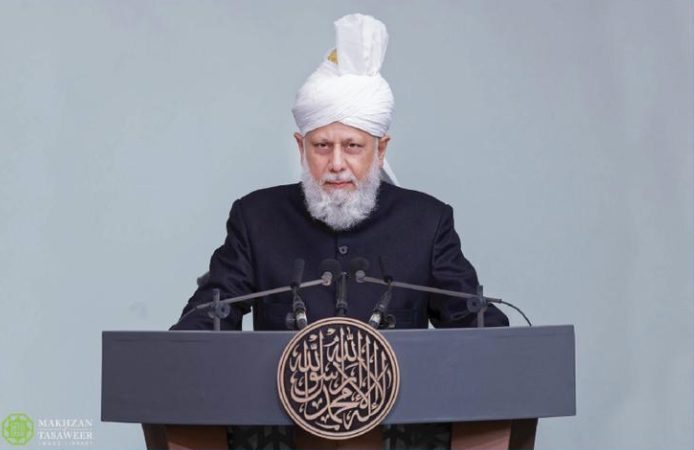
His Holiness (aba) said that he would speak about the Holy Prophet’s (sa) generosity. Narrations show how the Holy Prophet (sa) constantly drew the attention of believers towards being generous and how he established his own example in this regard, in fulfilment of the teachings of God Almighty as imparted in the Holy Qur’an. Indeed, every aspect of the Holy Prophet’s (sa) life was an embodiment of the moral teachings found in the Holy Qur’an. It was thus that his wife, Hazrat A’ishah (ra) said of the Holy Prophet (sa), ‘His morals were the Holy Qur’an.’
A Prayer for Protection from Miserliness
His Holiness (aba) said it is recorded that the Holy Prophet (sa) would pray to be safeguarded against becoming miserly, lazy, having the worst of life, and from the torment of the grave, and from the trials of this life and death.
The Generous Gain Nearness to God
His Holiness (aba) said that the Holy Prophet (sa) advised believers never to keep their money pouch closed; rather, they should keep it open, otherwise wealth would be withheld from them. In other words, one should spend and help others. Similarly, the Holy Prophet (sa) advised against counting every penny when giving in charity; otherwise, God would also be mindful of every penny when bestowing wealth upon them.
His Holiness (aba) said that once the Holy Prophet (sa) said that a person who is generous is close to Allah, close to heaven, close to people and distant from the fire. A person who is miserly is distant from Allah, distant from heaven, distant from the people and near the fire. An ignorant person who gives charity is dearer to Allah than a miserly person who worships.
His Holiness (aba) said that the Holy Prophet (sa) said that a person who deceives, a miserly person, and a person who constantly reminds others of their favours will not enter paradise. Similarly, the Holy Prophet (sa) said that a believer is simple in nature and generous while a sinner is deceptive and impure. Here, simplicity does not mean someone who is dull; rather, it means one who avoids quarrels, is kind and is someone who is worthy of respect from others.
His Holiness (aba) said that the best wealth one has is that which is spent and given as charity to others, as that is the wealth which will be multiplied in the hereafter. The Holy Prophet (sa) said that it is permissible to envy only two types of people: those who are granted wealth by God and are given the ability to spend it in charity openly, and those who are given wisdom and use that wisdom to make decisions and direct their actions.
The Best Way to Use One’s Wealth
His Holiness (aba) said that the Holy Prophet (sa) advised that one should certainly use their wealth to fulfil their needs and that which is in excess in charity. Similarly, the wealth one has for themselves is not the best wealth they own; rather, the wealth that they send forward for others is even better.
His Holiness (aba) said that once, the Holy Prophet (sa) saw a heap of dates before Bilal (ra) and asked him whether he did not fear that the heat of the hellfire would come and envelop this wealth? The Holy Prophet (sa) then advised him to continue spending his wealth and never to fear poverty or hunger, for God is present to provide.
His Holiness (aba) said that he was merely the distributor of wealth while God Almighty Himself was the provider. This was attested to by his wife, Hazrat Khadijah (ra), who said at the time that, when the Holy Prophet (sa) received his first revelation, he helped the poor and those going through difficulty.
Two Qualities that Cannot Coexist in a True Believer
His Holiness (aba) said that the Holy Prophet (sa) described that a believer can never have two qualities: miserliness and immorality. The Holy Prophet (sa) said that faith and miserliness cannot coexist within a person. Thus, these are the standards that one must analyse themselves against if they wish to become a true believer.
His Holiness (aba) said that the Holy Prophet (sa) once stated that every morning, two angels descend; one prays to Allah to grant a reward to those who spend in charity, while the other angel prays that the wealth of a miserly person be ruined. Thus, the wealth of those who spend in charity remains unblessed in this world, and that world brings them no benefit in the hereafter.
Examples of the Holy Prophet (sa) Spending His Wealth on Others
His Holiness (aba) said that the Holy Prophet (sa) said that God is the Most Generous, and amongst humans, the Holy Prophet (sa) said that he himself was the most generous. Indeed, the Holy Prophet’s (sa) generosity, especially during the month of Ramadan, has been described as a fast wind whereby he would spend in charity whatever he had.
His Holiness (aba) said that the Holy Prophet (sa) once said that if he had a mountain of gold, he would distribute it all in charity. He said that he did not like to have a mountain of gold for himself, and by the third day to have a single penny remaining that he hadn’t spent in charity, save what he owed as loans to be repaid.
His Holiness (aba) said that once, someone requested the Holy Prophet (sa) to grant him all the sheep between two mountains. The Holy Prophet (sa) proceeded to grant this man the sheep. This man then went back to his people and encouraged them to accept Islam, saying that the Holy Prophet (sa) was so generous that one need not fear poverty.
His Holiness (aba) said that once Hazrat Umm Salamah (ra) observed that the colour of the Holy Prophet’s (sa) face had changed and she figured that it was because he was feeling unwell. She asked the Holy Prophet (sa) whether he was feeling unwell, and he responded by saying that he was not unwell; rather, he was bothered by the fact that he had come into the possession of seven dinars and a night had passed yet he had not yet spent that wealth in charity as he had forgotten about it.
His Holiness (aba) said that once, after completing the prayer, the Holy Prophet (sa) rushed to one of his wives’ homes. The people became worried, and when the Holy Prophet (sa) emerged from the home and saw the worry on people’s faces, he explained that he had come into the possession of some gold, and he did not wish for it to become a distraction for him in prayer, so he instructed for that wealth to be distributed as charity۔
His Holiness (aba) said that once, the Holy Prophet (sa) received wealth from Bahrain, which was the most wealth he ever received. The Holy Prophet (sa) then distributed this wealth to whomever he saw. Hazrat Abbas (ra) approached the Holy Prophet (sa) and asked him for some wealth as well, and the Holy Prophet (sa) granted permission. Hazrat Abbas (ra) started loading heaps of gold into his clothes, but was unable to carry it. So he asked the Holy Prophet (sa) to get someone to help him carry the wealth. The Holy Prophet (sa) said that this would not be possible. Ultimately, Hazrat Abbas (ra) only took as much of the wealth as he was able to carry himself. Thus, the Holy Prophet (sa) taught his companions to be reasonable and balanced.
His Holiness (aba) said that it is recorded that the Holy Prophet (sa) never refused anyone who requested him for something. Hazrat Ali (ra) said that the Holy Prophet (sa) was the most generous of all people. Once, the Holy Prophet (sa) was gifted a piece of cloth, which he wore as a shirt. A companion saw it and asked the Holy Prophet (sa) to grant it to him. The Holy Prophet (sa) went into his home, took the cloak off, folded it and sent it to the companion who had requested it. People told this companion that he was not right to make this request, knowing that the Holy Prophet (sa) grants whatever is requested of him. However, the companion said that he had only asked for it so that he may be shrouded in it at the time of his death.
His Holiness (aba) said that the Holy Prophet (sa) once received seventy thousand dirhams, and not a single dirham of that wealth remained with him, for he distributed it all to everyone who came and asked for some wealth.
His Holiness (aba) said that once the Holy Prophet (sa) bought a shirt for four dirhams. The Holy Prophet (sa) wore the shirt and a companion asked him to grant it to him, and so the Holy Prophet (sa) did. Then, the Holy Prophet (sa) went back to the shop and bought another shirt for four dirhams. At this point, the Holy Prophet (sa) only had two dirhams remaining. As the Holy Prophet (sa) returned, he saw a female slave crying because she had been given two dirhams to buy flour for the home, but she lost the money. The Holy Prophet (sa) gave the remaining two dirhams he had to the woman. However, she continued crying in fear that she would be beaten at home for taking so long to fetch the flour. The Holy Prophet (sa) accompanied her to her home, where he greeted them with salutations of peace. At first, they did not respond and only did so the third time. The Holy Prophet (sa) asked them whether they had not heard him the first two times. They said that they had indeed heard him; however, they wished for the Holy Prophet (sa) to continue sending salutations of peace upon them. When the Holy Prophet (sa) told them that the female slave feared she would be chastised, her masters said that on account of being accompanied to their home by the Holy Prophet (sa), she was freed. The Holy Prophet (sa) said that the ten dirhams he had were extremely blessed, as with those ten dirhams, the Messenger of Allah (sa) was clothed, a companion was clothed, and a female slave was freed.
A Test of the Holy Prophet’s (sa) Moral Character
His Holiness (aba) said that once someone approached the Holy Prophet (sa) to send help to a group of Muslims who were experiencing strained circumstances due to a drought. Hazrat Ali (ra) was with the Holy Prophet (s) at the time and replied that there was nothing to send at the moment. A nearby Jewish man heard this, approached the Holy Prophet (sa) and asked whether a transaction could be made for him to buy some dates from the Holy Prophet (sa) at a later date. The Jewish man gave the Holy Prophet (sa) some gold as an initial payment, which the Holy Prophet (sa) gave to the man who had come asking for help and told him to distribute it evenly among the needy. A few days before the set date upon which the dates were to be delivered to the Jewish man as per the deal that had been made, the Jewish man went to the Holy Prophet (sa). He angrily said that the Banu Abdil Muttalib were known for avoiding the payment of their loans and fulfilling their business deals. He was an opponent of Islam at the time, and so he spoke angrily in this manner. Hazrat Umar (ra) heard this and became infuriated. However, the Holy Prophet (sa) remained calm and smiled. The Holy Prophet (sa) told Hazrat Umar (ra) to give the man what he was owed and to give him a little extra because of the anger he showed him. When Hazrat Umar (ra) learned that this man was a Jewish scholar, he asked how he could have spoken to the Holy Prophet (sa) with such disrespect. The Jewish man said that when he initially met the Holy Prophet (sa), he recognised in him the various qualities of a prophet; however, there were two qualities he could not immediately discern, so he wished to put them to the test. He wished to see whether the Holy Prophet’s (sa) kindness took precedence over his anger and whether he showed just as much kindness and compassion as he was shown ignorance and disrespect from others. Upon testing this, he found these qualities to be true in the Holy Prophet (sa), and thus he accepted Islam. Not only did he accept Islam, but he donated half of his wealth for the sake of Islam. Thus, the moral standards of the Holy Prophet (sa) brought a Jewish scholar to accept Islam.


Add Comment