
In the Christian world, the figure of St Thomas is often defined by a single, familiar moment: his famous doubt of Jesus’s (as) resurrection. St Thomas was not with the disciples when they first encountered the post-Crucifixion Jesus (as). He famously stated: ‘Unless I see the mark of the nails in his hands and put my finger in the mark of the nails and my hand in his side, I will not believe’.[1] The Gospel of John later describes Thomas confessing his faith upon seeing the wounds still visible on the body of Jesus (as) at a later meeting.
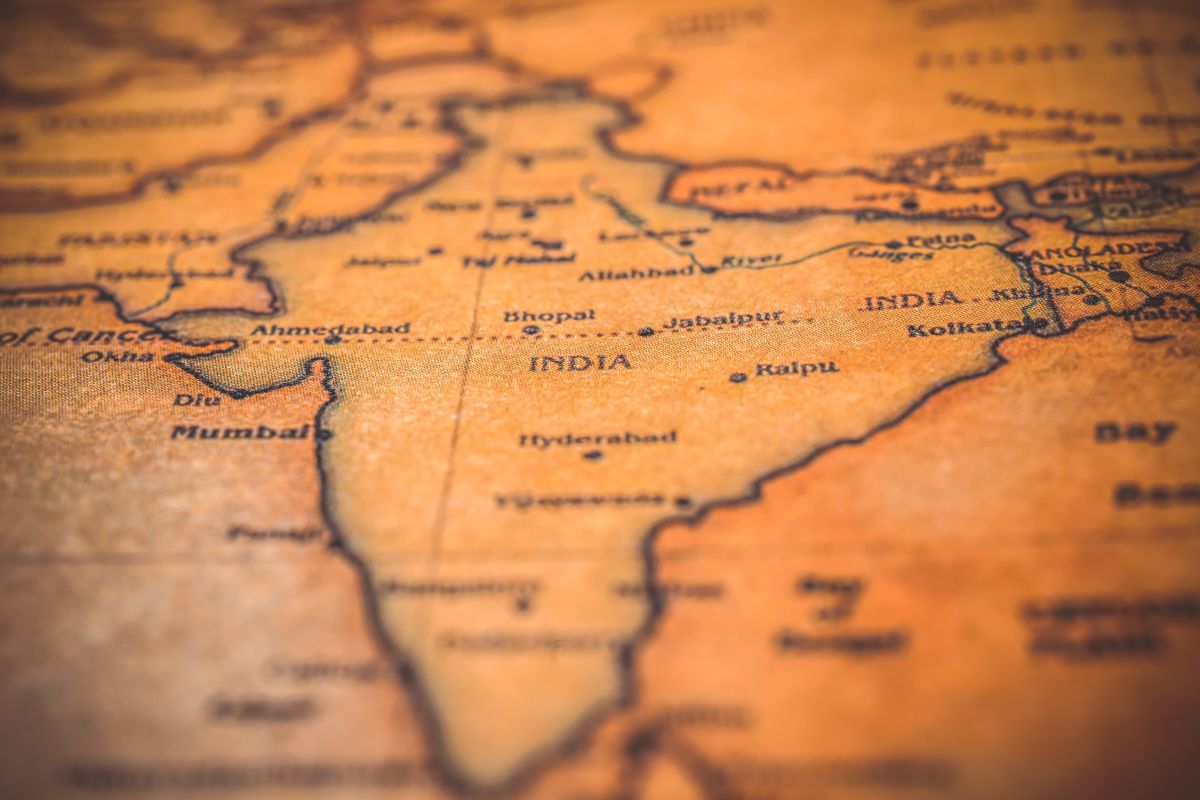
St Thomas is thus commonly known as ‘doubting Thomas’ for his original lack of faith. Yet, in another part of the world, his legacy is not one of scepticism, but of an extraordinary journey to the ‘ends of the earth.’ In India, St Thomas is revered as the apostle who travelled the furthest, a tradition that has deep roots in South Indian history and culture, yet is often overlooked in Western Christian narratives.
This profound and enduring tradition, which has been maintained by the St Thomas Christian community for nearly two millennia, raises a compelling question. If one of Jesus’s (as) closest apostles could undertake such an extensive journey, what does that imply about the possibilities of the first-century world? This article delves into the historical foundations of St Thomas’s journey to India, challenging Western thinking on the earliest Christian links with the East.
St Thomas in the Historical Record
The historical and traditional accounts of St Thomas’s presence in India draw from a variety of ancient texts, historical figures, and the living traditions of the Indian people.
Ancient Texts and Apocryphal Narratives
The primary textual source detailing St Thomas’s missionary journey is the Acts of Thomas, an apocryphal narrative from the early third century. To call a text ‘apocryphal’ means that it was not accepted into the canonical Christian scriptures and is therefore not considered to be divinely inspired or a fully reliable historical record. While not accepted as scripture, the Acts of Thomas is still of great interest to historians and theologians, as it is one of the few apocryphal works to have survived intact and offers a fascinating glimpse into the beliefs and traditions of some early Christian communities.
The narrative explicitly credits St Thomas, whom it refers to as Jesus’s (as) twin, with the conversion of India. Like other apocryphal texts, this Gospel appears to have been influenced by Gnostic teachings. A central theme in the Acts of Thomas is the promotion of an ascetic lifestyle and the rejection of the material body. The narrative describes Jesus (as) assuming the form of Thomas at a wedding ceremony, convincing the couple to embrace a life of celibacy and holiness.[2]
What are we to make of these events, and how should such a text be interpreted? While its fantastical elements, such as Jesus (as) appearing as a twin, make it hard to believe as a factual account, the very existence of this document is a significant historical clue. It suggests that by the third century, the belief in St Thomas’s journey to India was already so widespread that an author felt compelled to write a detailed, if legendary, account of it. The text has been interpreted by scholars as a type of hagiography – a spiritual story meant to edify and promote a certain theological viewpoint – rather than a news report.[3] The fact that it was written to explain Thomas’s mission in India provides a powerful, if indirect, hint of an authentic historical tradition.
The story of Thomas continues, stating that upon his arrival, Thomas is tasked by the king to build a magnificent palace. Instead of constructing a physical building, however, Thomas devotes the king’s funds to the poor and needy. When the king demands to see the completed palace, Thomas reveals that he has built a ‘palace in heaven’ for the monarch, a claim that initially leads to his imprisonment. The miraculous return to life of the king’s brother, who recounts a vision of the magnificent heavenly palace, prompts the king’s conversion and the subsequent baptism of the entire community.[4]
Corroboration from Church Fathers and Explorers
This tradition was not confined to apocryphal texts; it found corroboration in the writings of several early Christian figures whose authority and scholarship were foundational to the nascent Church. Origen (c. 185-254 CE), for instance, was an immensely influential scholar and theologian from Alexandria. His mention of Thomas’s evangelisation efforts in India, recorded by the historian Eusebius, carries significant weight due to his intellectual stature and the fact that he was writing only a century after the commonly accepted date of Thomas’s martyrdom.[5] Similarly, St Ephrem the Syrian (c. 306-373 CE), a highly respected theologian and poet, composed hymns that vividly describe Thomas ministering in India. St Ephrem, who came from Edessa, a city with its own deep traditions concerning St Thomas’s work, wrote that Thomas’s mission was to ‘clothe them by Baptism in white robes’ and that ‘his grateful dawn dispelled India’s painful darkness’.
A fourth-century bishop named Theophilus also attests to directly finding Christians in India. Bishop Theophilus was originally from an island in the Indian Ocean, possibly Socotra or the Maldives. He earned the name ‘the Indian’ due to his origins and journey. Around 354 CE, the Roman Emperor Constantius II sent him to southern Arabia and Asia. Theophilus’s mission was to build churches for Roman merchants and to find and support Christian communities in the region.[6]
Historical sources, such as the account by the fourth-century historian Philostorgius, relate that Theophilus visited his home island and other parts of India, where he ‘found Christians’ and made reforms to their liturgical practices, such as ensuring the Gospel was not read in a ‘sitting’ position. This detail is highly significant because it implies that he did not establish a new community but encountered an already existing one. His account is one of the earliest references to a body of Christians with a church and clergy in the vicinity of the Maldives, a description that could only apply to the community on the adjacent coast of India.[7] The fact that this testimony comes from a bishop and diplomat on an official mission makes his report a valuable and credible historical source for an ancient Christian presence.[8]
These early, independent accounts from distant parts of the Christian world confirm that Thomas’s journey to India was a known and accepted tradition.
Centuries later, the renowned Venetian explorer Marco Polo (1254-1324) further cemented this belief in the Western world. As a celebrated merchant, diplomat, and chronicler, whose accounts of his extensive travels to Asia were hugely popular and influential, Marco Polo’s words were widely trusted. His book, The Travels of Marco Polo, was the definitive source for knowledge of the Far East for centuries. In the 13th century, he famously noted the existence of St Thomas’s tomb on the Coromandel Coast, specifically in Mylapore.[9] His widely-read account significantly contributed to the widespread belief in the West that Thomas was not only active in India but also buried there.
A Living Legacy – The Nasrani Community of Kerala
The most compelling evidence for St Thomas’s legacy in India is the living testimony of the Saint Thomas Christians, also known as the Nasrani community. This distinct ethno-religious community, primarily located in Kerala, maintains an unbroken tradition that St Thomas the Apostle landed in Muziris (modern-day Cranganore/Pattanam) in 52 CE.[10] They believe he established seven foundational Christian communities or churches in Kerala, including significant sites like Kodungallur and Mylapore.
Their unique identity is reflected in their culture, which is described as ‘Indian in culture, Christian in faith and Syrian in liturgy’.[11]
Physical and historical support for this tradition is found in Chennai, Tamil Nadu. St Thomas Mount is traditionally revered as the site of his martyrdom in 72 CE.[12] The ancient church atop this hill serves as a globally recognised pilgrimage site and is believed to house a relic and the famous ‘St Thomas Cross’, a venerated stone cross.[13] The church is known as the Church of St Thomas Mount National Shrine and was built by the Portuguese in the 16th century. The San Thome Cathedral Basilica in Mylapore is also strongly associated with Thomas’s tomb.
Although the sites in Chennai are internationally venerated as the place of martyrdom, it must be noted that the sheer depth and spread of the St Thomas tradition across India has led to multiple locations holding profound spiritual significance. While the San Thome Cathedral rests over his alleged burial site, the tradition of the Nasrani community is primarily anchored in Kerala, where he first arrived at Muziris in 52 CE. The region is home to the seven churches he is traditionally credited with founding, and contains other major pilgrimage sites, such as the St Thomas International Shrine at Malayattoor. Rather than competing for the location of the body, these sites collectively attest to the widespread nature of the apostle’s mission, from his landing on the Malabar Coast to his martyrdom on the Coromandel Coast.
Reflecting on the overall story, we have apocryphal texts, the testimony of church fathers, oral traditions of communities in Kerala, and an alleged tomb. Does this provide sufficient evidence that these traditions of the disciple Thomas preaching in India should be taken seriously? Pope John Paul II certainly thought so, and his pilgrimage to India showed that the St Thomas tradition is recognised at the highest levels of the Catholic Church.
A Modern-Day Pilgrimage: Two Leaders, One Ancient Tradition – Pope John Paul II and the Catholic Acknowledgement
In 1986, Pope John Paul II made a historic visit to India, the first official visit by a Pope to the country.[14] In his first speech in Delhi, he explained his purpose was ‘to pay a pastoral visit to the Catholics of India, and I come in friendship with a deep desire to pay honour to all your people and to your different cultures’.[15] This visit was not just about interfaith dialogue, but also about a direct acknowledgement of the ancient connection between Rome and India.
During his ten-day tour, Pope John Paul II travelled to Madras (now Chennai), where he visited the Cathedral Basilica of St Thomas the Apostle to ‘venerate the Tomb of the Apostle to India.’[16] This act of prayer and reverence at the supposed burial site of St Thomas was a powerful statement from the head of the Catholic Church, validating the ancient traditions of the St Thomas Christians. He further reinforced this belief in a prayer in Calcutta, where he referred to St Thomas as a martyr who ‘died for Christ’.[17] The Pope’s second visit in 1999 further reinforced this legacy. This trip was specifically for the promulgation of the post-synodal document ‘Ecclesia in Asia,’ and New Delhi was chosen as the location for this important event, in what was seen as an acknowledgement of India’s unique place in the history of Asian Christianity.[18] In a speech, he explicitly referred to the Indian Christian communities in the South, stating they ‘justly glory themselves with the name of “Christians of St Thomas the Apostle.”’[19]
The actions of a modern-day Pope serve as a powerful testament to the historical and spiritual significance of St Thomas’s journey, demonstrating that his legacy continues to be a point of pride and connection for a vibrant Christian community.
A Modern Muslim Perspective: His Holiness’s (aba) Visit to Kerala
Similarly, a profound acknowledgement of this history was made during the 2008 tour of India by the Worldwide Head of the Ahmadiyya Muslim Community, Hazrat Mirza Masroor Ahmad (aba). While addressing the history of the region, His Holiness (aba) spoke specifically about the area known as Mount Thomas, confirming the tradition that Christianity reached Kerala around 52 CE through the disciple of Jesus (as), Thomas.[20]
This visit underscored the historical significance of the region, not only as the origin of Christianity in India but also as a destination for the mission to the Lost Tribes of Israel. His Holiness (aba) specifically noted the importance of Calicut, Kerala, as the first city Thomas likely arrived at due to the presence of a large Jewish population – the Malabari Jews – who had settled there during the time of Prophet Solomon (as), arriving with trade caravans. The converts Thomas gained are known today as ‘Nasrani’ or Thomas Christians, who still maintain a belief in the unity of God.[21]
The simultaneous recognition of this history by leaders from two different global faiths – one rooted in Roman tradition and one in modern Islamic revival – demonstrates that the St Thomas legacy is far from being a local legend; it is a profound historical truth acknowledged across the spectrum of religious belief.
The Ancient Silk Road of the Seas – Travel Was Possible
The notion of long-distance travel in the 1st century might seem extraordinary, but historical and archaeological evidence paints a picture of a surprisingly interconnected world. This was a time of extensive trade and movement between the Roman Empire and the Indian subcontinent, facilitated by sophisticated maritime and overland routes.[22]
Wealthy Romans, for instance, enjoyed exotic luxuries such as cinnamon, myrrh, pepper, and silk, all acquired through these long-distance international trade networks.[23] Two primary corridors enabled this East-West exchange: the Red Sea route and the Persian Gulf corridor. ]24]The Red Sea route involved a substantial maritime journey of approximately 4,500 km from Indian ports to Red Sea cities, followed by a 380 km caravan route across the Egyptian Desert, and then another 760 km by ship on the Nile to the Mediterranean.[25] The Persian Gulf corridor, while shorter, still entailed a 2,350 km ship trip from India to the confluence of the Tigris and Euphrates Rivers, succeeded by a 1,400 km caravan journey across the Syrian desert.[26]
Archaeological excavations have yielded significant evidence of this robust trade, most notably the discovery of over two thousand Roman coins from the first to fourth centuries CE in South India, particularly from the reigns of emperors Augustus and Tiberius.[27] These numerous finds, along with historical trade accounts, unequivocally confirm the existence of well-travelled commercial links between the Mediterranean world and South India, making long-distance travel entirely plausible.[28]
Adding another layer of historical context is the documented presence of established Jewish communities in India during the 1st century CE, such as the Cochin Jews in Kerala.[29] These diaspora communities, with their strong ties to Judea, would have provided crucial religious and cultural linkages for a traveller from the Middle East. The prevalence of Aramaic, the lingua franca of trade in early centuries, among these Jewish communities would have created a familiar linguistic and cultural environment for a figure like St Thomas. The validity of the claims of the Cochin Jews has been supported by DNA evidence in recent years.[30]
Ultimately, the historically corroborated journey of St Thomas to India serves as irrefutable proof that such extensive travel by religious figures was not only possible but actively undertaken in the first century.
A New Horizon – Another Journey to the East?
The established historical precedent of St Thomas’s journey to India leads to an intriguing question, linked to another widespread tradition. If an apostle could travel so far for his divine mission, is it possible that Jesus (as) himself undertook a similar journey after the crucifixion? The Acts of Thomas also hints at this possibility, explicitly mentioning Jesus (as) appearing at a wedding ceremony many years after the Crucifixion.
Several modern researchers have written about Jesus’s (as) possible travels to India [31]. It is believed that after his recovery, he emigrated eastward to escape further persecution and, crucially, to fulfil his divine mission of reaching the ‘Lost Tribes of Israel,’ who had dispersed and settled in regions like Afghanistan and Kashmir.[32]
This narrative finds a crucial anchor in the Rozabal shrine in Srinagar, Kashmir, which has long been venerated as the tomb of a foreign prophet named Yuz Asaf.[33] Local Kashmiri chronicles from the 18th century, such as Tarikh-i-Kashmir, refer to Yuz Asaf as a prophet who came from a foreign land. The name ‘Yuz Asaf’ itself is believed to derive from Buddhist origins, potentially linking to ‘Yusu’ or ‘Yehoshua’ (Jesus (as)) and ‘Asaf’ (the Gatherer).[34]
Hazrat Mirza Ghulam Ahmad (as), the Founder of the Ahmadiyya Muslim Community, was the first to systematically present the argument that this shrine is, in fact, the tomb of Jesus (as) Christ. His pioneering research in the 19th century, detailed in his treatise Jesus in India, meticulously built a case for Jesus’s (as) survival, his journey through Persia and Afghanistan, and his eventual natural death and burial in Kashmir.[35]
Jesus (as) & Thomas in India?
The comprehensive examination of historical and traditional accounts strongly supports the assertion that St Thomas embarked on an extensive journey to India in the 1st century. The enduring traditions of the Nasrani community, corroborated by the writings of early Church Fathers and archaeological findings, provide a continuous living testimony to this legacy. The modern-day recognition of this tradition by Pope John Paul II, the head of the Catholic Church, further underscores its importance.
The story of St Thomas is not just an interesting historical footnote but a crucial piece of the puzzle that makes a new, surprising narrative historically and logically plausible. By demonstrating that such a journey was feasible and was, in fact, undertaken by a close apostle, the St Thomas tradition opens the door for a new perspective on the life of Jesus (as) himself.
Finally, let’s consider the words of Jesus (as) himself. In the Gospel of John, while speaking to his followers in Jerusalem, he stated:
‘I have other sheep that are not of this fold. I must bring them also, and they will listen to my voice. Then there will be one flock, one shepherd.’
While this verse is often interpreted as a reference to the Gentiles, Jesus (as) had previously stated:
‘I am not sent but unto the lost sheep of the house of Israel.’ [36]
A more likely scenario is that the ‘other sheep’ were, in fact, the lost tribes of Israel, who had long been scattered to distant lands.[37] Seen through this lens, the eastward journey of Jesus (as) is not at all unexpected, but the logical and divinely mandated continuation of his life’s work.
………………………………………………………
About the Author: Arif Khan is a Biblical researcher, Editor of the ‘Tomb of Jesus’ website and appears in Paul Davids’ film – ‘Jesus in India’, first aired on the Sundance Channel. Arif is currently serving as the Deputy Editor of the Christianity Section of The Review of Religions.
ENDNOTES
1.The Bible, John 20:24.
2.“Acts of Thomas,” NASSCAL. Accessed: August 24, 2025, https://www.nasscal.com/e-clavis-christian-apocrypha/acts-of-thomas/
3. George Nedungatt, “The Apocryphal Acts of Thomas and Christian Origins in India,” Gregorianum. Accessed: September 13, 2025.
https://malankaralibrary.com/ImageUpload/c2aec9709a5a9e8aeb6d8b770f19f496.pdf
4.“Saint Thomas, Missionary Apostle to India,” University of California Press. Accessed: June 8, 2025, https://content.ucpress.edu/chapters/12898.ch01.pdf
5.“Thomas the Apostle,” Wikipedia. Accessed June 8, 2025, https://en.wikipedia.org/wiki/Thomas_the_Apostle
6. “The Journey of Christianity to India in Late Antiquity,” Cambridge University Press, Accessed: September 13, 2025. https://www.cambridge.org/core/books/abs/journey-of-christianity-to-india-in-late-antiquity/early-christianity-and-its-many-indias/9720EC2B140EAAEBB5B188B9C999E0C9
7. Ibid.
8. Ibid.
9. Sandhya Jain, “Merchant Thomas to Saint Thomas,” ACTA INDICA. Accessed: June 8, 2025, https://ishwarsharan.com/the-myth-of-saint-thomas-and-the-mylapore-shiva-temple/merchant-thomas-to-saint-thomas-sandhya-jain/
10.Robert E. Frykenberg, “Thomas Christians,” Britannica. Accessed: September 13, 2025.
https://www.britannica.com/topic/Thomas-Christians
11.Jesudas Athyal, “Theology,”Christianity in South And Central Asia (Cambridge University Press, April 2020). (https://www.cambridge.org/core/books/abs/christianity-in-south-and-central-asia/theology/03D044DCFE3D0F6AA5E3F529E34FFD1F )
14. https://www.nytimes.com/1986/02/01/world/pontiff-begins-his-10-day-visit-to-india.html
15. https://catholicsindia.in/the-chronicles-of-the-visit-of-pope-john-paul-ii-to-india/
17. https://www.clerus.org/bibliaclerusonline/en/fs2.htm
18. https://www.catholicculture.org/culture/library/view.cfm?recnum=1341
19. https://catholicsindia.in/the-chronicles-of-the-visit-of-pope-john-paul-ii-to-india/
20. https://www.alislam.org/friday-sermon/2008-12-12.html
21. https://www.alislam.org/friday-sermon/2008-12-12.html
22. https://www.metmuseum.org/essays/trade-between-the-romans-and-the-empires-of-asia
23. https://www.worldhistory.org/article/1761/the-eastern-trade-network-of-ancient-rome/
24. https://www.metmuseum.org/essays/trade-between-the-romans-and-the-empires-of-asia
25. https://www.worldhistory.org/article/1761/the-eastern-trade-network-of-ancient-rome/
26. https://www.worldhistory.org/article/1761/the-eastern-trade-network-of-ancient-rome/
27. https://en.wikipedia.org/wiki/Indo-Roman_trade_relations
28. https://en.wikipedia.org/wiki/Indo-Roman_trade_relations
29. https://pmc.ncbi.nlm.nih.gov/articles/PMC5020127/
30, https://www.reviewofreligions.org/6107/the-lost-tribes-of-israel-in-india-a-genetic-perspective/
31. https://www.reviewofreligions.org/30018/sowing-the-seed-jesus-in-india/
32. https://www.alislam.org/articles/lost-tribes-of-israel/
34. https://www.reviewofreligions.org/2727/rozabal-%E2%80%93-the-tomb-of-jesus-christas/
35. https://www.reviewofreligions.org/2727/rozabal-%E2%80%93-the-tomb-of-jesus-christas/
36. The Bible, Matthew 15:24.
37. The Bible, John 10-16.


Add Comment