
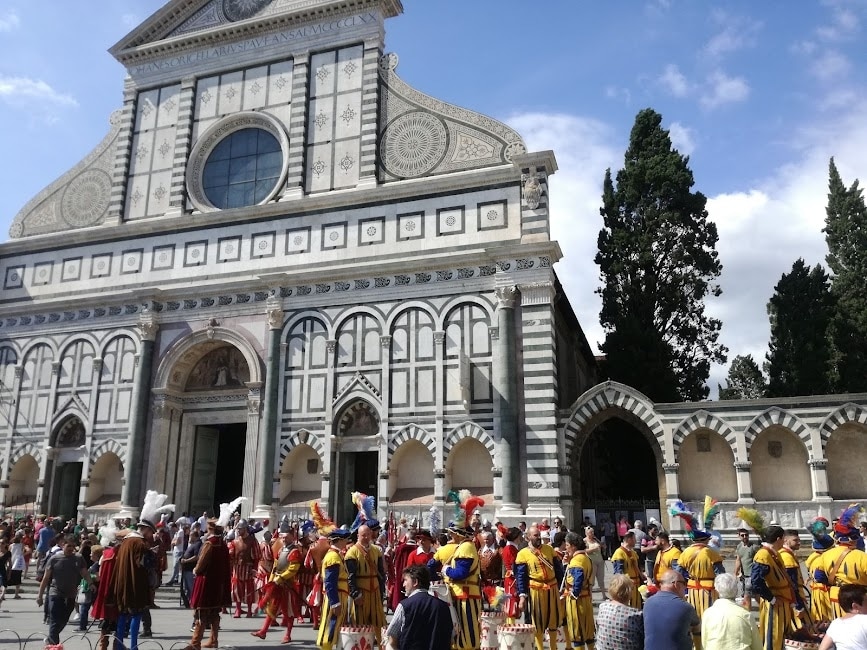
Epanto, CC BY-SA 4.0 https://creativecommons.org/licenses/by-sa/4.0, via Wikimedia Commons
The air has been different across the United Kingdom over the past few weeks. I feel more united and connected with my nation than I have felt in such a long time. This feeling of togetherness generally comes and goes with the World Cup, a time when the entire country forgets their differences despite loaded political attempts to splinter communities. The heartbreak in the semi-finals reverberated across the entire nation as Argentina catapulted themselves into their consecutive World Cup final. The deeper meaning that team games, such as football, provide for both players and the country shines through loud and clear in times like these. However, the phenomenon of fostering community ties and celebrating cultural traditions through football is not just something that has hallmarked the last two centuries, it instead pays homage to the rich ancient heritage of the game that were precursors to the beautiful game that we all enjoy today.
Enter Calcio Storico Fiorentino, a 16th century team ball game that shares its ancestry with the football that evolved in England to what we have today. Calcio is essentially a mixture of football, rugby and wrestling, and has been the cause of fatalities due to the violent nature of the game. It is thought that the sport was developed to militarily train soldiers and to keep them fit in periods of non-fighting.
However, Calcio’s interest waned across Italy in the 17th century until Benito Mussolini re-established the game in the Kingdom of Italy, where it is now played in the Piazza Santa Croce, in Florence.
The 4 teams (each composed of 27 players) of the 4 historic neighborhoods of Florence (the Bianchi di Santo Spirito, the Azzurri of Santa Croce, the Rossi di Santa Maria Novella, the Verdi di San Giovanni) compete against each other, playing the two semifinals and the final to determine the winner.
The matches take place on a sand-covered field and last about fifty minutes. The players have the goal of taking the ball to the bottom of the opponent’s field and putting it in the net to score the “hunt”. The winning team is the one that, at the end of the time available, has scored the most points.
Every 24th June, the final is played on the square with bleachers set up for spectators to enjoy. The 24th June is the day that is dedicated to the city’s patron saint, John the Baptist, which is why this day is commemorated with different religious and cultural ceremonies, with the final in the Piazza being one of them.
Florence adopted John the Baptist as its patron saint since the Middle Ages; the Baptistry of San Giovanni, Florence’s most important religious building, was also dedicated to him. Saint John became a symbol of what it was to be Florentine, as generations of Florentines were Baptised in this Church. Originally dedicated to the Roman military god Mars, the Baptistry became the seat of the representation of John as a spiritual figure who was admired by Renaissance Florence for his being the protector of Florence. John the Baptist was revered for his courage in preaching and his bravery when he condemned Herod which eventually led to his execution according to the Gospels. And it makes sense that the Florentines chose John as their patron saint after the arrival of Christianity in Florence because his fearlessness reflects that of the predecessor patron, Mars.
Calcio is considered an adaptation of an even earlier form of football called Harpastum played across ancient Rome, which itself evolved from Episkyros, the ancient Greek form of the game. These games were also a means for military training. This is why Episkyros was a favourite for the Spartans, because Sparta was home to the state-run education and military training system, agoge, that really pushed for boys to grow into fearless soldiers where strength, endurance, teamwork and resilience could thrive. The sport embodied these qualities in the style of game that had to be played, where just like Calcio, wrestling, body strength, and strategy were all put to the test.
Even after Rome adopted Episkyros into Harpastum, the Roman physician Galen described Harpastum as excellent exercise and how it developed one’s agility, strength, endurance, and tactical awareness.
One thread that weaves through these early iterations of the football we know today is the pursuit of physical excellence, communal identity and shared civic ideals. In ancient Greece, Rome and Renaissance Florence, physical training prepared citizens to serve their communities, whether on the battlefield or in public life, and their respective forms of football reflected those priorities. Yet these games were never solely about athletic competition. They were embedded within the religious and cultural fabric of society. In Florence, Calcio Storico continues to be played as part of the Feast of John the Baptist, reminding spectators that the game remains inseparable from the city’s history and patron saint.
Perhaps that is why football continues to resonate so deeply today. While modern stadiums have replaced ancient agoras and Renaissance piazzas, and VAR has replaced the judgement of a lone referee, the game’s greatest power still lies beyond the final score. Whether it is a Florentine neighbourhood gathering beneath the shadow of the Basilica of Santa Croce or millions of supporters willing England on from their living rooms, football continues to give communities a shared identity.
About the author: Hazeem Arif graduated from Jamia Ahmadiyya UK in 2024 with a Shahid degree in Islamic Theology and Modern Languages. He currently serves on the Editorial Board of The Review of Religions while pursuing further studies in Religion, Philosophy and Ethics at King’s College London



Add Comment