
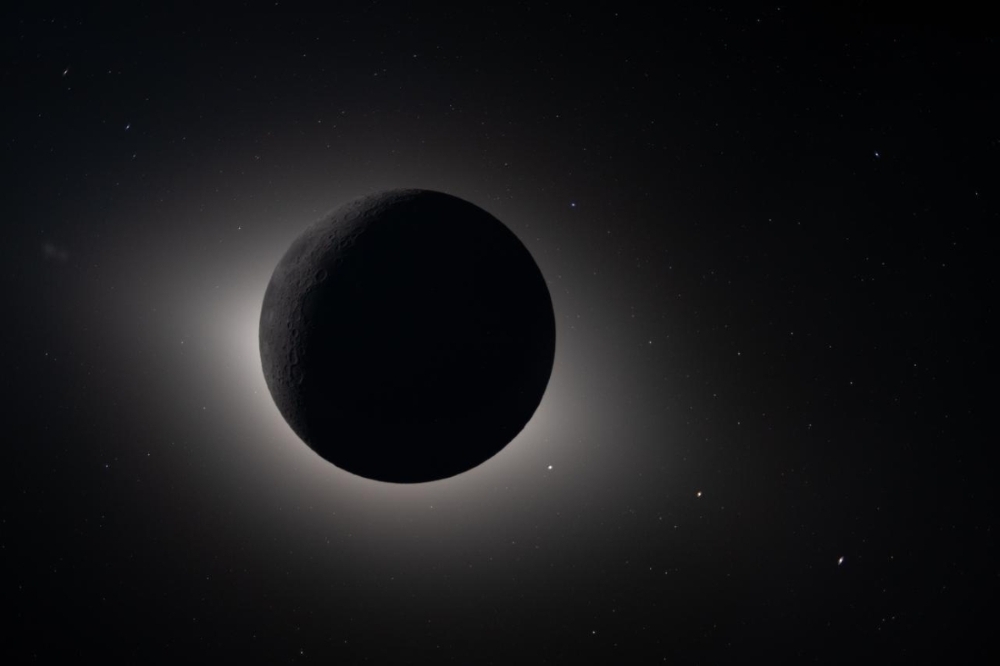
Image credit: NASA
Mansoor Dahri, UK
Introduction
This Wednesday, on 12th August 2026, an impressive array of cosmological events will be coinciding within 24 hours of each other in a stunning way. This includes the peak of the Perseid Meteor shower, a total Solar Eclipse over parts of North America and Western Europe and the alignment of 6 planets: Jupiter, Saturn, Mars, Mercury, Uranus and Neptune. At the end of August 2026, there will also be a partial Lunar Eclipse.
Solar eclipses in particular hold special fascination for human beings. It’s truly a strange sight to witness when the sun goes dark in the middle of the day. From time immemorial, these celestial occurrences have made an impression on the human psyche. It’s therefore no surprise that we find mention of them throughout the great religions and faith traditions of the world.
This includes some interesting symbolic and mythological descriptions which clearly refer to solar eclipse events.
Describing Eclipses
For instance, in Hinduism, we find a mythological description of a solar eclipse:
“The Atris found the Sun again, him whom Svarbhanu of the brood Of Asuras had pierced with gloom. This none besides had power to do.” (Rig Veda 5.40.9)
This hymn describes how the Atris (ancient seers) found the Sun after it had been eclipsed by Svarbhānu (symbolic of the forces of ignorance and darkness). Interestingly, it’s possible that this refers to a real eclipse that happened thousands of years ago.
We find a similar description in Buddhist scriptures as well:
“Now at that time the Sun God had been seized by Rāhu” (Sūriya Sutta, Saṃyutta Nikāya 2.10)
The surrounding context of these words make it clear that this refers to an eclipse because the Sun is described as being seized “as he traverses the sky” (i.e. during the day) and then, after being persuaded by the Buddha, Rāhu finally “released the Sun”.
These fascinating descriptions capture the awe that human beings feel upon witnessing solar eclipses. It feels supernatural or magical. This is why it is interesting when we come across attempts to interpret or understand eclipses in relation to prevailing beliefs and doctrines of a faith tradition.
Understanding Eclipses
For instance, the Holy Prophet Muhammad (sa) is recorded as stating:
“The sun and the moon do not eclipse because of the death or life (i.e. birth) of someone. When you see the eclipse, pray and invoke Allah.” (Sahih al-Bukhari 1043, Book of Eclipses)
For context, there was a solar eclipse on the day that the Holy Prophet (sa) lost his son Ibrahim (ra). People started assuming that it eclipsed due to the death of his son, so the Holy Prophet (sa) had to clarify matters by stating explicitly that there was no link. He taught people the proper way to understand these spectacular phenomena.
Likewise, in the Sikh tradition, it is stated:
“Taking my cleansing bath in the Name of the Lord, Har, Har, I have been purified. Its reward surpasses the giving of charity at millions of solar eclipses.” (Guru Granth Sahib, Ang 197, Gauri, Fifth Mehl)
This refers to the traditional Indian/Hindu practice of bathing and giving charity to counteract what was perceived to be spiritual disturbance arising from an eclipse. Sikhism teaches that the remembrance of God’s name is unimaginably meritorious and beneficial, so much so that it far exceeds even something as meritorious as the tradition of giving charity during an eclipse.
Both these examples point to the fact that it is important not to ascribe excessive significance to solar eclipses. Nevertheless, there are clear examples in the world’s faith traditions when eclipses are to be interpreted in a special way.
Interpreting Eclipses
For instance, in the Islamic tradition there is a Hadith that states:
“For our Mahdi there are two signs which have never appeared before since the creation of the Heavens and the Earth: the moon will be eclipsed on the first night of Ramadan, and the sun will be eclipsed in the middle of it.” (Sunan al-Daraqutni, Kitab al-Eidain)
This is interpreted by the Ahmadiyya Muslim Community to refer to Hazrat Mirza Ghulam Ahmad (as) of Qadian, who claimed to be the Messiah and Imam Mahdi foretold in many different religions. In March 1894, solar and lunar eclipses appeared exactly as per the prophecy.
Interestingly, something very similar is also found in the Old Testament of the Bible:
“The sun shall be turned into darkness, and the moon into blood, before the great and notable day of the Lord come.” (Joel 2:31)
Much like the Hadith, this verse of the similar also seems to be referring to both a solar and a lunar eclipse as an omen heralding the arrival of “the great and notable day of the Lord”. During a lunar eclipse, the moon turns a red colour, hence why these are referred to as “blood moons”. Likewise, the fact that the “sun shall be turned into darkness” clearly therefore refers to a solar eclipse. So we seem to have a prophecy in the Bible stating that a solar and lunar eclipse will occur as portents of a Divine event. This has interesting parallels with the Ahmadiyya Muslim belief.
Conclusion
Muslims around the world usually offer special prayers at the time of the Eclipse (known as Salat al-Kusoof). Hindus typically offer ritual bathing and give to charity to counter what they consider negative energy. In Judaism, eclipses are seen as a time for reflection and teshuvah (repentance) prayers. There are many other faiths, each with their own unique traditions and interpretations of these events.
May these days be a time for positive change, repentance, forgiveness and turning to God.

Add Comment