
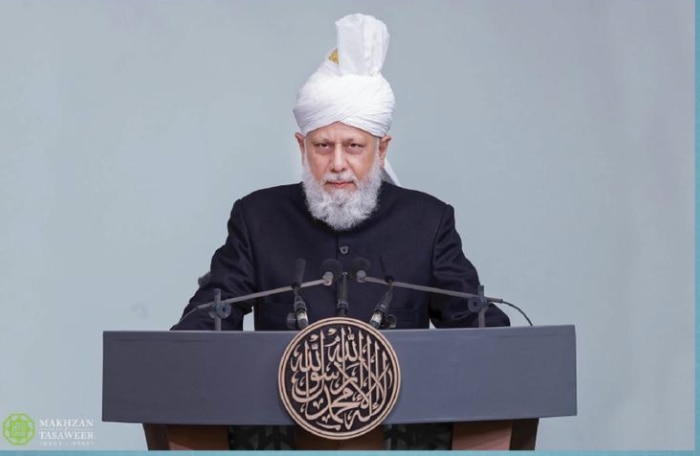
After reciting Tashahhud, Ta‘awwuz and Surah al-Fatihah, His Holiness, Hazrat Mirza Masroor Ahmad (aba) said that he would continue speaking about the examples of gratitude established by the Promised Messiah (as).
Being Grateful for the Intellect We Are Bestowed
His Holiness (aba) said that once, the Promised Messiah (as) asked someone whether he’d had an argument with someone. The Promised Messiah (as) explained to him that the person he’d quarrelled with did not have much sense, and enjoined that one should refrain from arguing with such people, because they do not know any better. Instead, one should show leniency and kindness to those who are ignorant and not completely sound of senses. On the other hand, the Promised Mesisah (as) also enjoined this person to be grateful to God Almighty that He had bestowed upon him a sound mind, granted him wisdom and the ability to recognise the attributes of God.
His Holiness (aba) said that once, after the morning prayer, the Promised Messiah (as) asked where the sounds of music had been coming from a nearby area. The Promised Messiah (as) was informed that Mian Nizamuddin had hired a woman to dance throughout the night and had promised her twenty rupees. The Promised Messiah (as) expressed his disappointment and said that this woman stayed up dancing all night for only twenty rupees, yet in exchange for the countless blessings God has bestowed upon us, people are unable to wake up at night to supplicate before God and express gratitude to Him.
His Gratitude Over Every Morsel of Food
His Holiness (aba) said that when eating, the Promised Messiah (as) would express gratitude to God with every bite he ate. The Promised Messiah (as) would eat carefully, in small bites, and throughout the time he ate, he would be engaged in expressing thanks to God.
His Gratitude for the Means Provided by Allah
His Holiness (aba) said that whenever the plague would spread in the area, the Promised Messiah (as) would ensure that his own home was very thoroughly cleaned and antibacterial materials were used. The Promised Messiah (as) also ensured that the homes in the area did the same. He would say that using the means which God has provided is indeed another way of being thankful to Him. If God has created certain things that can fight against bacteria or destroy them, then gratitude to God dictates using the means He has provided. Trust in God denotes that one must use the means God has provided, but not place all trust in them; instead, place complete trust in God, that He will procure the desired results through the means He provided.
His Holiness (aba) said that at the time of writing his book Tashkiratush-Shahadatain (A Tale of Two Martyrdoms), the Promised Messiah (as) fell quite ill. During this illness, the Promised Messiah (as) was moved to pray for recovery, and he asked his family to join him in prayer as well. The Promised Messiah (as) made an extremely heartfelt prayer, and it was in response to this prayer that God revealed to the Promised Messiah: ‘Peace on you – a word of greeting from the Merciful Lord.’
His Gratitude to All Those Who Helped Him
His Holiness (aba) said that it was the Promised Messiah’s (as) personality to express gratitude for even the smallest things. When the Promised Messiah (as) wrote his book Barahin-e-Ahmadiyya, he included a list of names of all those who had sent donations to help in the publication of this book. This list included the names of even those who had donated very small amounts. Regardless, the Promised Messiah (as) expressed gratitude to them all and prayed for them. The Promised Messiah (as) also wrote that anyone who read this book and benefitted from it should pray not only for him, but for all those who he had listed for their help in the book’s publication through their donations. The Promised Messiah (as) did the same when it came to other books he wrote as well, such as Minanur Rahman, for the publication of which people had sent donations. The Promised Messiah (as) would take specific names to laud and appreciate what he described as great sacrifices and services. He would take every opportunity to appreciate those who rendered any sort of assistance.
His Holiness (aba) said that once the Promised Messiah (as) was walking in an orchard and he had a staff in his hand that he would use to get fruits down from the trees. As the Promised Messiah (as) was getting some fruit down, the staff got stuck in the tree. Upon this, one of his companions, who was young at the time, quickly climbed up the tree to retrieve the Promised Messiah’s (as) staff. The Promised Messiah (as) was extremely pleased, and in an extremely loving and appreciative manner, the Promised Messiah (as) expressed his amazement at how the young boy was able to climb the tree with such proficiency. The Promised Messiah (as) expressed a great deal of appreciation. Although he was a young boy, the Promised Messiah (as) spoke to him with great respect and honour, appreciating that he’d retrieved his staff.
His Holiness (aba) said that during one of the Promised Messiah’s (as) court cases, there came a time when the financial situation became strained, and the Promised Messiah (as) made an appeal for financial contributions. One of the people to whom this appeal was made was Dr Khalifa Rashiduddin, who sent to the Promised Messiah (as) all that he had, and pledged to continue sending whatever income he made. The Promised Messiah (as) sent a note to him expressing immense gratitude, and said that he had sacrificed so much that he did not need to make financial contributions any longer. Still, Dr Khalifa Rashiduddin would continue offering financial contributions out of his sincere devotion.
Remaining Grateful Servants of Allah
His Holiness (aba) said that Hazrat Mirza Bashiruddin Mahmud Ahmad (ra), the Second Caliph of the Ahmadiyya Muslim Community and son of the Promised Messiah (as), wrote that the Promised Messiah (as) had exempted his five children from contributions to the Wasiyyat (the Will) scheme. However, Hazrat Mirza Bashiruddin Mahmud Ahmad (ra) thought that even the Holy Prophet (sa), despite being promised forgiveness and paradise, would continue offering prayers for so long that his feet would become swollen, and the reason he gave was, ‘Should I not be a grateful servant?’ In the same spirit, Hazrat Mirza Bashiruddin Mahmud Ahmad (ra) felt that in the same spirit he should, and indeed he did, make financial contributions to the Wasiyyat scheme.
His Holiness (aba) clarified that some people think that all members of the Promised Messiah’s (as) family or the Caliphs are exempt from the Wasiyyat Scheme. His Holiness (aba) said that exemption was only for the five children explicitly stated by the Promised Messiah (as), not their spouses or further progeny. Even those who were exempt still made profound financial contributions and sacrifices. Therefore, everyone, including those members of the Promised Messiah’s (as) family who have joined the Wasiyyat scheme, must offer the stipulated contributions. His Holiness (aba) further clarified that no Caliph after the Second Caliph (ra) has been exempted from paying the stipulated contributions for the Wasiyyat scheme. His Holiness (aba) said that he made this clarification because he had received word of a question that was being raised in this regard.
His Holiness (aba) said that once, the Promised Messiah (as) was invited to someone’s home for tea. The Promised Messiah (as) was informed that those who had prepared the food were the servants of those who had been preaching the message of Christianity. Regardless of the religious differences, the Promised Messiah (as) expressed thanks to them. He didn’t just stop there; in fact, the Promised Messiah (as) announced his gratitude to them later in the newspaper as well.
His Holiness (aba) prayed that may Allah enable us all to reach the same standards of gratitude.

Add Comment