
Summary prepared by The Review of Religions
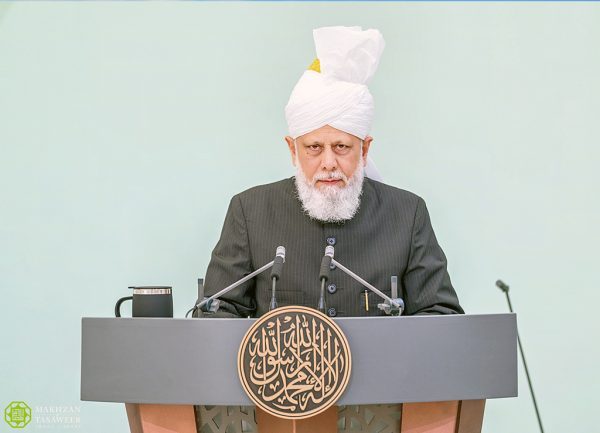
After reciting Tashahhud, Ta‘awwuz and Surah al-Fatihah, His Holiness, Hazrat Mirza Masroor Ahmad (aba) said that he would continue speaking about the Holy Prophet’s (sa) standard of placing his trust in God.
Prayers to Remove Worries
His Holiness (aba) said that once, the Holy Prophet (sa) said that whoever recited the following seven times: ‘Allah is sufficient for me, there is none worthy of worship besides Him, I have placed my trust in Him, and He is the Lord of the magnificent throne’, then Allah will be sufficient in removing whatever it is that worries that person.
His Holiness (aba) said that once, the Holy Prophet (sa) said that whenever he would be worried about something, the Angel Gabriel would come to him and tell him to recite, ‘I have placed my trust in the Living Being Who will never die. All praise belongs to Allah, Who has no son nor partner. He has never needed a partner to help Him in weakness. Extol His greatness with great vigour.’
His Holiness (aba) said that the Holy Prophet (sa) would say, ‘O Allah, I have adopted subservience to You, and I believe in You, and I have placed my trust in You, and I bow towards You. It is only by Your help that I can face anything. O Allah, by Your honour I seek refuge from being adjudged astray. There is none worthy of worship besides You. You Alone are Living and will never die, while all creation will die.’
Trusting God Does Not Mean Abandoning the Means He Has Granted
His Holiness (aba) said that the Holy Prophet (sa) would always be thinking about God. Certainly, the Holy Prophet (sa) did not abandon worldly means; however, after utilising them, he never placed his trust in them, but placed his trust solely in Allah. It is recorded that during times of worry, the Holy Prophet (sa) would pray, ‘There is none worthy of worship; He is the Lord of the great throne of sovereignty. There is none worthy of worship; He is the Lord of the heavens and the earth, and the great throne.’ In other words, the Holy Prophet (sa) expressed that all of his trust had been placed in Allah.
His Holiness (aba) said that the Prophet Abraham (as) prayed, ‘Allah is sufficient for us, and He is the best Protector’ when he was placed in a fire. It is recorded that the Holy Prophet (sa) prayed the same when he was informed that the disbelievers had prepared a great army for him and that he should be fearful. Rather than being fearful, the Holy Prophet’s (sa) faith only increased, and he recited this prayer.
The Holy Prophet’s (sa) Rejection of Worldly Temptations & Complete Trust in God
His Holiness (aba) said that there were various instances in which the Makkans offered the Holy Prophet (sa) many things to abandon his mission; however, the Holy Prophet (sa) would always remain resolute. Once, a Makkan chieftain approached the Holy Prophet (sa) at a time when Islam was steadily growing. He said to the Holy Prophet (sa) that he had a lofty rank in his family; however, he was dishonouring them by the message he was spreading. Then, this chieftain said that if the Holy Prophet (sa) desired wealth, they would make him the wealthiest in the land. If he desired influence, then they would make him a grand chieftain without whom no decision would be made. If he desired sovereignty, then they would accept him as their king. Or, if he had been possessed by some sort of evil spirit, then they would spend their money to have him treated by the best physicians until he was cured. Upon this, the Holy Prophet (sa) recited:
‘In the name of Allah, the Gracious, the Merciful. Ha Mim. This is a revelation from the Gracious, the Merciful. A Book, the verses of which have been expounded in detail – the Qur’an in clear, eloquent language – for a people who have knowledge, A bringer of glad tidings and a warner. But most of them turn away, and they hear not. And they say: ‘Our hearts are under covers and are protected against that to which thou callest us.’ (The Holy Qur’an, 41:1-6)
When the Holy Prophet (sa) had recited this, he told Utbah, the chieftain, that now the decision rested with him. When their efforts to stop the Holy Prophet (sa) proved futile, the chieftains gathered and went to the Holy Prophet’s (sa) uncle Abu Talib and said that they had tried everything and if he did not stop his nephew, then they would fight them both. Abu Talib called his nephew and told them what the Makkan chieftains were saying and pleaded with him to consider their offer. The Holy Prophet (sa) replied, ‘Even if they were to put the sun in my right hand and the moon in my left, I will never abandon my mission, and I will continue until God sees it to completion, or until I die in this endeavour.’ Upon this, Abu Talib told the Holy Prophet (sa) to continue on in his mission, and that nothing would cause him to renounce his support for him.
His Holiness (aba) quoted the Promised Messiah (as) who writes:
‘When the verses [of the Holy Qur’an] were revealed condemning the pagans as an abomination, polluted, and the worst of creation, and as stupid and the progeny of Satan, and that their idols will be the fuel of fire and will be castigated into Hell, Abu Talib sent for the Holy Prophet, may peace and blessings of Allah be upon him, and said to him: ‘Son of my brother, the people are much provoked by your abuses and are bent on killing you and me too. You have dubbed their wise men as fools and have called their ancestors the worst of creation, and have named their revered gods the firewood of hell and fuel for fire and have generally described all of them as an abomination, progeny of Satan, and polluted. I advise you, as your well-wisher, to control your tongue and stop all this abuse; otherwise, I would have no power to protect you against the wrath of the people.’
The Holy Prophet, may peace and blessings of Allah be upon him, answered: Uncle, I have uttered no abuse. All that I have said is a fact and is entirely relevant to the situation. This is what I have been sent for. If this should involve my death, I would gladly welcome such death for myself. My life is dedicated to this purpose, and I cannot refrain from expressing the truth for fear of death. Uncle, if you are apprehensive on account of your own weakness and on the score of the trouble in which you might be involved, you might withdraw your protection from me. God knows that I am in no need of you. I shall never refrain from conveying the Divine message. I hold the commandments of my Lord as dearer than my life. Should I be killed in this cause, I would wish to be restored to life so that each time I should die in the cause of Allah. I am not affected by fear. Rather, I consider it most delightful to suffer in this cause.
While the Holy Prophet, may the peace and blessings of Allah be upon him, was speaking, his face shone with the light of truth. When he concluded, Abu Talib, perceiving the light in his face, was overcome by emotion and said: I was not aware of this exalted condition of yours. You exist in a different world and in a different condition. Go and continue as you wish. So long as I am alive, I shall support you to the limits of my capacity.’ (Izala-e-Auham, pp. 16–18, Ruhani Khaza’in, vol. 3, pp. 110–111, taken from Tadhkirah, English Translation, pp. 228-229)
Trust in God Even in Times of Great Difficulty
His Holiness (aba) said that the Holy Prophet (sa) exhibited great trust in God at the time of his migration from Makkah to Madinah as well. When instructing Hazrat Ali (ra) to spend the night in his place, the Holy Prophet (sa) assured him with the greatest certainty that the enemy would not be able to harm so much as a hair on his head. Even when his home was surrounded by people ready to kill him, the Holy Prophet (sa) placed his complete trust in God and walked by those men completely undetected. Upon reaching the Cave of Thaur, he was followed by expert trackers, one of whom reached the mouth of the cave and said that if Muhammad (sa) was anywhere, it would be in this cave. Had anyone wanted to, they could easily look inside the cave to see if the Holy Prophet (sa) was truly in there. Yet, even in that instance, the Holy Prophet (sa) was not worried in the slightest. Instead of expressing any worry, the Holy Prophet (sa) said to his companion Hazrat Abu Bakr (ra) that the two of them were not alone in the cave; rather, there was a third with them: God.
His Holiness (aba) quoted the Promised Messiah (as) who writes:
‘‘The truth and sincerity of Abu Bakr Siddiq (ra) came to light as a fire was ablaze around him, at a time when the Holy Prophet, peace and blessings of Allah be upon him, was surrounded by his assailants. Although some of them were of the opinion that he should merely be banished from Mecca, most of them actually sought to put an end to his life. It was at that hour that Hazrat Abu Bakr Siddiq (ra) demonstrated his sincerity and loyalty, which will shine as an example until the end of time. In this trying hour, the very selection of the Holy Prophet, peace and blessings of Allah be upon him, is a powerful argument in favour of the excellence and supreme loyalty of Hazrat Abu Bakr Siddiq (ra)…This is also the case with the selection of the Holy Prophet, peace and blessings of Allah be upon him. At that time, the Holy Prophet (sa) had seventy or eighty companions, and even Hazrat Ali (ra) was with him, but from all of these companions, the Holy Prophet (sa) chose none other than Hazrat Abu Bakr (ra). What is the secret in this? The fact is that a Prophet sees through the eye of God Almighty, and his insight comes from God Almighty. Therefore, Allah the Exalted had informed the Holy Prophet, peace and blessings of Allah be upon him, by means of vision and revelation that the best and most appropriate person for this task was Hazrat Abu Bakr Siddiq (ra).
Hazrat Abu Bakr, may Allah be pleased with him, accompanied the Holy Prophet (sa) in this difficult hour. This was a time of perilous trial. When a similar time dawned upon the Messiah (as), his disciples abandoned him and fled, and one of them even stood before him and cursed him. But each and every one of the noble companions of the Holy Prophet (sa) demonstrated complete loyalty. Therefore, Hazrat Abu Bakr Siddiq ra stood by the Holy Prophet (sa) and gave him full support, and when they reached a cave known as the Cave of Thaur, they both took refuge in the cave. The evil disbelievers who had conspired to harm the Holy Prophet (sa) were led to this cave in their search. Hazrat Abu Bakr Siddiq (ra) submitted to the Holy Prophet (sa): ‘Now, these people are upon us, and if any one of them looks down even slightly, they will be able to see us, and we shall be apprehended.’ At that time, the Holy Prophet (sa) said: “Do not fear in the least, for Allah the Exalted is with us. Reflect on these words. The Holy Prophet, peace and blessings of Allah be upon him, joins Hazrat Abu Bakr Siddiq (ra) with himself and states: Verily, Allah is with us.
The Arabic words ma’ana refer to both of them, i.e. ‘with you and I.’ Allah the Exalted placed the Holy Prophet, peace and blessings of Allah be upon him, on one side and Hazrat Abu Bakr Siddiq (ra) on the other. At that time, both of them were in a state of trial. For it was at this point in time when the foundation of Islam was either going to be secured or brought to an end.
The enemy stood at the mouth of the cave, and various opinions were being voiced. Some said that the cave ought to be searched because the footprints ended at the cave, while others pointed out that it was impossible for a person to pass through here and enter the cave, as a spider had woven a web at the mouth of the cave and a dove had laid its eggs. These discussions could be heard from within the cave, and the Holy Prophet (sa) could also hear them clearly. In this state of affairs, the enemy had come to kill them both and had set out with immense vigour to complete their task, but just observe the remarkable courage of the Holy Prophet (sa), who says to his true friend:
Grieve not, for Allah is with us. These words evidently demonstrate that the Holy Prophet (sa) said the aforementioned phrase with his tongue, because such words could only be expressed with a voice and not through sign language. The enemy stood outside consulting amongst themselves, and inside the cave, both servant and master were also engaged in discourse. The Holy Prophet (sa) had no concern that the enemy would hear his voice, and this is proof of his remarkable faith and his insight into Allah the Exalted. It demonstrates that he had full trust in the promises of God Almighty.’ (Malfuzat, English Translation, Vol. 2, pp. 90-92)
His Holiness (aba) said that he would continue narrating these incidents in the future.


Add Comment