
Summary prepared by The Review of Religions
After reciting Tashahhud, Ta‘awwuz and Surah al-Fatihah, His Holiness Hazrat Mirza Masroor Ahmad (aba) said that having sent the Holy Prophet (sa) as the perfect example for all of humanity, God established within him every moral quality and developed it to perfection. Then, God exhorted all of humanity, saying that if it wished to establish the best morals within itself, then it must follow the Holy Prophet (sa).
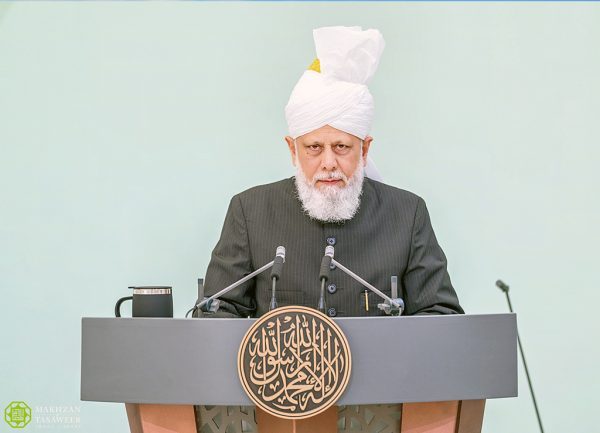
His Holiness (aba) said that as he’s been highlighting various aspects of the moral character of the Holy Prophet (sa), today he would speak about the Holy Prophet’s (sa) trust in God; how he practised it, enjoined it, and set his own example.
Trust in God Removes All Fears
His Holiness (aba) said that God taught the Holy Prophet (sa) about trusting Allah at various instances. For example, God says in the Holy Qur’an:
‘O Prophet, truly We have sent thee as a Witness, and Bearer of glad tidings, and a Warner, and as a Summoner unto Allah by His command, and as a Lamp that gives bright light. And announce to the believers the glad tidings that they will have great bounty from Allah. And follow not the disbelievers and the hypocrites, and leave alone their annoyance, and put thy trust in Allah; for Allah is sufficient as a Guardian.’ (The Holy Qur’an, 33:46-49)
At another instance, God says in the Holy Qur’an:
‘Allah! there is no God but He; so in Allah let the believers put their trust.’ (The Holy Qur’an, 64:14)
His Holiness (aba) quoted the Promised Messiah (as), ‘It is very clear when we study the life of Hazrat Khatamul-Anbiya’ [the Seal of the Prophets], may the peace and blessings of Allah be upon him, that he possessed the highest level of uprightness and integrity. He was ever willing to sacrifice his life for God. He was entirely free from fear or hope from the people and placed his trust only in his Lord. So complete was his submission and devotion to the will of God that he preached His oneness without fear of the calamities that would befall him and the pain and suffering that he would have to endure at the hands of idolaters. In carrying out his Lord’s command, he embraced every tribulation, hardship and affliction.
Undaunted by threats, he fulfilled all the requirements of spiritual exercise, preaching and exhortation. I tell you truly that throughout the history of all other prophets there is not one who showed such trust in God, preached His oneness, forbade idolatry in the face of so much danger, and remained ever-steadfast and firm while facing so many enemies.’ (Barahin-e-Ahmadiyya – Part II, English Translation, pp. 130-131)
The Precondition to Becoming Wholly Devoted to God Almighty
His Holiness (aba) further quoted the Promised Messiah (as), who wrote:
‘It is the Messenger of Allah, our Prophet, who is the true example of complete devotion towards God, excluding all others. The Holy Prophet (sa) neither cared for anyone’s praise nor for their reproach. He was faced with countless hardships, but he did not care in the least. No greed or desire could obstruct the Holy Prophet (sa) from the work of God that he had come to accomplish. Until a person is able to see this state within themselves and passes their test, they should never become free from care.
Moreover, it should also be borne in mind that only when a person becomes completely devoted to God can they nurture trust in Him. That is to say, in order to become a person who trusts God, it is a precondition that one must first become wholly devoted to Him. For while one maintains a relationship of trust and dependency on others, how can one purely trust Allah alone? When a person severs all their ties for the sake of God, they detach themselves from the world and forge a bond with God, and this occurs when they develop absolute trust in God. Just as our Noble Messenger, peace and blessings of Allah be upon him, was a man perfectly and wholly devoted to God, so too he possessed absolute trust in God. This is precisely the reason that he was not awed at all by powerful chieftains who commanded large peoples and tribes, and he was not even the least affected by their opposition. The Holy Prophet (sa) possessed an extraordinary belief in the being of God Almighty. This is how he undertook the magnificent burden that was placed on him and opposed the whole world, without considering the people to have any power whatsoever. This is a formidable example of trust in God, which is unparalleled the world over, because in this a person gives precedence to God and the world becomes their opponent.
However, this state does not develop within a person until they have, as if, seen God, and until they believe that after this, another door will surely open for them. When a person develops this belief and certainty, they are happy to bear the enmity of even their own relatives for the sake of God. For such people know that Allah will give them new friends. They will even give up their property because they know that they will be given something that is better.
In summary, to be wholly devoted to God, excluding all else, is to give precedence to the pleasure of God. In truth, complete devotion to God and trust in God are twins, as it were. The secret that underpins complete devotion to God is trust in God, and the precondition for trust in God is complete devotion to God. This is my belief on the subject.’ (Malfuzat, English Translation, Vol. 4, pp. 27-28)
His Holiness (aba) continued quoting the Promised Messiah (as) who writes:
‘Think not that Allah Almighty is weak. Indeed, He is the possessor of immense power. When you put your trust in Him for support in any matter, He shall come to your aid.
“And he who puts his trust in Allah – He is sufficient for him.”
However, those who were first addressed in these verses were people of faith. All of their thoughts revolved around religion and they left their worldly affairs to God. This is why Allah the Exalted reassured them and told them that He was their support. And so, one of the blessings of righteousness is that Allah the Exalted grants security to a pious person from the afflictions that impinge upon his religious affairs. Despite being unlettered, the Holy Prophet (sa) was to confront the entire world, which included the People of the Book, philosophers, the highly intellectual, scholars and the learned. However, the Holy Prophet (sa) was so amply blessed with spiritual provision that he prevailed over them all and rectified their errors. This spiritual provision is unparalleled. (Malfuzat, English Translation, Vol. 1, p. 11)
God Almighty Continues to Provide for Those Who Trust in Him
His Holiness (aba) said that once, the Holy Prophet (sa) said that if one places their trust in God, then they will certainly be granted provisions, just like a bird. In the morning, a bird leaves its nest with an empty stomach, and returns to its nest in the evening having eaten to its fill. On another occasion, the Holy Prophet (sa) said that heedlessness in the world is not to deem impermissible that which has been made lawful. Instead, heedlessness in the world is to place more trust in that which lies in your hands, more so than that which lies in the hands of God. Therefore, true trust in God means to place one’s complete trust in God, even when they have the means to fulfil an objective in their possession.
His Holiness (aba) said that on another occasion, the Holy Prophet (sa) said that if a person’s primary concern is regarding their spiritual state, then Allah the Almighty tends to all of their other worldly concerns.
His Holiness (aba) said that placing his trust in God was a part of the Holy Prophet’s (sa) everyday life. Whenever he left the home, he would pray, ‘In the name of Allah, having placed my trust in Him; O Allah, we seek Your protection from faltering or from going astray, or from committing excesses or having excesses committed against us, or to adopt arrogance or to be treated in a manner of arrogance.’
His Holiness (aba) said that upon entering into the home, the Holy Prophet (sa) prayed, ‘O Allah, I seek good upon entering my home and good upon exiting my home. We enter in the name of Allah and leave in the name of Allah, and we place our trust in Allah, our Lord.’ The Holy Prophet (sa) said that one should greet those inside the home after reciting this prayer.
His Holiness (aba) quoted the Promised Messiah (as), who writes:
‘There can be progress in man’s faith only when he follows the directives of God Almighty and establishes his trust in God. Once the Noble Messenger, may peace and blessings of Allah be upon him, saw Bilal ra gathering dates. He asked Bilal (ra) why he was doing so. Bilal (ra) said that he was collecting them for the next day. The Messenger (sa) asked him, ‘Do you not believe in the God of tawakkul [trusting in Him]?’ But he said this only to Bilal (ra); he didn’t say it to everyone. Everyone is advised and instructed according to what they can bear.’ (Malfuzat, English Translation, Vol. 9, 323)
Trusting in God Does Not Mean to Abandon Precaution
His Holiness (aba) said that placing one’s trust in God does not mean that they should abandon all care and precaution. It is recorded that someone once asked the Holy Prophet (sa) whether they should leave their camel untied and place their trust in God, or tie their camel and then place their trust in God. The Holy Prophet (sa) said that one should tie their camel and then place their trust in God. Thus, true trust in Allah denotes that one utilises the means and faculties provided by God, and after doing so, they should then place their trust in God. Once, a person went to meet the Holy Prophet (sa) and left his camel untied outside the mosque. When he went back out, his camel was nowhere to be found. He went and told the Holy Prophet (sa) that he had placed his trust in God, yet his camel had run off. The Holy Prophet (sa) said that it would have been better if he had first tied his camel and then placed his trust in God.
His Holiness (aba) said that the Holy Prophet (sa) did not rely on the world and its means; rather, his sights were always set on the heavens, and he would always place his trust in Allah for all matters. Once, Musailimah Kazzab went to the Holy Prophet (sa) with an army, saying that if the Holy Prophet (sa) appointed him as his successor, then he and his army would accept Islam. The state of Islam was weak, and from a worldly lens, having more numbers would have been in its favour. Yet, the Holy Prophet (sa) did not care for the worldly lens and rejected Musailimah’s proposal. The Holy Prophet (sa) said that even if Musailimah had asked for the branch in his hand, he would not have granted it to him. Musailmah’s lot would be no more than what had been decreed for him by God, and if Musailimah turned away, then the Holy Prophet (sa) said that God Himself would hamstring him. The Holy Prophet (sa) said that he had seen a dream about Musailimah, in which he saw himself wearing two bangles, and this displeased him. It was revealed in the dream to the Holy Prophet (sa) that he should blow on the bangles. When he did, the bangles disappeared. The Holy Prophet (sa) understood this to mean that there would be two false claimants after him, namely Aswad Ansi and the other Musailma Kazzab. This shows the depths of the Holy Prophet’s (sa) trust and belief in God.
Funeral Prayers
His Holiness (aba) said that he would lead the funeral prayer in absentia of the following:
Mirza Safdar Mahmud of Pakistan. He was martyred on 2nd September by an unknown assailant who opened fire on him from behind and then fled the scene. On the day of this incident, Mirza Safdar Mahmud was headed to the mosque when the attack took place. He was a mechanic by profession and adopted transparency and truth in all his dealings. He would always help the poor, and no beggar would leave his shop empty-handed. His wife attests that he possessed excellent moral qualities, was regular in offering worship and always made financial contributions and sacrifices on a regular basis. No matter how busy he would get in his work, he would also give precedence to events of the Community. He served the local chapter of the Community in various capacities. He would be the one to open the mosque for prayers. He is survived by his wife and two sons. His Holiness (aba) prayed that may Allah grant the deceased martyr forgiveness and mercy and grant him a lofty station in Paradise. May Allah grant his family patience and protect them.
Amatul Aziz who recently passed away after a long illness. She was the granddaughter of Hazrat Mirza Bashiruddin Mahmud Ahmad (ra). She was His Holiness’ (aba) cousin and the younger sister of His Holiness’ (aba) respected wife. She had two sons, Mahmud Iftikhar and Hashir Ahmad. Both sons served their mother to the fullest extent. Although she faced many difficult circumstances in life, she endured them with great patience. His Holiness (aba) said that he has seldom seen people as patient as she was. She served her parents a great deal. She loved Khilafat a great deal, and she raised her children in an excellent manner. She never said or bore hearing anything negative about anyone. Even when people falsely accused her or spoke ill of her, she always avoided conflict at all costs. She was always kind to others and could not bear to see them in discomfort. She had a great deal of trust in Allah. She enjoined her children to love Khilafat and be loyal to the system of the Community. She cared more for others than herself. Her husband had children from his first wife who had passed away, and she always taught her children to live harmoniously together, and this is something which His Holiness (aba) attested to seeing as well. She always practiced what she preached. She would conceal the secrets and faults of others. His Holiness (aba) prayed that may Allah grant her forgiveness and mercy and elevate her station.
Rashid Ahmad Hayat of Pakistan. He is survived by his wife, two daughters and four sons. His son is a missionary and serving as vice principal of Jamiatul Mubashireen in Ghana. Due to being in the field of service he was unable to attend his father’s funeral. He was devoted to worship, loved Khilafat, and regularly recited the Holy Qur’an. He was regular in offering financial contributions. His Holiness (aba) prayed that may Allah grant him forgiveness and mercy.



Add Comment