
Summary prepared by The Review of Religions
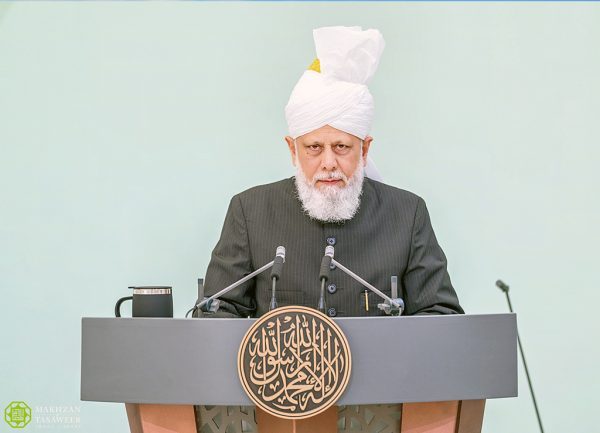
After reciting Tashahhud, Ta‘awwuz and Surah al-Fatihah, His Holiness, Hazrat Mirza Masroor Ahmad (aba) said that he would continue speaking about the lofty standards of truthfulness established through the example of the Holy Prophet (sa).
Spreading Gossip is Akin to Lying
His Holiness (aba) said that once, the Holy Prophet (sa) said that the sign of a person who is given falsehood is that they spread whatever they hear. This is a common habit that exists within the Community as well. His Holiness (aba) said that people often write to him, saying that a certain person acted in a certain way. However, upon investigation, that claim turns out to be false. When questioned, the complainant says they had only heard about it. The Holy Prophet (sa) deemed such people to be false.
His Holiness (aba) said that the companions disliked no attribute more than falsehood. If the Holy Prophet (sa) came to learn that someone had lied, he would feel great pain until that person repented from their falsehood.
His Holiness (aba) said that once, a woman asked the Holy Prophet (sa) whether it was wrong for her to tell her sister-wife that her husband had given her many things, even though he hadn’t, just to bother her sister-wife. The Holy Prophet (sa) said that one who claims to have received that which they have not is akin to a person who wears two garments of falsehood. Here, the word ‘garment’ has been used to indicate that such a person is covered head to toe with falsehood. This was the intricate detail with which the Holy Prophet (sa) enjoined against falsehood.
Lying is a Quality of the Hypocrites
His Holiness (aba) said that the Holy Prophet (sa) once described four qualities of a hypocrite and said that anyone who possessed even one of these qualities possessed a characteristic of hypocrisy, until they abandoned that characteristic:
1. They do not honour the trusts they are given.
2. When they speak, they lie.
3. When they make oaths, they break them.
4. When they quarrel, they use foul language.
Bearing this in mind, everyone must analyse themselves as to the degree to which these characteristics exist within them.
His Holiness (aba) said that the Holy Prophet (sa) warned against those who spread falsities. The Holy Prophet (sa) often asked his companions whether they’d seen any dreams. Once, the Holy Prophet (sa) narrated his own dream in which he saw a man’s face being torn. In the dream, the Holy Prophet (sa) was told that the man whose face was being torn would leave his home and spread rumours in every direction. His Holiness (aba) said that sometimes people create rumours for their own enjoyment or to harm someone. Such people should always remember that they are answerable for these things and so must be very fearful.
Shunning Deception in Our Transactions
His Holiness (aba) said that the Holy Prophet (sa) stated that when two people are making a business transaction, they can terminate it while they are still in each other’s presence, but not after that, when the deal has been made. If they both act with truthfulness and speak truthfully, then their business will be blessed. However, if they hide things and lie, then their business will not be blessed. Many business transactions are based upon falsehood and deceit; such transactions are never blessed.
His Holiness (aba) said that the Holy Prophet (sa) once said that when a person tells a lie, angels move a mile away from them, because of the foul stench that emanates from the person who lies.
His Holiness (aba) said that once, the Holy Prophet (sa) placed his hands in some sacks of grain or wheat and felt some of them to be wet. He asked the seller about this. The seller said it had rained, which made them wet. The Holy Prophet (sa) asked him why he did not place them on top of the pile, rather than hiding them at the bottom, so that people could know. The Holy Prophet (sa) said that one who deceived was not from among his people. This was the degree to which the Holy Prophet (sa) enjoined against deceit. Yet, it is unfortunate that today, many Muslims engage in deceitful business. Therefore, it is our responsibility as followers of the Holy Prophet (sa) to uphold the highest standards of truthfulness.
His Holiness (aba) presented the quote of an author who spoke about the truthfulness and trustworthiness of the Holy Prophet (sa). The author writes that the Holy Prophet (sa) was never swayed by the people and stood firm against the worship of idols. He was also known to be extremely truthful, to the extent that people would come to him to make decisions.
Falsehood is Akin to Idol Worship
His Holiness (aba) quoted Hazrat Mirza Bashiruddin Mahmud Ahmad, the Second Caliph of the Ahmadiyya Muslim Community, who writes that a great testament to the character of the Holy Prophet (sa) was the titles which he was given by his own people: Al-Sadiq (The Truthful) and Al-Amin (The Trustworthy). Such titles are not given out by a nation without just cause, just as every British soldier does not receive the distinction of the Victoria Cross. A person being truthful and trustworthy is not itself a great feat, but what is a great feat is to be regarded as truthful and trustworthy by the entire nation. Never in the history of Arabia was anyone unanimously given the titles of The Truthful and The Trustworthy, other than the Holy Prophet (sa).
His Holiness (aba) quoted the Promised Messiah (as), who said that our world is in a precarious state, where falsehood is common. Indeed, false witnesses, false cases, and even forged documents are common. People do not rely on speaking the truth but rely on saying what benefits them. Yet, this was not the teaching brought by the Holy Prophet (sa). In fact, the teaching brought by the Holy Prophet (sa) was that falsehood is akin to idol worship, as is stated in the Holy Qur’an:
‘Shun therefore the abomination of idols, and shun all words of untruth.’ (The Holy Qur’an, 22:31)
His Holiness (aba) said that the Promised Messiah (as) further explained that when a person lies, they effectively make that lie their idol. Just as people rely on idols for their own gain, that person relies on falsehood for their personal gain. Then, people begin to think that without relying on falsehood, they cannot get by. How unfortunate it is that people rely on falsehood. But indeed, the ultimate victory is of the truth.
Testimonies to the Truthfulness of the Holy Prophet (sa)
His Holiness (aba) quoted Hazrat Mirza Bashiruddin Mahmud Ahmad (ra), who said that when the Holy Prophet (sa) went to his wife and told her for the first time the revelation he had received, her initial response was not to question him and say that he was making up stories. Instead, she immediately said that whatever he said was true, and that God would never humiliate him, because he was kind to his relatives, helped the poor, revived lost virtues, was hospitable to guests and supported the truth. Then her cousin Waraqah bin Naufal also attested to his truth. Then his own cousin, his freed slave, his closest friend, indeed his closest relations all attested to his truthfulness immediately upon hearing his claim because they had seen up close the high and lofty moral standards of truthfulness in the Holy Prophet (sa). Thus, upon hearing the jeers and jests of the Makkans, the Holy Prophet (sa) surely would have smiled and said that these are just the claims of those who did not know him. In contrast, the testimonies of those who knew him intimately were clear and incontrovertible in favour of his truth. It was for this very reason that these same people were willing to stand so staunchly for the truth and supported the Holy Prophet (sa) despite facing constant struggles and hardships.
His Holiness (aba) continued quoting the Promised Messiah (as), who said that what else was it that enabled Hazrat Abu Bakr (ra) to immediately accept the Holy Prophet’s (sa) claim when he had only heard about it from someone else? Without seeking proofs of the claim or any signs or miracles? It was solely because he had seen the immense degree of truthfulness and straightforwardness within the Holy Prophet (sa) from the time of his childhood, which persisted throughout his life. Thus, the very first proof for the truthfulness of a prophet is his own character. That serves as such a magnificent proof that it does not require any other sign or miracle.
His Holiness (aba) prayed that may Allah enable everyone to follow in the Holy Prophet’s (sa) footsteps, adopting the teachings of the Holy Qur’an and his example and elevate the standards of our truthfulness.


Add Comment