
Summary prepared by The Review of Religions
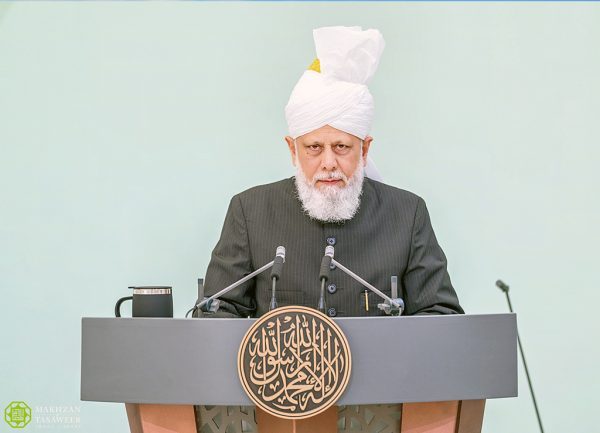
After reciting Tashahhud, Ta‘awwuz and Surah al-Fatihah, His Holiness Hazrat Mirza Masroor Ahmad (aba) recited the following verse of the Holy Qur’an:
‘Say, ‘I ask not of you any reward for it, nor am I of those who are given to affectation.’ (The Holy Qur’an, 38:87)
His Holiness (aba) said that in this verse, God instructed the Holy Prophet (sa) to announce that the message he was spreading was solely for the benefit of the people and for the betterment of their lives in this world and the hereafter; he did not require any reward or recompense in return. His recompense would be from the One Who possesses all the treasures in the universe, and he had no need or desire for worldly treasures. God Himself was already tending to all his basic needs, and he needed no more. Such was the simplicity of the Holy Prophet (sa), which was expressed in various ways throughout his life.
The Holy Prophet’s (sa) Desire to Be Raised Among the Meek
His Holiness (aba) said that once, the Holy Prophet (sa) said, ‘The sons of Adam have rights over nothing except that they should have one home, enough clothes to cover themselves, dry bread and water.’ In reality, the Holy Prophet (sa) was describing the manner in which he lived himself.
His Holiness (aba) said that on another occasion, the Holy Prophet (sa) instructed us to love the poor, and he prayed, ‘O Allah, allow me to live in meekness and die in meekness and raise me up among the meek.’ Similarly, while enjoining believers to embrace simplicity, the Holy Prophet (sa) advised that simplicity is part of faith. The Holy Prophet (sa) also said that Allah certainly loves those who are believers, who are poor, who avoid begging, and have a family. One can avoid begging by living a life of simplicity and contentment.
The Poor Will Enter Paradise Before the Wealthy
His Holiness (aba) said that once, some poor migrants complained to the Holy Prophet (sa), saying that God had given precedence to the wealthy over them. The Holy Prophet (sa) replied, saying that a poor believer will enter Paradise 500 years before a wealthy person. Thus, how fortunate are those who live lives of simplicity and contentment. Yet, today, the world encourages a mindset of greed to the degree that people’s minds are set only on the world. Those who adhere to the advice of the Holy Prophet (sa) will certainly reap the rewards of Allah. At the same time, this does not mean that one should sit idly. Rather, it means that one should strive and make all the efforts that they can; then after doing so, they should incline toward living with simplicity and leading a life of contentment.
His Holiness (aba) said that once, the Holy Prophet (sa) advised that one should live in the world like a traveller. When it is morning, do not anticipate the night, and when it is night, do not anticipate the morning. In times of health, make provisions for times of sickness; in life, prepare for death. In other words, in every state, one should remain mindful of God’s pleasure and meeting Him.
The Holy Prophet’s (sa) Discontent Over Excessive Praise
His Holiness (aba) said that the Holy Prophet (sa) would advise not to become excessive in praising him, as the Christians did in the case of Jesus (as), and thus considered him to be God. The Holy Prophet (sa) advised his companions to say that he is just a servant of God and His Messenger (sa). Once, someone went to the Holy Prophet (sa) and said that he was their leader. The Holy Prophet (sa) replied by saying that the true leader is God. The man then said the Holy Prophet (sa) was the greatest among them in benevolence and kindness. The Holy Prophet (sa) prompted him to stop such talk and return to the actual subject he wished to discuss, lest Satan incite him. The Holy Prophet (sa) taught not only simplicity, but also to avoid even the subtlest forms of associating partners with God.
His Holiness (aba) said that once, a group of girls were beating a drum and singing songs praising the martyrs of Badr and also praising the Holy Prophet (sa). As they did so, they said that a prophet was among them who knew what would happen the next day. The Holy Prophet (sa) stopped them, as their praise had gone too far and was turning into association of partners with God. The Holy Prophet (sa) told them to stop such praise and to return to the initial subject of the martyrs of Badr.
His Simple Life at Home
His Holiness (aba) said that the Holy Prophet (sa) had a small home of no more than a ten-by-fifteen-foot room, which served as his home by the Prophet’s Mosque. As the Holy Prophet (sa) married, similar rooms were prepared as homes. While other homes in the city were built of stone, the Holy Prophet’s (sa) homes were built of clay and date palms. According to some accounts, these rooms were five meters by four meters, and the roof was only high enough that one could raise a hand and touch it. After the Holy Prophet’s (sa) demise, most of these homes were demolished, but some companions longed for them to remain standing so people from far and wide could come and see the great simplicity with which the Holy Prophet (sa) lived.
His Holiness (aba) said that the Holy Prophet (sa) did not have a bed; instead, he slept on a cot on the floor. His wife Hazrat A’ishah (ra) said they often had only dates and water at home to eat and drink. Indeed, on the day of the Holy Prophet’s (sa) demise, the only food and drink in the home were dates and water.
His Holiness (aba) quoted the Promised Messiah (as), who writes:
‘Just think how, to his last breath, the Holy Prophet (sa) steadfastly and unwaveringly held on to his claim of prophethood in the face of countless perils and so many enemies, detractors and threateners. The persecution and hardship he endured for years seemed to preclude all possibility of success, and were increasing day by day. His patient response to them clearly rules out any plans for material gain. On the contrary, the very moment he made his claim to prophethood, he lost even the little support he already had. With a single announcement, he made innumerable enemies and brought upon himself countless tribulations. He was forced into exile, pursued by bloodthirsty enemies; his home and property were destroyed, and repeated attempts were made to poison him. Those who were once his well-wishers turned against him, and friends became foes. The severe hardship he endured for so long and with such fortitude could not have been tolerated by a deceiving imposter. And when, at long last, Islam became victorious and a time of ease and prosperity ushered in, he accumulated no wealth, built himself no citadels or mansions, piled up no provisions for luxurious and royal living, and made no personal acquisitions. Rather, he gave away everything to orphans, the needy, widows, and those burdened by debt, while he himself never even enjoyed a full meal.’ (Barahin-e-Ahmadyyat Part I, English Translation, pp. 127-128)
His Holiness (aba) said that according to Hazrat A’ishah (ra), the Holy Prophet’s (sa) bed was made of leather and stuffed with date-palm leaves. Hazrat Hafsah (ra) said that she used to make two folds in the sheet that the Holy Prophet (sa) would sleep on. One night, she thought that for the Holy Prophet’s (sa) comfort, she should fold it four times. The next morning, the Holy Prophet (sa)asked whether she had changed his bedding. She replied that it was the same bedding, but she had folded it four times. The Holy Prophet (sa) asked her to continue making the bed as she used to before, lest the added comfort should make it difficult to rise for prayer. This did not mean the Holy Prophet (sa) had actually found it difficult to rise for prayer that now concerned the degree of concern was he Holy Prophet (sa) had that might the future, there should be even the slightest detraction from being able to offer prayer.
His Gaze Upon the Hereafter, not the World
His Holiness (aba) said that once, Hazrat Umar (ra) visited the Holy Prophet (sa) at his home. When he entered the Holy Prophet’s (sa) room, the Holy Prophet (sa) lay on a rough grass mat. Hazrat Umar (ra) could see the imprints of the rough bed upon the Holy Prophet’s (sa) back. This brought Hazrat Umar (ra) to tears as he said that the Holy Prophet (sa) was living in such conditions while Caesar and Chosroes were living in such luxury. The Holy Prophet (sa) replied, ‘Are you not content that they have this world while we have the hereafter?’
His Advice to His Daughter
His Holiness (aba) said that the Holy Prophet (sa) also enjoined his children to adopt simplicity. Once, his daughter Hazrat Fatimah (ra) came to him and complained about the difficulty she faced in crushing grains. During that time, the Holy Prophet (sa) had received some slaves. Hazrat Fatimah (ra) went back to the Holy Prophet’s (sa) home to request that one of them be assigned to her, but she did not find him there.
Later, when the Holy Prophet (sa) returned home, Hazrat A’ishah (ra) told him that Hazrat Fatimah (ra) had come to see him. So, the Holy Prophet (sa) went to her home and said, ‘Shall I not tell you of something which is even better than that which you have requested? It is that when you lie in your bed, glorify God’s name saying “Allah is the Greatest” 34 times, say “Holy is Allah” 33 times and say “All praise belongs to Allah” 33 times. This is better than having a slave.’ It was the Holy Prophet’s (sa) practice that whatever he received in wealth or in slaves, he would not keep it for himself or his family, but would distribute it all among the people.
An Example for Husbands in How to Treat Their Wives
His Holiness (aba) said that at the time of Hazrat Fatimah’s (ra) marriage, the Holy Prophet (sa) sent her to her new home with silk cloth, a leather cushion, date fibres, two grain grinders and a water skin. Such was the Holy Prophet’s (sa) simplicity. Had he wanted to, he could have sent more. People often take out loans to send things with their daughters. The Holy Prophet’s (sa) companions would have been eager to help him; yet the Holy Prophet (sa) chose simplicity. Hazrat Fatimah’s (ra) wedding was also very simple. The guests were given dates, grapes and water. Thus, the Holy Prophet (sa) taught his daughter to adopt simplicity and focus on attaining the pleasure of God.
His Holiness (aba) said that the Holy Prophet’s (sa) own home life was also simple. When asked what the Holy Prophet (sa) would do at home, Hazrat A’ishah (ra) said that he would help with various chores at home, and then when it was time for prayer, he would go to offer the prayer. His Holiness (aba) said that many women write to him saying that their husbands adopt a very cruel and controlling demeanour at home, whereas the example of the Holy Prophet (sa) was entirely to the contrary. They must reflect on this and adopt the example which the Holy Prophet (sa) established.
The Humble Lives of Prophets
His Holiness (aba) said that once, the Holy Prophet (sa) and some companions were passing by some fruit trees. The Holy Prophet (sa) told the companions to eat fruit from a certain tree, as its fruit was very sweet. The companions asked him how he knew this. The Holy Prophet (sa) said that he knew this from the days when he used to be a shepherd. Thus, God does not desire for prophets to come from lofty lives; rather, as did the Holy Prophet (sa), they come from lives of work and simplicity.
His Holiness (aba) said that it is recorded that, as the Holy Prophet (sa) was making his way home one day, an elderly woman stopped him. She began speaking to him about her life’s circumstances, and the Holy Prophet (sa) listened to her patiently until she was done. The person with the Holy Prophet (sa) thought to himself that this could not be a king, because kings do not possess such morals. Then the man accompanied the Holy Prophet (sa) to his home, saw the leather mat on which the Holy Prophet (sa) would sleep, and again thought that this man could not be a worldly king. Upon seeing the great simplicity of the Holy Prophet (sa), this man was so moved that he accepted Islam.
Appeal for Prayers for Ahmadis in Pakistan and Malaysia
His Holiness (aba) made an appeal for prayers for the Ahmadis in Pakistan. Unjust and cruel people who have personal interests are using the name of God and His Messenger (sa) to perpetrate cruelties against Ahmadis. Due to fear of the clerics, lawmakers are afraid to even grant freedom to Ahmadi prisoners who are held only on the basis of their faith. His Holiness (aba) prayed that may Allah bring these evildoers swiftly to account.
His Holiness (aba) said that the Ahmadis in Pakistan should particularly pay attention to sending salutations upon the Holy Prophet (sa), praying for forgiveness, and reciting the prayers which he advised some time ago.
His Holiness (aba) said that the situation for Ahmadis in Malaysia is also precarious. The government there is being unjust towards Ahmadis, and random raids are carried out on Ahmadi mosques. His Holiness (aba) prayed that may Allah protect the Ahmadis in Malaysia.


Add Comment