
676 CE (56 AH)
Amir Mu’awiyahra appoints his son, Yazid, as his “heir apparent”.
April 680 CE (Rajab 60 AH)
Amir Mu’awiyah (ra) passed away at the age of 70. When Yazid ascends the throne, he wrote to all the governors to take the pledge of allegiance (Bai’at) from all their subordinates. Al-Walid bin Utbah, the governor of Madinah, was tasked with obtaining the pledge of allegiance from Abdullah bin Umar (ra) , Abdullah bin Zubair (ra) and Husain bin Ali (ra) . All three refuse to pledge allegiance. Abdullah bin Zubair (ra) and Husain bin Ali (ra) leave Madinah for Makkah along with their families.
Meanwhile, the people of Kufa wished for Husain (ra) to become the Caliph and sent letters to him in Makkah urging him to come to Kufa. When he received a considerable number of these letters, Husain (ra) sent his cousin, Muslim bin Aqil bin Abu Talib to go to Kufa and assess the situation. Upon his arrival in Kufa, more than 10,000 people came to see him and all of them pledged allegiance to Husain bin Ali (ra). They also tell him that if Imam Husain (ra) personally comes, there would be thousands more ready to join his ranks. Seeing the willingness of the Kufans, Muslim bin Aqil wrote to Husain (ra) in Makkah, informing him of the situation and advised him to come to Kufa.
The governor of Kufa, Nu’man bin Bashir did not take any action against Muslim bin Aqil. When Yazid learnt of this, he immediately dismissed Nu’man bin Bashir from office and appointed Ubaidullah bin Ziyad, the governor of Basra, to take over in Kufa and to crush the uprising by force, including the arrest and detention of Muslim bin Aqil. But before Ubaidullah had left for Kufa, Husain’s (ra) emissary, a man named Sulayman, came to Basra to seek support for his cause. Ubaidullah arrested him and gathered the people of Basra. Ubaidullah issued an ultimatum to all the people of Basra saying that anyone who pledges allegiance to Husain bin Ali (ra) or does not recant from their pledge, would be put to death. He then killed the emissary of Husain (ra) in front of the entire gathering.
When Ubaidullah arrived with his army in Kufa, he set about looking for Muslim bin Aqil, who was staying with a man named Hani bin Urwa. He was arrested and questioned. Muslim bin Aqil called on the supporters who had pledged allegiance to Husain (ra) to help him release Hani. Only 4,000 people responded to his call but many of their family members dissuaded them from joining the rally cry. As a result, this army withered down to only 500 men. Muslim bin Aqil laid down his arms and was taken to Ubaidullah. The next day, Ubaidullah ordered for both of them to be hanged on the rooftop for everyone to see.
Unaware of any of these events, Husain (ra) made preparations to leave Makkah for Kufa. Yazid issued orders to Ubaidullah to prevent Husain (ra) from reaching Kufa. Abdullah bin Umar (ra), Abdullah bin Abba (ra) and Abdullah bin Zubair (ra) all tried to stop him. They said that the Kufans were not to be trusted since both Hazrat Ali (ra) and Hazrat Hasan (ra) were let down by them. However, Husain (ra) responded that since he had given his word to the Kufans, he would not go back on his word.
September 680 CE (Dhu al-Hijjah, 60 AH)
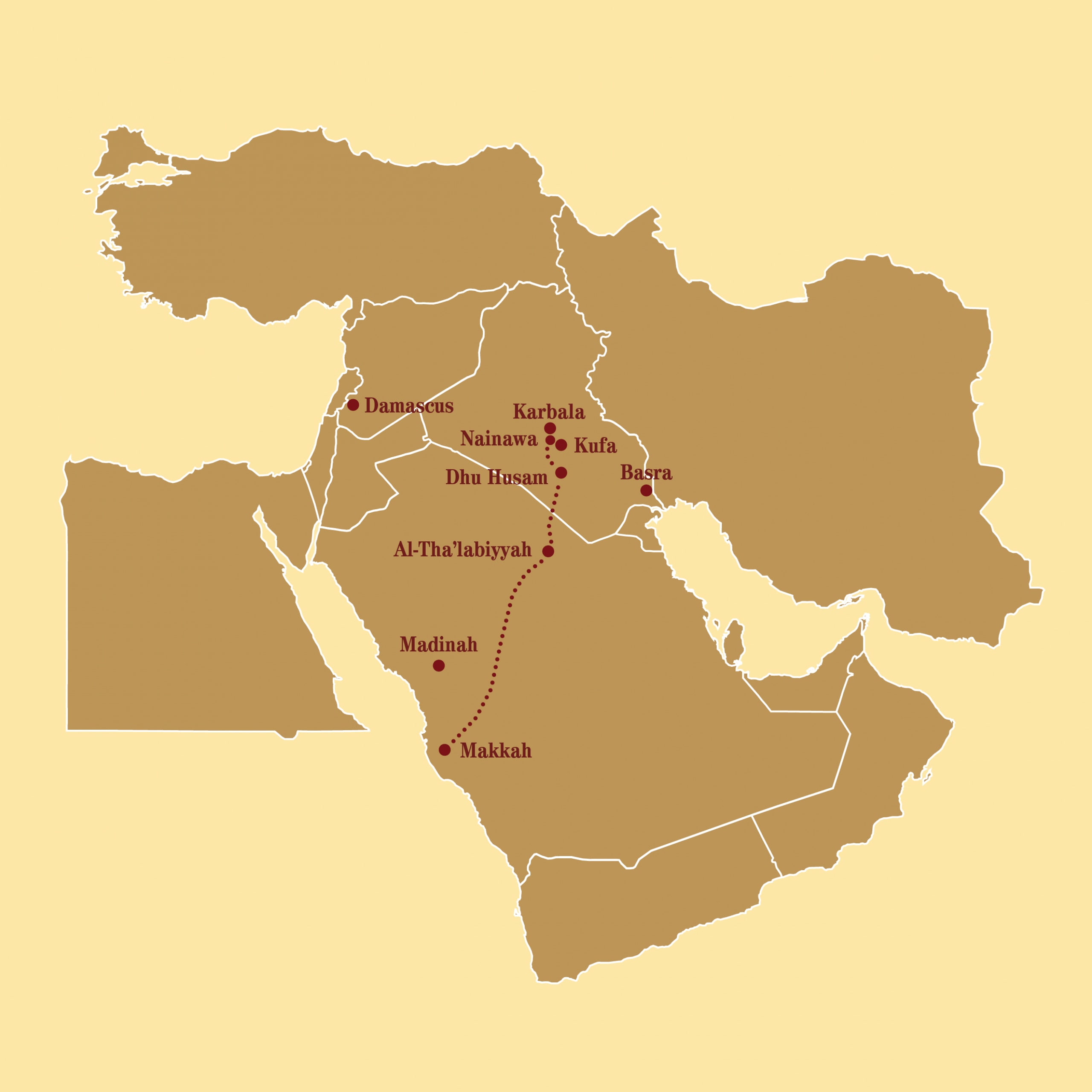
After performing Umrah [pilgrimage performed outside of Hajj] Husain (ra) set off from Makkah towards Kufa with approximately 72 people, which comprised of members of his household, including women and children and also some of his supporters.
When he reached a place named Al-Tha’labiyyah, he received news that Muslim bin Aqil and Hani bin Urwa had been killed and that the Kufans no longer supported him. Some people in Husain’s (ra) caravan urged him to continue to Kufa, saying he would receive support once the Kufans physically see him. Husain (ra) agreed to go ahead but advised everyone who was with him that they were free to leave, as the situation had changed.
Meanwhile, Ubaidullah bin Ziyad sent Al-Hurr bin Yazid al-Tamimi with an army of 1000 men to bring Husain (ra) to him. He also gave 4000 men to Umar bin Sa’d to guard all the routes in and out of Kufa.
When Husain (ra) reached Dhu Husam, he encountered the army of Hurr. Seeing the parched state of Hurr’s army, Husain (ra) ordered for Hurr’s men and cavalry to be given water to drink. Husain (ra) also led the midday prayer and the army of Hurr prayed behind him. Husain (ra) explained the reason for his coming based on the insistence of the Kufans. But stated that if they had recanted from this, then he would turn back to Madinah. Hurr stated that he was unaware of any such correspondence; he was given orders to detain him and take him to Ubaidullah bin Ziyad to pledge allegiance to Yazid. Therefore, he could not let him turn back, nor enter Kufa. Husain (ra) responded that he would not pledge allegiance and ordered his camp to depart. However, Hurr blocked his path to Kufa forcing Husain (ra) to change course, with Hurr’s army following Husain’s (ra) every move.
2nd October 680 CE (2nd Muharram 61 AH)
Husain (ra) eventually arrived at Nainawa towards the last few days of Dhu al-Hijjah, 60 AH A messenger of Ubaidullah bin Ziyad arrived, ordering Hurr to force Husain to stop in an open plain, without protection and water. In search of water Husain (ra) travelled along the Euphrates River, and reached the plains of Karbala on 2nd Muharram, 61 AH.
The next day, Umar bin Sa’d arrived with an army of 4000 men, some of whom had written to Husain (ra) calling him to Kufa. Husain (ra) began a dialogue with Umar bin Sa’d, to seek a peaceful outcome. Eventually Husain (ra) concluded:
“I present to you three options regarding me:
- Let me go back to the place from where I came [i.e. Makkah]
- Let me go to any frontier, where I can fight and be martyred for the sake of Islam
- Allow me to go to Yazid in Damascus and settle my affair with him directly, just like my elder brother [Hasan (ra)] settled the matter with Amir Mu’awiyah.”
Umar bin Sa’d sent these proposals to Ubaidullah bin Ziyad. His advisor, Shimr bin Dhi al-Jawshan urged him not to let Husain (ra) go now that he was in his grasp as this would indicate weakness. Ubaidullah became paranoid that if Umar accepted Husain’s (ra) viewpoint, it would greatly strengthen his cause and they would gain a considerable army. To prevent this from happening, Ubaidullah wrote back to Umar stating that if Husain (ra) pledged allegiance, they should be granted peace, otherwise he should fight against them. And if he refused or hesitated in taking action, then Shimr would take command of the army.
7th October 680 CE (7th Muharram, 61 AH)
Upon receiving this letter, Umar bin Sa’d positioned 500 horsemen along the Euphrates River to cut off Husain’s (ra) access to water.
9th October 680 CE (9th Muharram, 61 AH)
Despite several attempts by Husain (ra) to seek a peaceful resolution, Umar bin Sa’d lined up his army to begin the battle. However, Husain (ra) asked him to delay the battle until the next day, which he accepted.
Husain (ra) spent the night in prayers and worship. He also asked his comrades, who numbered approximately 72, to leave under the cover of the night to save themselves, but they all refused to abandon him.
10th October 680 CE (10th Muharram, 61 AH)
After offering the morning [Fajr] prayer, Husain (ra) arranged his comrades in rows and delivered one final speech reminding the Muslims of their responsibilities and to desist from fighting. Al-Hurr bin Yazid, who had previously blocked Husain (ra)’s path defected and joined the army of Husain (ra), vowing to make amends for his earlier mistake. Despite all this, Husain (ra) refused to attack first. Umar bin Sa’d fired the first arrow towards Husain’s (ra) army. Amr bin al-Hajjaj commanded the right flank and Shimr bin al-Jawshan was commander of the left flank of Umar’s army. Imam Husain (ra) appointed Zuhair bin al-Qayn as commander of the right flank and Habib bin Muzahir to command the left flank while his half-brother, Abbas, was appointed as the standard bearer.
When the Umayyad cavalry charged at them, Imam Husain (ra) raised his hand and prayed:
“O God! It is You in Whom I trust amid all grief. You are my hope amid all distress. You are my trust and provision in everything that happens to me, no matter how much the heart may seem to weaken, ingenuity to fail, the friend to desert and the enemy to rejoice. I have received it through You and I complain to You out of my desire for You, You alone. May You dispel it for me and relieve me of it. You are the Master of all grace, the Possessor of all goodness and the Ultimate Resort of all desire.”
Every single one of Husain’s (ra) comrades were martyred one by one. Leaving Husain (ra) alone to fend off the army. Despite being wounded, some of the soldiers were hesitant on killing Husain (ra). Eventually, Shimr took a group of 10 soldiers and attacked Husain (ra). Sinan bin Anas stepped forward and delivered the fatal blow and is recorded in history as the one who severed the blessed head of Husain (ra). It was sent to Ubaidullah bin Ziyad who put it on display in Kufa before sending to Yazid in Damascus. Umar bin Sa’d then asked for volunteers to trample over the body of Husain (ra) on with their horses. The women and children, including one infant son of Husain (ra) known as “Zain al-Abidin”, were sent to Yazid in Damascus. He later allowed them all to return to Madinah.
Those martyred in Husain’s (ra) army included Husain’s (ra) own sons, his paternal half-brothers, his nephews (sons of Hasan (ra) and Zainab bint Ali (ra)), sons and grandsons of his uncle Aqil bin Abi Talib, as well as grandchildren of his other uncle, Ja’far bin Abi Talib (ra).
Bibliography
Hazrat Mirza Bashiruddin Mahmud Ahmad (ra), Khilafat-e-Rashida.
Friday Sermon, Hazrat Mirza Masroor Ahmad (aba), 10th December 2010, 23rd November 2012, 28th August 2020.
Sahih al-Bukhari.
Muhammad ibn Jarir al-Tabari, Tarikh al-Tabari.
Ibn al-Athir, Al-Kamil fi al-Tarikh.
Akbar Shah Najeebabadi, History of Islam – Vol. I & II.
Ibn Hajar Asqalani, Al-Isabah fi Tamyiz al-Sahabah.
Professor Abdus Salam, “A Short Sketch of Muslim History,” The Review of Religions. October 24, 2016.(https://www.reviewofreligions.org/12789/from-the-archives-a-short-sketch-of-muslim-history/)
No related posts.
Add Comment