
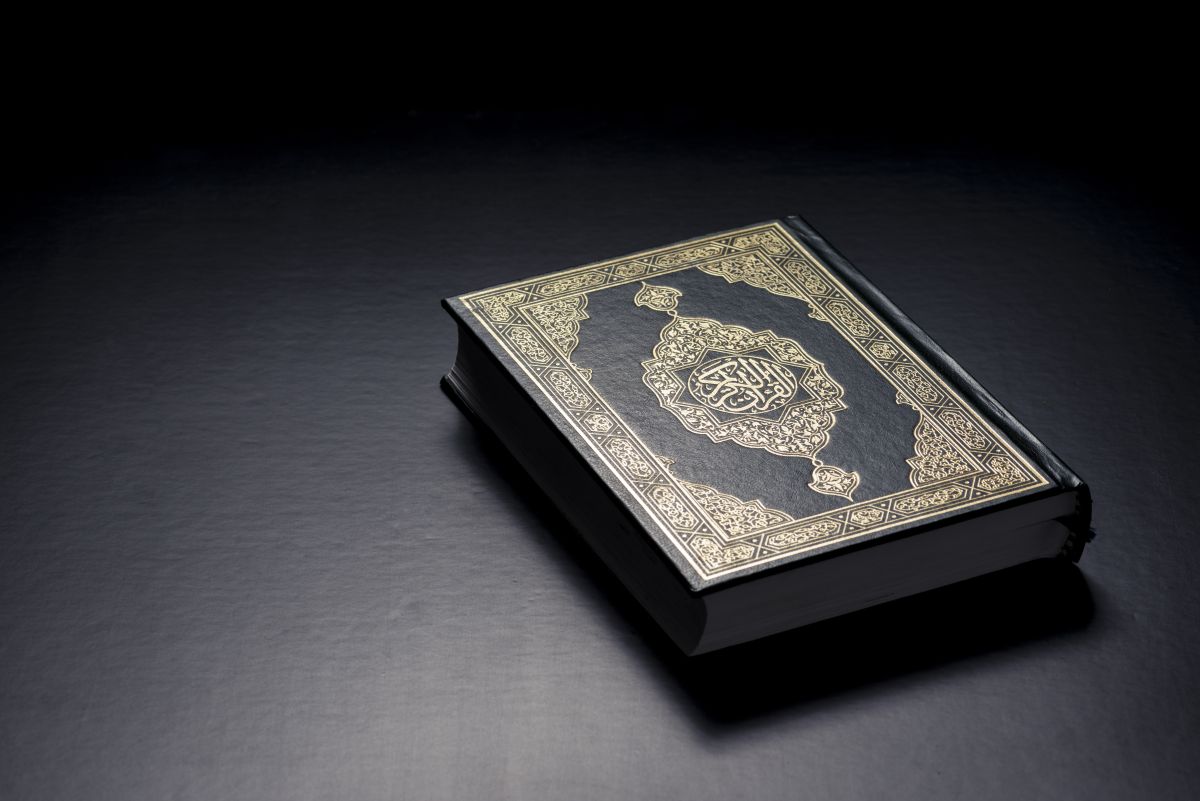
© Shutterstock
Shahzad Ahmed, London, UK
There is perhaps not a single human culture or society where poetry is not found. When it comes to articulating the deepest human emotions, evoking intense passion or expressing abstract thoughts – poetry (arguably) has no equal amongst literary forms. From its prehistoric roots, whether it be the epic of Gilgamesh or Homer’s ‘The Iliad’ and ‘The Odyssey’, it enjoys an enduring legacy and an indelible impact.
The Arabs valued poetry and had a strong oral tradition. Moreover, they valued beautiful and powerful language and poets were influential members of society. When the Qur’an was revealed, the act of writing it standardised the Arabic language, while the beauty of its prose led to the conversion of many. Thus, the Qur’an was instrumental in developing Arabic literary tradition.
The era prior to the dawn of Islam in Arabia is known as the period of Jahiliyyah, an age of ignorance and darkness. But despite the Arabs being steeped in all kinds of moral and spiritual decay, and largely illiterate, its poetic tradition, was renowned for its powerful literary style, richness, eloquence and rhythm.
The poetic tradition that emerged amidst the Bedouin tribes in the desert sands of Arabia prior to Islam was not just an expression of emotion; in fact, the Arab poet stood amongst the very elite and the power that they wielded – through the craftsmanship of their expression and astounding eloquence – was perhaps even greater than the might of the sword. Their poetic verses could instantly raise the reputation of any tribe and enhance its grandeur and glory, yet, at the same time, it was equally powerful in bringing utter humiliation and disgrace to an entire clan in an instant. A single verse could ignite the hearts and lead to wide-scale bloodshed or end centuries of feuds and rivalries. Much like the powerful influence of the modern-day media, the Arab poets could sway opinions and narratives.
Poetry was integral to society, and the annual festivals and trade fairs that took place across Arabia were renowned and eagerly anticipated for their poetic battles. The poets from various tribes across the land would gather and passionately compete in the mastery of their skill, genius and poetic flair. The more eloquent and fluent a poet was, the greater the honour they brought to their tribe.
Apart from its social and cultural importance, the poets of pre-Islamic Arabia have played a crucial role in the preservation of their history, people and customs. Their poetry reflected the everyday life, the stories and major events of their tribes and the history of their ancestral lineage. In this era, writing was not widespread. Instead, almost every tribe possessed its own poet, who would preserve the history of his tribe through poetry. These verbal narrations, passed down from generation to generation, have become a vital source of Arabian history which no historian can disregard.
The Arabs were well aware of the excellence of poetry and its significance. Thus, they would rejoice and offer felicitations to one another on three instances: ‘firstly, at the birth of a boy, secondly, at the rise of a new poet and thirdly, at the birth of an exceptional calf.’[1]
Some of the renowned and famous poets of the time include: Imra’-ul-Qais, Nabighah Dhubyani, Zuhair, Turfah, ‘Antarah, ‘Alqamah, A‘asha’, ‘Amr bin Kulthum, Umaiyyah bin Abi Salt, Ka‘b bin Zuhair, Labid, Hassan bin Thabit and Khansa’. Their poetic works are regarded as the precious jewels of their national heritage. The Al-Mu’allaqat – a collection of seven pre-Islamic Arabic odes – are a powerful enduring legacy of that era, representing some of the finest early Arabic poetry which is renowned till this day for its powerful themes and astounding composition of structure, rhythm and words.[2]
The emergence of Islam brought about an incredible transformation amongst the Arab people – at the very heart of which was the divine revelation being sent down to the Holy Prophet (sa) in the form of the Holy Qur’an. Aside from its immaculate teaching, sublime moral code, spiritual insights and powerful prophecies, the very language of the Qur’an was an extraordinary miracle in itself. And who could appreciate this more than the Arabs themselves, who had reached the summit of their literary attainments, but were now presented with a scripture that was unparalleled in its composition, flow, eloquence, brevity and depth. A famous historian of Islam, Karen Armstrong, notes of the Qur’an, ‘It is as though Muhammad had created an entirely new literary form…’ [3]
In their utmost efforts to dissuade people from being influenced by the message of the Holy Qur’an, the disbelievers of Makkah would level all kinds of false charges against the Holy Prophet (sa), one of them being that he was a poet.[4] They would warn people to not go near him lest his enchanting words entered their ears. However, had the Qur’an not held such lofty literary merit, the Arabs – who took great pride in their eloquence and fluency of speech – would have been the first to object and critique it.The Holy Qur’an went on challenge people to produce even a single chapter like it. Yet, it remains unchallenged till this day. In fact, far from being challenged, the Arabs were left awestruck by its literary brilliance. Renowned poets of the era, the likes of Ka‘b bin Zuhair, Labid, Hassan bin Thabit and Khansa embraced Islam at the hands of the Holy Prophet (sa). To quote the British orientalist George Sale, who has aptly described the supreme literary excellence of the Holy Qur’an:
‘I will mention but one instance out of several, to show that this book was really admired for the beauty of its composure by those who must be allowed to have been competent judges. A poem of Labid Ibn Rabia, one of the greatest wits in Arabia in Mohammed’s time, being fixed up on the gate of the temple of Mecca, an honour allowed to none but the most esteemed performances, none of the other poets durst offer anything of their own in competition with it. But the second chapter of the Koran being fixed up by it soon after, Labid himself (then an idolator) on reading the first verses only, was struck with admiration, and immediately professed the religion taught thereby, declaring that such words could proceed from an inspired person only. This Labid was afterwards of great service to Mohammed, in writing answers to the satires and invectives that were made on him and his religion by the infidels, and particularly by Amri al Kais, prince of the tribe of Asad, and author of one of those seven famous poems called al Mollakat.’[5]
Another famous incident is that of Tufayl Dawsi, a distinguished Arab noble who was a chieftain and a great and reputable poet himself from the south of Arabia. Having travelled to Makkah, completely unaware of the Holy Prophet’s (sa) claim, he was immediately warned by the Quraish of Makkah of the state of affairs. They drummed-up their usual false propaganda and cautioned him to stay well clear of the Holy Prophet (sa), claiming that, God-forbid, ‘He has the speech of a wizard, causing division between father and son, between brother and brother and between husband and wife.’
Tufayl, in his words, states:
‘The following morning, I went to the Sacred Mosque to make tawaf [circuits] around the Kabah as an act of worship to the idols…I inserted a piece of cotton in my ears out of fear that something of the speech of Muhammad would reach my hearing. As soon as I entered the Mosque, I saw him standing near the Kabah. He was praying in a fashion which was different from our prayer… The scene captivated me. His worship made me tremble and I felt drawn to him…Notwithstanding the precaution I had taken, God willed that some of what he was saying should reach my hearing and I heard a speech that was so beautiful that I said to myself, ‘What are you doing, Tufayl? You are a perceptive poet. You can distinguish between the good and the bad in poetry. What prevents you from listening to what this man is saying? If what comes from him is good, accept it, and if it is bad, reject it.’
I remained there until the Prophet left for his home. I followed him as he entered his house, and I entered also and said, ‘O Muhammad, your people have said certain things to me about you. By God, they kept on frightening me away from your message so that I even blocked my ears to keep out your words. Despite this, God caused me to hear something of it and I found it good. So tell me more about your mission.’
The Prophet, peace be upon him, did and recited to me Surah al-Ikhlas and Surah al-Falaq [the last two verses]. I swear by God, I had never heard such beautiful words before. Neither was a more noble or just mission ever described to me. Thereupon, I stretched out my hand to him in allegiance and testified that there is no God but Allah and that Muhammad is the messenger of Allah. This is how I entered Islam.[6] Such was the enchanting and captivating nature of the Holy Qur’an and its linguistic excellence.
Since oral tradition was a dominant feature of their culture, the Arabs possessed an extraordinary distinction in their retentive faculties, easily memorising hundreds of verses. However, with the revelation of the Holy Qur’an, the revealed words of God now became the centre of their reverence and devotion. Their fondness for poetic verses and its gatherings had now been replaced with a deep love for the Holy Qur’an and its melodious recitations. They would eagerly await for any new divine revelation and commit it to memory at once. They would recite it in their daily prayers, discuss it in their gatherings and deeply contemplate over its meanings. It is said that the famous poet Labid even gave up composing poetry of his own after hearing the Qur’anic revelation.
Although writing was not widely practiced among the Arabs, the revelation of the Holy Qur’an marked the beginning of a new era of script and documentation. To ensure its preservation, the Holy Prophet (sa) appointed scribes to record the revelations on materials like parchment, palm leaves, stones, and bones. As a result, right from its outset, the Qur’an was preserved both through memorisation and written form. Commenting on its flawless preservation, Sir William Muir notes:
‘We may upon the strongest presumption affirm that every verse in the Coran [sic] is the genuine and unaltered composition of Mahomet himself…There is otherwise every security, internal and external, that we possess a text the same as that which Mahomet himself gave forth and used.’[7]
Although some written documents existed in the pre-Islamic era, they were rare and often obscure. However, the revelation and compilation of the Holy Qur’an had a profound impact in the development of Arabic writing itself. Not only did it elevate the status of the written word, but it also played a pivotal role in shaping the Arabic language. Initially recorded on various materials such as parchment, bones, and palm leaves, the Qur’anic text was eventually compiled into a unified, codified manuscript. This monumental effort not only ensured its preservation but also profoundly influenced the development of Arabic grammar, vocabulary, orthography, and the highly sophisticated art of calligraphy. The Qur’an thus became both a spiritual guide and a linguistic cornerstone for generations to come.
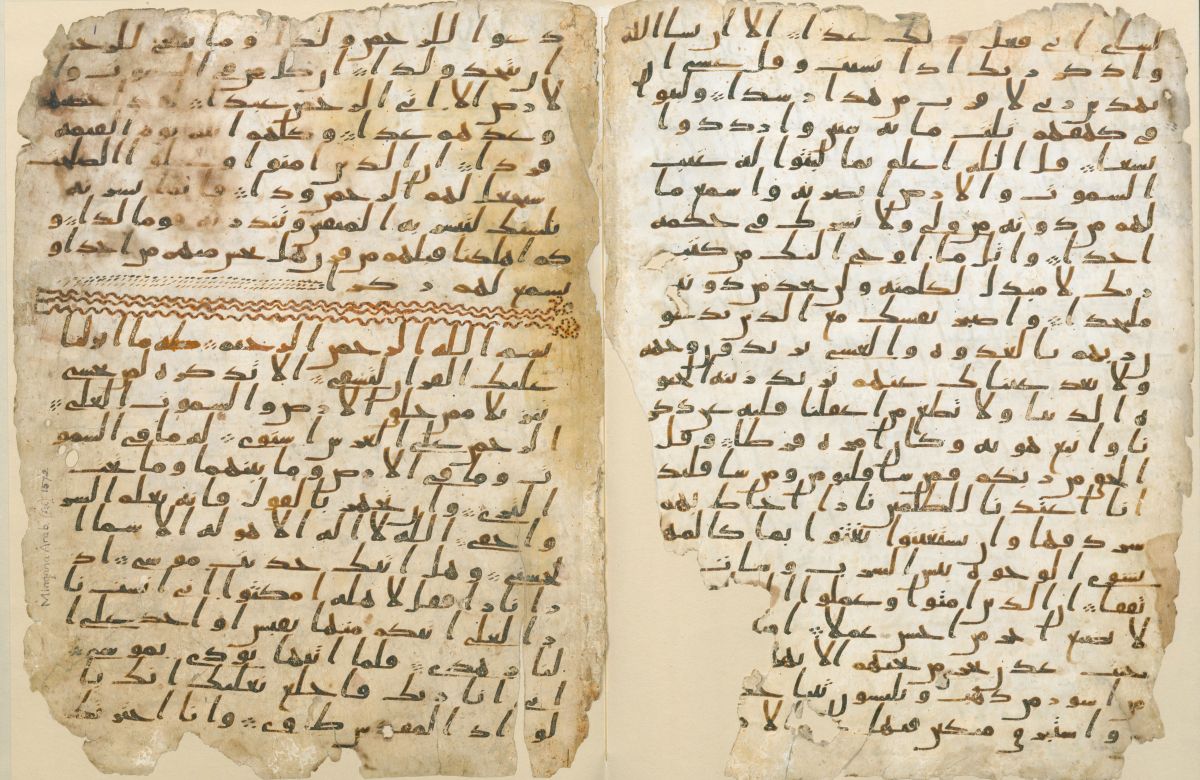
A Qur’anic manuscript dating back to 568-635 CE, comprising of two
leaves of parchment.
About the Author: Shahzad Ahmed serves as the Associate Editor of The Review of Religions, having graduated from Jamia Ahmadiyya UK – Institute of Modern Languages and Theology. He is also a missionary of the Ahmadiyya Muslim Community, has a Bachelor’s Degree in English Literature and presents shows on contemporary Islamic issues for MTA International.
ENDNOTES
1. Jalal al-Din Suyuti, Al-Mazhar fi ‘Ulum al-Lughati wa Anwa‘iha, Al-Nau‘ut Tasi‘ wa al-Arba‘un, Part 2, p. 236.
2.https://www.britannica.com/topic/Al-Muallaqat-Arabic-literature.
3. K. Armstrong, A History of God: the 4,000 Year Quest of Judaism, Christianity and Islam (Vintage, 1993), 171.
4. The Holy Qur’an, 36:70.
5. George Sale, The Preliminary Discourse in Al Coran of Mohammed (Charles Mason, 1836), 48.
6.https://www.alim.org/history/prophet-companions/4/.
7. Sir William Muir, The Life of Mahomet, Appendix (Sources for the Biography of Mahomet) – The Corân (Smith, Elder & Co. London 1878), 561.

Add Comment