
Summary prepared by The Review of Religions
After reciting Tashahhud, Ta‘awwuz and Surah al-Fatihah, His Holiness, Hazrat Mirza Masroor Ahmad (aba) said that Ahmadis believe that if ever there was a perfect person in the world, it was the Holy Prophet Muhammad (sa). There was no one before him, or after him, to reach such perfection. He exemplified the highest standards of fulfilling the rights of God, the rights of humanity and possessed perfect morality.
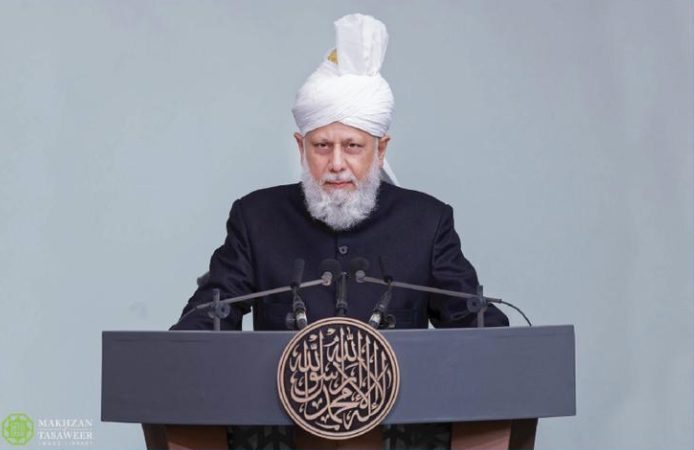
His Holiness (aba) said that one can take any moral quality and find its perfection in the person of the Holy Prophet (sa). One such moral quality is humility, which the Holy Prophet (sa) possessed to the perfect degree. The Holy Prophet (sa) also taught his own followers to adopt the quality of humility. God Almighty told the Holy Prophet (sa) to announce regarding his own humility:
‘Say, “I am only a man like yourselves.”’ (The Holy Qur’an, 18:111)
His Holiness (aba) said that despite the fact that God granted him the status of being the final law-bearing prophet and the Seal of the Prophets, he had him announce that he was a humble human being.
His Holiness (aba) said that he would highlight this quality of humility found in the Holy Prophet (sa).
His Holiness (aba) quoted the Promised Messiah (as) who said that there has never been an example of humility like that shown by the Holy Prophet (sa). Despite the lofty ranks he received, he continued proclaiming that he was just a man like everyone else. He showed humility to such a degree that one cannot be considered a true Muslim or follower of the Holy Prophet (sa) unless they too adopt the quality of humility.
Treatment of a Blind Man
His Holiness (aba) quoted the Promised Messiah (as) who, whilst describing the humility of the Holy Prophet (sa), related a story from his life. He said that a blind man would come to the Holy Prophet (sa) and recite the Holy Qur’an. One day, when he went to the Holy Prophet (sa), some people around the Holy Prophet (sa) were engaged in conversation with him. After waiting for a while, the blind man got up and left. God informed the Holy Prophet (sa) about this. Hence, the Holy Prophet (sa) went to his home, brought him along and seated him upon his own sheet. This story shows that those who have love in their hearts for God must certainly possess the qualities of humility and meekness. This is not just a story, but a lesson for us to adopt.
Humility – A Means to Attaining Paradise
His Holiness (aba) said that once, the Holy Prophet (sa) said that every person has two chains attached to them; one facing the heavens and one facing the earth. When a person adopts humility, the angel towards the heavens lifts the chain and lifts the person up. However, when one shows arrogance and haughtiness, the chain towards the earth pulls them down.
His Holiness (aba) said that the Holy Prophet (sa) once said that a person who adopts humility is ascended to the seventh heaven. Similarly, the Holy Prophet (sa) said that if one adopts humility for the sake of God, God lifts them up. At the same time, the Holy Prophet (sa) also explained that giving charity does not lessen one’s wealth, and forgiveness does not lessen one’s honour. His Holiness (aba) said that these things could bring about a great positive change in society today.
His Holiness (aba) said that once, a person addressed the Holy Prophet (sa) and called him their chief and the best among them. Upon this, the Holy Prophet (sa) enjoined everyone to stay on guard from being beguiled by Satan. He said that he was a servant of God named Muhammad bin Abdillah and a Messenger of God. He said that he should not be addressed in a manner exceeding the ranks given to him by God. At another instance, the Holy Prophet (sa) said that no one’s own actions will cause them to enter paradise. The companions asked whether this applied to the Holy Prophet (sa) as well. He said indeed it did, for no one’s own actions could cause them to enter paradise, save for being covered by the grace and mercy of God. Therefore, everyone should carry out their actions carefully, seeking to draw nearer to God.
A Prayer for Humbleness
His Holiness (aba) said that once, the Holy Prophet (sa) was heard praying, ‘O Allah, let me live in meekness, let me die in meekness, and raise me up among the meek.’ It is also recorded that the Holy Prophet (sa) would not mind walking alongside widows or the poor in order to hear what they had to say. Alongside his lofty spiritual standards, the Holy Prophet (sa) would take care to hear what even the deprived in society had to say, and he would listen to them with patience and care.
The Holy Prophet’s (sa) Meekness in the Presence of Others
His Holiness (aba) said once, the Holy Prophet (sa) was walking when an elderly lady stopped him along the way and began explaining her needs to him. The Holy Prophet (sa) stood patiently and listened to what she had to say. Hatim bin Adiyy was with the Holy Prophet (sa) at the time, and as he stood and watched this transpiring before him, he thought to himself that this man certainly cannot be a king, for kings do not stand and listen to the poor. Then the Holy Prophet (sa) took Hatim to his home, brought a cushion, and told Hatim to sit on it, while the Holy Prophet (sa) sat on the ground. Hatim again thought that such qualities were not typical of a king.
His Holiness (aba) said that the Holy Prophet’s (sa) humility was such that he would also show kindness to children and greet them. It is recorded that whenever the Holy Prophet (sa) met the Ansar, he would greet their children, place his hand on their heads and pray for them.
His Holiness (aba) said that it is recorded that once, a man went to the Holy Prophet (sa) to speak with him, but due to the awe of being in the presence of the Holy Prophet (sa), the man began shaking. The Holy Prophet (sa) told him to remain calm, for he was the son of a woman who would eat dried meat. Describing this incident, the Promised Messiah (as) said that as the successes of the Holy Prophet (sa) increased, so too did his standard of humility continue increasing.
His Holiness (aba) said that the time of migration when the Holy Prophet (sa) arrived in Madinah, he was greeted by such Ansar who had not yet seen him. At that time, Hazrat Abu Bakr (ra) was with the Holy Prophet (sa), and he stood up to meet the Ansar, who also came and met Hazrat Abu Bakr (ra). During this time, the Holy Prophet (sa) remained silent. In the midst of this, the sun fell upon the Holy Prophet (sa). In order to shade him, Hazrat Abu Bakr (ra) covered him with his sheet. It was only when Hazrat Abu Bakr (ra) did this that the Ansar realised that the person sitting was indeed the Holy Prophet (sa) himself.
His Holiness (aba) said that the Holy Prophet (sa) advised his followers not to exaggerate when speaking about him, as the Christians exaggerated in the manner in which they spoke of and complimented Jesus (as). Once, as a person was numbering the great qualities of the Holy Prophet (sa) before saying what he intended to say, the Holy Prophet (sa) stopped him and asked him not to be influenced by Satan, and instead to proceed with what he actually intended to say. Once, a person came to the Holy Prophet (sa) and addressed him as “The Best of Creation.” The Holy Prophet (sa) stopped him and said that this title was for the Prophet Abraham (as). Such was the Holy Prophet’s (sa) humility that, although he indeed was the best of all creation, out of his own humility, he deflected this title to the Prophet Abraham (as) instead.
zThe Meaning of the Titles ‘Muhammad’ and ‘Ahmad’
His Holiness (aba) quoted the Promised Messiah (as) who writes:
‘The name Ahmad is the manifestation of jamal, and – in contrast to this – the name Muhammad is the manifestation of jalal. The reason for this is that inherent in the name Muhammad is the quality of being the beloved because having all praiseworthy excellences and possessing utmost beauty and all perfect praiseworthy excellences requires splendour, grandeur, awe, and glory. But inherent in the name Ahmad is the quality of falling in love because to praise someone demands humility, lover’s submissiveness, and meekness. This is verily called a jamali state, and this condition requires humility and meekness.
Our Holy Prophet, may peace and blessings of Allah be upon him, was eminently lovable, which is required by the name Muhammad, because being ‘Muhammad’ – that is, encompassing all praiseworthy excellences – is what brings into being the state of being eminently lovable. And the Holy Prophet, may peace and blessings of Allah be upon him, also possessed the best qualities of a lover [of God and humanity], which the name Ahmad requires; for, it is essential that hamid [the one who praises] must also be muhibb [the one who loves]. A person can only truly and perfectly praise someone when he is in love – nay rather, he is passionately in love – and in order to be a lover and a muhibb, one needs to be submissive and humble.
This is precisely the jamali state necessary to realise the essence of Ahmadiyyah. The belovedness, which was inherent in the name Muhammad, manifested through the Companions. As for those who were insulting and rebellious, the jalal being the beloved of God, subdued them.’ (Arba’in, p. 151)
His Holiness (aba) further quoted the Promised Messiah (as) who writes:
‘There is an underlying secret in the blessed names of the Holy Prophet
(sa). His two names, Muhammad, meaning the most praiseworthy, and Ahmad, meaning the one who is greatest in giving praise, both allude to two distinct forms of excellence possessed by the Holy Prophet (sa). The name Muhammad demands characteristics of glory and majestic greatness because the name means ‘one who is praised immensely’ and it naturally follows that the bearer of this name be loved, characteristics of glory and majestic greatness, which are the hallmarks of one who is loved, in the same manner, the name Ahmad inherently bears qualities of humility and meekness, which are the distinctions of one who loves another.
The underlying secret in these names is that the life of the Holy Prophet
sa has essentially been divided into two parts. First, there was his life in Mecca, which spanned a period of thirteen years. The second part of his life was spent in Medina, which lasted ten years. During his life in Mecca, we see a manifestation of his name Ahmad. During this time, the Holy Prophet (sa) engaged himself in weeping and crying before God Almighty day and night and would spend his time seeking divine help and in prayer. Anyone who is fully aware of the manner in which the Holy Prophet (sa) spent his life during this time knows that no lover has ever cried and wept so fervently in search of their beloved as the Holy Prophet (sa) did during
his life in Mecca, and nor will anyone ever be able to match him in this regard.
Then, these lamentations of the Holy Prophet (sa) were not for his own soul, but due to his clear knowledge of the state of the world. The worship of God had disappeared completely. The soul and the inherent nature of the Holy Prophet (sa) was leavened by a faith in Allah the Exalted, which fostered within him pleasure and delight. The Holy Prophet (sa) naturally desired to fill the world with this pleasure and joy as well. But when he cast a glance on the world, he found that their capacities and natures had been strangely deformed, and there were many difficulties and hardships at hand. In short, the Holy Prophet (sa) would weep and cry over this state of the world, and he did so to such an extent that he may well-nigh have lost
his life. It is to this that the following words of Allah the Exalted allude:
“Haply thou wilt grieve thyself to death because they believe not.”
This was the life of the Holy Prophet (sa) in which he humbly begged for divine grace and mercy, a life which showed a manifestation of his name Ahmad. During this era, the Holy Prophet (sa) was engaged in deep contemplation. The effects of this contemplation and prayer became apparent during life in Medina, when the name Muhammad was manifested, as is evident from the following verse:
“And they prayed for victory, and as a result thereof every haughty enemy of truth came to naught.”’
(Malfuzat, English Translation, Vol. 3, pp. 70-72)
Further Instances of the Holy Prophet’s (sa) Humility
His Holiness (aba) quoted the Promised Messiah (as) who writes:
‘Hence, on various instances, wherever the humility and humbleness of the Holy Prophet, peace and blessings of Allah be upon him, may be seen to reach the heights of perfection, it appears that he was supported and illumined by the succour and light of the Holy Spirit in equal degree. The state of the deeds and actions of our Noble Prophet, peace and blessings of Allah be upon him, clearly demonstrates this. In fact, the sphere of his light and blessings is so vast that his manifestation and reflection can be observed to extend into all eternity.
As such, all the bounty and grace of God Almighty that is being sent down in this day and age is received through obedience and subservience to none other than the Holy Prophet (sa).
I truthfully say and proclaim on the basis of my own experience that no one
can perform true virtue, attain the pleasure of God Almighty, and be fortunate enough to receive the divine favours, blessings, insights, verities and visions that are bestowed upon one who purifies their soul to the highest degree, until they are lost in subservience to the Messenger of Allah, peace and blessings of Allah be upon him. Evidence of this is found from the word of God Almighty Himself:
“Say, ‘If you love Allah, follow me: then will Allah love you.”
I am a practical and living proof of this claim by God Almighty. Recognise me in light of the hallmarks that represent the saints and beloved of God Almighty as established by the Holy Quran. Hence, the Noble Prophet, peace and blessings of Allah be upon him, possessed such perfect morals that even if an old lady took hold of his hand, the Holy Prophetsa would remain there listening to her attentively; and until she would leave him, he would not leave her.’ (Malfuzat, English Translation, Vol. 1, p. 211)
His Holiness (aba) said that Hazrat Uthman (ra) recounted how the Holy Prophet (sa) would always visit the sick, join funeral processions and would remain among the people for all occasions. The Holy Prophet (sa) said that if he was ever invited somewhere, he would accept the invitationa nd if he was given even a small gift, he would accept it. Once, the Holy Prophet (sa) was presented with some food containing squash and meat. The Holy Prophet (sa) ate the squash from the sides of the bowl wherever he found it. His Holiness (aba) said that this was a lesson for us today as well. Some people, at the time of the Jalsa Salana (Annual Convention), when meat and potatoes are cooked, some people demand to only be given meat. However, the Holy Prophet (sa) set the example that one should eat whatever is prepared and presented to them.
His Holiness (aba) said that on the way to the Battle of Badr, there were three people assigned to one camel. When it was the Holy Prophet (sa) ‘s turn to walk, his two companions requested that he continue sitting on the camel while they walked. The Holy Prophet (sa) replied by saying that they did not have more endurance to walk than he did, nor was he any different from them, and insisted that they rode on the camel while he walked.
His Holiness (aba) said that Hazrat A’ishah (ra) would say that the Holy Prophet (sa) helped in household work and then would go to the mosque when it was time for prayer. His Holiness (aba) said that this is a lesson for men who refuse to do household work and their wives subsequently complain. The companions also took up this example and helped with household work. While household work is primarily the responsibility of women, there is no excuse for men not to help their wives.
His Holiness (aba) said that the Holy Prophet (sa) would also help his companions in laborious work, such as the building and fixing of mosques. In other words, there was no such task which the Holy Prophet (sa) thought himself above doing.
His Holiness (aba) said that these are the examples of the Holy Prophet (sa) which we must strive to adopt in our own lives.


Add Comment