
© Shutterstock
Ahmad Nooruddeen Jahangeer Khan, London, UK
Every religion speaks of prophecies – glimpses of what is yet to come. For Muslims, the Qur’an is replete with them; some of which have been fulfilled, whilst others are reserved for the future. But what if I told you that one of the most powerful prophecies relating to the Holy Prophet (sa) of Islam is found not in the Qur’an, but in the Bible? What if this Biblical prophecy wasn’t fulfilled in the lands of Israel, but in the deserts of Arabia?
The prophecy I am referring to, in the book of Deuteronomy, is as follows:
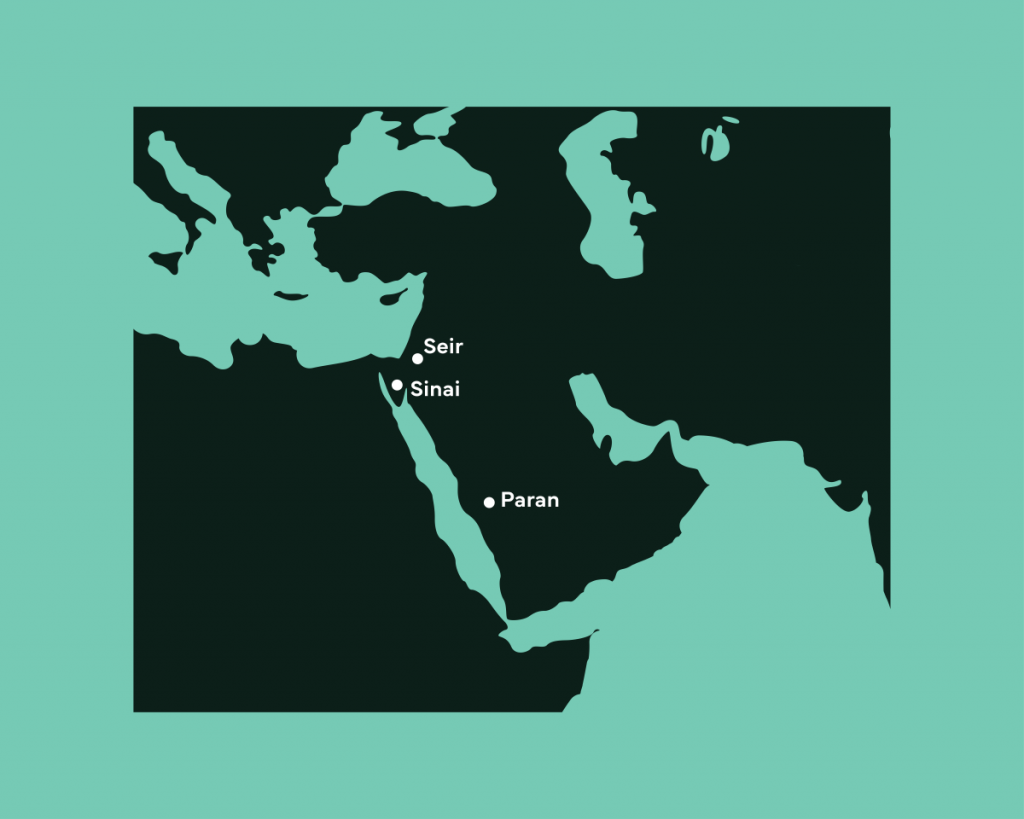
‘The Lord came from Sinai, and rose up from Seir unto them; he shined forth from Mount Paran, and he came with ten thousands of saints: from his right hand went a fiery law for them.’[1]
This verse describes manifestations of divine glory – God’s words conveyed through His prophets – culminating in one who would ‘shine forth from Mount Paran.’ But where is Paran? And who fulfilled this prophecy? For Jewish and Christian commentators, its meaning has long been shrouded in interpretation – yet for Muslims, it carries unmistakable clarity.
What Is the Significance of this Prophecy?
Scholars note that there are three manifestations mentioned in this verse:
1) in Sinai 2) in Seir 3) at Paran
Jewish, Christian and Muslim scholars are in agreement that the first was fulfilled by Moses (as), as he saved the Children of Israel from the clutches of Pharaoh in Egypt and brought them the Torah. He also received the Ten Commandments on Mount Sinai. The common Jewish understanding is that the three manifestations at Sinai, Seir and Paran all refer to the advent and ministry of Moses (as) alone, and not to anyone else.
Seir is said to have been in the ancient land of Edom, located in the mountainous region of what is now southern Jordan and southern Israel. While some Christians share the same view of Moses (as) fulfilling the first two parts of the prophecy, there are others who believe that it was Jesus (as) who fulfilled the second manifestation (Seir), as the New Testament indicates that his ministry spanned this very area. This view is shared by Muslims also, for they accept Jesus (as) as being sent by God to the tribes of Israel in that area and beyond.
Addressing this difference of opinions, the Second Worldwide Head of the Ahmadiyya Muslim Community, Hazrat Mirza Bashiruddin Mahmud Ahmad (ra) states:
‘Christian exponents of the Gospels identify Seir with Sinai, but this is a mistake…To identify Seir with Sinai and to attribute both manifestations to Moses is wrong also because Moses never crossed into Canaan. He died at a spot from where he could only see its borders. After Moses and before Jesus, no manifestation of divine glory took place which could rank with that of Sinai. “Rising up from Seir”, therefore, means the advent of Jesus, which took place right in Canaan, and through which, as it were, God showed His face for a second time.’[2]
If the first two manifestations were separate historical events, it only makes sense that Paran was meant to signal a distinct, later divine appearance, one that would surpass those before it.
These fundamental geographical clues about where the ministries of Moses (as) and Jesus (as) were, help us identify which of them fulfilled the first two parts of this prophecy. That leaves the final piece to the puzzle. Who fulfilled the manifestation at Paran? To solve this, we must turn once again to geography.
Where Is Mount Paran?
The debate gets heated when it comes to locating Paran. Many Christian and Jewish scholars have argued that Paran cannot be in Arabia. They place it in Sinai or nearby mountains, thereby negating the possibility of the Holy Prophet (sa) fulfilling this prophecy.
For instance, Jewish commentators such as Rashi, a leading Biblical exegete in the Middle Ages, treat Paran as a general wilderness associated with Ishmael (as), but still near Canaan, not in the Arabian heartland.
Christian scholars often link Paran with the northern Sinai Peninsula or Edom, claiming it lies just outside the traditional land of Israel.
These are two prevalent theories, but they lack stronger evidence to back them.
Classical Muslim geographers, such as Yaqut al-Hamawi, identify Faran or Paran as one of the names for Makkah mentioned in earlier traditions. Tales like that of the Yemeni historian Wahb ibn Munabbih refer to a ‘Tal Faran’ (Hill of Paran) on the outskirts of Makkah.
Interestingly, Eusebius, also known as the ‘Father of Church History’, placed the Biblical Wilderness of Paran in the region east of the Jordan River, which was known as ‘Arabia’ during the Roman era. This distinguished it from the modern Sinai Peninsula, which Eusebius viewed as part of Egypt. He equated the Wilderness of Paran with the ‘desert of the Saracens,’ a term used for the desert inhabited by nomadic Arabs.
Shedding further light on the use of the name Faran (the Arabic name for Paran) amongst the inhabitants of Arabia, Hazrat Mirza Bashiruddin Mahmud Ahmad (ra) writes:
‘The third manifestation of divine glory was to take its rise from Paran, and Paran ([in] Arabic Faran) is the name of the hills which lie between Makkah and Madinah. Arab geographers always called this territory Faran. A halting place on the way from Makkah to Madinah is called the Valley of Fatima. When caravans pass through it, children from the neighbourhood meet them and sell them flowers. Asked where the flowers come from, the children answer: “Bariyyat Faran,” that is, the wilderness of Faran. Faran, therefore, is part of Arabia, the Hijaz to be exact.’[3]
Even with these historical and geographical records, pinpointing the exact location of Paran remains challenging due to the inherent ambiguity. But what is, in fact, one of the greatest proofs of it being in the Arabian Peninsula, has to do with what the Bible tells us about Ishmael (as), Abraham’s (as) son – that he ‘dwelt in the wilderness of Paran.’[4]
Hazrat Mirza Bashiruddin Mahmud Ahmad (ra) points out:
‘Historical and geographical evidence, therefore, shows that the descendants of Abraham have lived in Arabia. All of them held Makkah and the Ka’bah in great reverence, and from this it appears that Ishmael first settled in Makkah, and this is the part which, according to both Arab and Old Testament records, is called Paran.’[5]
He explains that for hundreds of years, only a single group of people have regarded themselves as the descendants of Ishmael (as).
‘Only one people today trace their descent from Ishmael, and they are the Quraish. They live in Arabia, and Makkah is their centre. If the Quraish claim is a pretence, it is difficult to find a motive for it. The claim could not advance their racial status, for the Israelites still looked down upon them. Nothing could make a desert people trace their descent to Ishmael unless the descent was a fact.’[6]
It is clear, therefore, that the area Ishmael (as) dwelt in was none other than the Hijaz in Arabia. No other location fits the description, and no people in any other location claims to be the descendants of Ishmael (as).
So the idea that Paran is somewhere in Sinai or Edom simply ignores centuries of tradition and geography. The Bible, Arab traditions, and even independent historical sources point to the Hijaz as the true location of Mount Paran.
What Other Clues Does the Prophecy Give Us?
Having established that Paran is neither located where Moses (as) or Jesus (as) appeared, we can hone in on what else Deuteronomy 33:2 tells us about the third manifestation.
‘He shined forth from Mount Paran, and he came with ten thousands of saints: from his right hand went a fiery law for them.’
There are two key aspects mentioned here regarding the person to appear at Paran:
1) They shall appear with 10,000 saints.
2) They shall come with a fiery law.
Only one who fulfils both criteria can be considered the true fulfilment of this manifestation.
But as we have proven, neither Moses (as) nor Jesus (as) appeared in the location in question, and that in itself rules them out. Yes, Moses (as) was a law-bearing prophet, and he did have thousands of followers from the Children of Israel, but this was in another region altogether. He did not even enter the land of Canaan, let alone shine forth from Paran.
Jesus (as), according to the Bible, had only twelve companions, not ten thousand.
Furthermore, he did not come bearing a new law. In Matthew 5:17-18, he says:
‘Do not think that I have come to abolish the law or the prophets; I have come not to abolish but to fulfil. For truly I tell you, until heaven and earth pass away, not one letter, not one stroke of a letter, will pass from the law until all is accomplished.’
Clearly, the prophecy of Paran awaited someone who could fulfil all its details – someone from the wilderness of Paran, with a new law and a vast following.
How Did Muhammad (sa) Fulfil the Prophecy?
All pieces of the puzzle fall into place only with the Holy Prophet Muhammad (sa). He fits every detail that the Paran prophecy and related texts appear to require:
Muhammad (sa) was born into the Quraish tribe of Makkah, the descendants of Ishmael (as). No other people can trace their ancestry so clearly to him.
He was born and began his prophethood in the Hijaz, at the foot of the hills of Faran between Makkah and Madinah, where tradition and geography place Paran. So in a way, he literally arose from Paran.
The prophecy mentions accompanying ‘ten thousands of saints’. Remarkably, when Muhammad (sa) finally entered Makkah in 630 CE during the Conquest of Makkah, he was backed by ten thousand Muslims (by conservative numbers), who marched with him from Madinah to Makkah. This was a momentous moment in which the law brought by Muhammad (sa) was to be established far and wide.
The Qur’an, which was revealed to the Prophet Muhammad (sa), is the transformative, divine law referenced here as a ‘fiery law’, for just as a fire removes all impurities from gold, the Qur’an brought a message that completely rid the society of the impurity of idol worship and moral decay.
The Promised Messiah and Imam Mahdi, Hazrat Mirza Ghulam Ahmad (as) has beautifully summarised this and explained the transformation that the Qur’an has brought with it, as he states:
‘That the last divine guidance should shine forth from Arabia was determined by divine wisdom. The Arabs are descended from Ishmael, who was cut asunder from Israel and had, under divine wisdom, been cast into the wilderness of Paran (Faran), which means two fugitives. The descendants of Ishmael had been cut asunder from Bani Isra’il by Prophet Abraham himself, and they had no part in the law of the Torah, as was written that they would not inherit from Isaac. Thus, they were abandoned by those to whom they belonged and had no relationship with anyone else. In all other countries, there were some traces of worship and commandments, which indicated that they had at one time received instruction from prophets. Arabia alone was a country that was utterly unacquainted with such teachings and was the most backward of all. Its turn came last of all, and it received the benefit of a universal prophethood, so that all countries might share again in the blessings of prophethood, and the errors that had become current in the meantime among them might be weeded out.
The Holy Qur’an is the Perfect Book which undertook the entire project of human reform and is not addressed only to one people. It seeks the reform of all and has set forth all grades of human development. It teaches savages the manners and ways of humanity and thereafter instructs them in high moral qualities. Thus, there is no need for any other book besides the Holy Qur’an.’[7]
In short, Muhammad (sa) alone meets every criterion: Ishmaelite descent, location in Paran, a large following, and a new, universal law for humanity.
Conclusion
Mount Paran symbolises more than a mountain – its prophecy was a roadmap to history. From Sinai came Moses (as); from Seir came Jesus (as); and from Paran rose the greatest of messengers, the Holy Prophet Muhammad (sa). Each mountain represented a stage in humanity’s moral and spiritual development, but it was in the deserts of Arabia that the divine light shone at its brightest. The evidence is not concealed in mystery; it is inscribed across the pages of scripture and validated by the course of history.
Perhaps the question is not where Mount Paran once stood, but whether we will recognise and benefit from its light.
About the Author: Ahmad Nooruddeen Jahangeer Khan is a missionary of the Ahmadiyya Muslim Community and serves on the editorial board of The Review of Religions.
ENDNOTES
1. The Torah, Deuteronomy 33:2.
2. Hazrat Mirza Bashiruddin Mahmud Ahmad (ra), Muhammad in the Bible (Islam International Publications Ltd. 2003), 17.
3. Ibid, 17-18.
4. The Torah, Genesis 21:21.
5. Hazrat Mirza Bashiruddin Mahmud Ahmad (ra), Muhammad in the Bible (Islam International Publications Ltd. 2003), 21.
6. Ibid, 18.
7. Hazrat Mirza Ghulam Ahmad (as), The Philosophy of the Teachings of Islam (Islam International Publications Ltd., 2017), 84-85.

Add Comment