
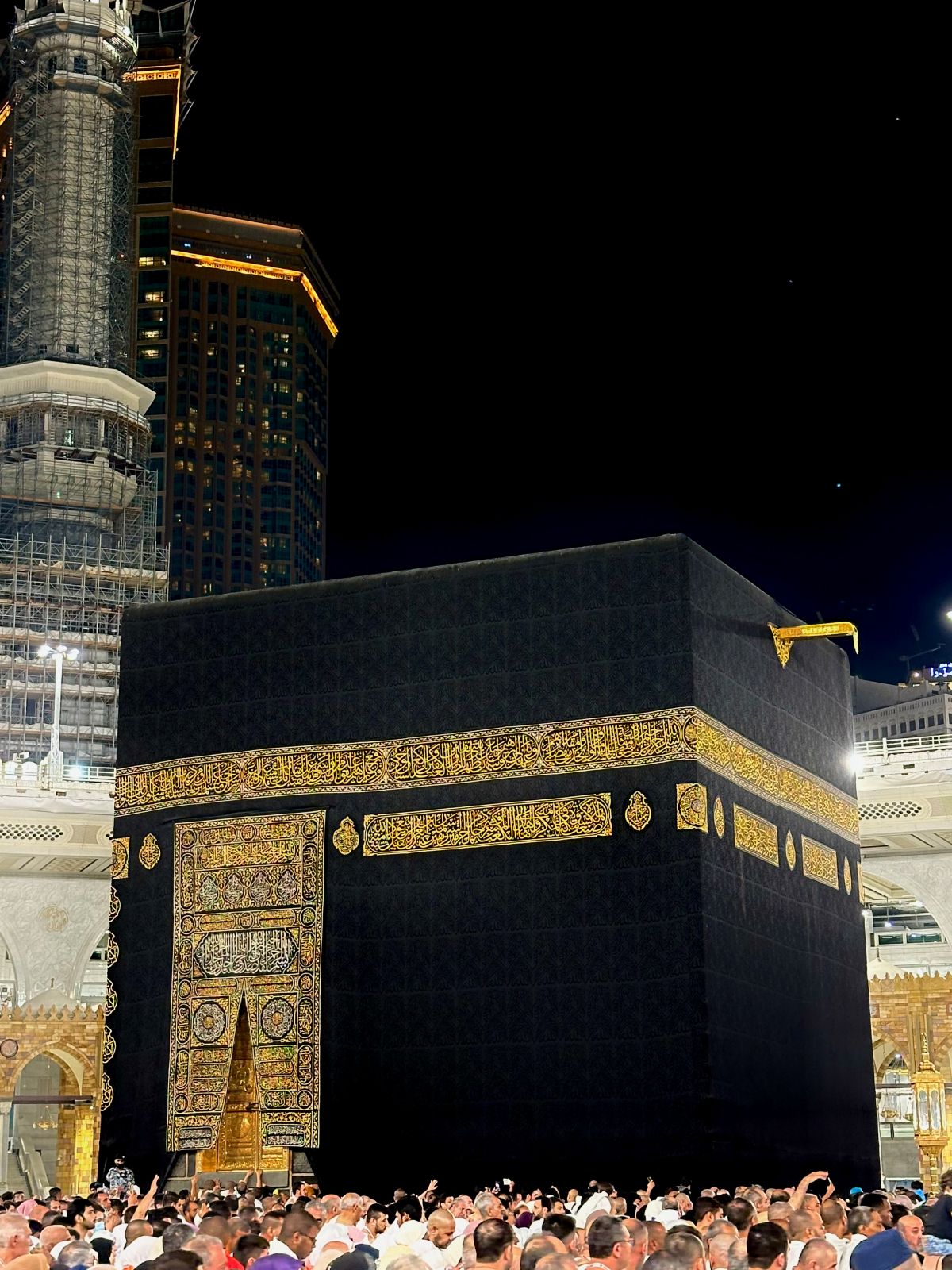
Zafir Mahmood Malik, London, UK
The silky-smooth black cloth draped over the Ka’ba – Islam’s holiest site – is arguably one of the most iconic images in Islam. Known also as ‘Kiswah al-Ka’bah’ – ‘The Cloth of the Ka’bah’, it is held in high regard by Muslims. But the Ka’bah has not always been covered by a cloth; in fact, it only started to be draped a short while before the advent of Islam, a time when the Ka’bah, located in Makkah, was a polytheist sanctuary, housing 360 idols.[1]
The first person to put a covering over the Ka’bah was Tubba Abu Karib Asad al-Kamil, king of the Himyarite kingdom (in present-day Yemen), who ruled in the fifth century. At the time, Makkah was under the rule of the Jurham tribe. He saw a dream that he was placing a drape over the Ka’bah[2] and so decided to use a traditional Yemeni striped red woollen cloth.[3] Tubba’s successors continued this ritual by sending various types of fabrics made in Egypt, Yemen and other parts of the Arabian Peninsula. With the advent of Islam, prominent chieftains of the Quraish (the ruling tribe of Makkah during the time of the Holy Prophet Muhammad (sa)) would see it as an honour to make a drape for the Ka’bah and even used leather and woven palm leaves.[4] New drapes would be placed over the older ones.
According to some sources, after Prophet Muhammad (sa) conquered the city of Makkah, he was the first person to use ‘Qubati’ Egyptian cloth, the name coming from the Coptic Christians who were famous for making it.[5] This set a precedent for the cloth of the Ka’bah coming from Egypt, and the Caliphs who succeeded him – Abu Bakr (ra), Umar (ra) and Uthman (ra) – all ordered the cloth from there. While different ruling dynasties controlled Makkah over the next few hundred years, it was only under the Mamluk king, Sultan Baybars (r.1223-1277) that Egypt officially took on the duty of providing the Kiswah each year.[6] The cost for providing it was originally covered by the treasury known as ‘Bait al-Mal’; however, as the cost for producing the Kiswah (and other drapes such as those covering the Prophet Muhammad’s (sa) tomb in Madinah) increased, the Mamluk Sultan, Al-Salih, set up an endowment from the revenue generated from certain villages.[7] Later, the Ottoman ruler Suleiman the Magnificent streamlined the process and dedicated a set revenue stream for this purpose.[8]
During Umayyad rule (approximately 661-750 CE), two Kiswahs were made for the Ka’bah per year: one would be draped on the day of Ashurah (the 10th day of the Islamic month of Muharram[9]) and the other towards the end of Ramadan to mark preparation for Eid al-Fitr,[10] the latter being a practice adopted by Uthman (ra), the third Caliph of Islam. During the time of Abbasid ruler Al-Mamun (813-833 CE), the Kiswah was changed three times a year: on 8th Dhu al-Hijjah it would be draped with a red brocade; with the Qubati cloth at the sighting of the new moon in the month of Rajab (the 7th month of the Islamic calendar); and with a white brocade on the 27th of Ramadan.[11] In the Seljuk era (approximately 1037-1194 CE), it was draped in a yellow brocade but it was during the Abbasid Caliphate when Al-Nasir (1180-1225 CE) changed the colour to green and then to black, and the cloth has been black since that time.[12]
In the early 19th century, the Ottoman Governor of Egypt, Muhammad Ali Pasha, set up Dar al-Khoronfosh, a workshop in the Al-Gamaleya district of Cairo.[13] The Kiswah was manufactured here until Ibn Saud took control of the Hejaz, including the two holy cities of Makkah and Madinah, from the Sharif family in the 1920s.[14] He set up a Kiswah factory in the Ajyad neighbourhood of Makkah in 1927.[15] Manufacturing went back to Egypt briefly between 1961 and 1972, after which a new factory was established in the Umm al-Joud district in Makkah, where the Kiswah is still being manufactured today.
While the Kiswah had been hand crafted by artisans for centuries, today, complex machinery is also used alongside the traditional handcrafted elements. The 100,000 square meter state-of-the art facility is known as the ‘King Abdulaziz Complex of Manufacturing the Kaaba [sic] Kiswa’. Once the cotton and silk – usually imported from Italy – are sourced, they are tested in the laboratory for quality. High-end machinery then dyes the threads and weaves it into a cloth. This works in tandem with a jacquard machine which is responsible for the texts that are visible on the black silk Kiswah. At each stage, the cloth undergoes rigorous strength and durability tests to ensure the best quality is used. The embroidery of the golden belt and other verses of the Qur’an are still etched on by over 50 skilled artisans and embroiderers. The letters are initially filled in with cotton threads before being covered in gold and silver threads. All the Arabic is written in the Thuluth script – a type of Arabic calligraphy style – adopted by Abdul Rahim Amin Bukhari, the former calligrapher of the Ka’bah. All of this embroidery takes between eight and ten months to complete.[16] The full Kiswah weighs approximately 1400 kg and takes a team of over 150 craftsmen to remove the old piece, in time for the first of Muharram, the first day of the Islamic New Year. [17]
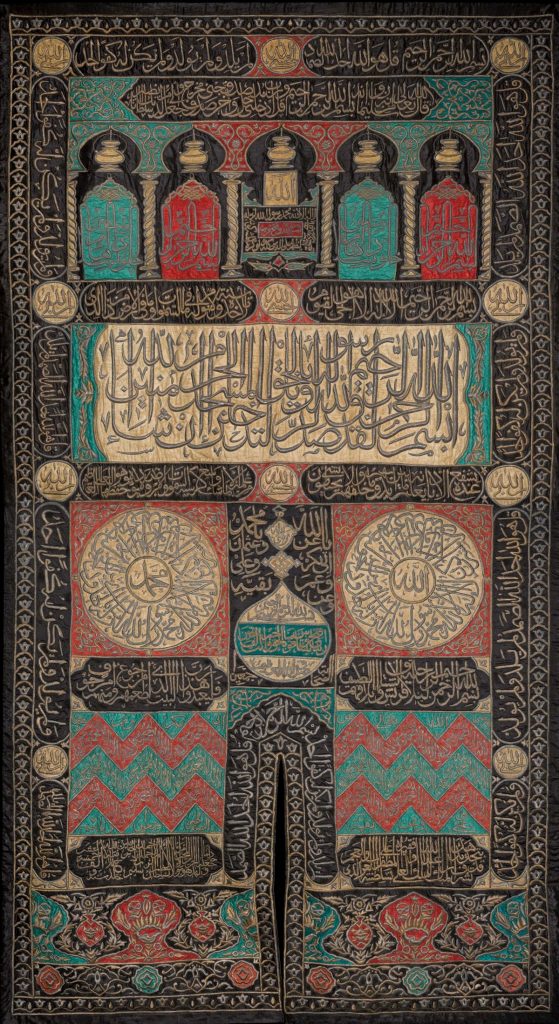
The curtain for the door of the Ka’bah from 1015 AH (1606 CE)
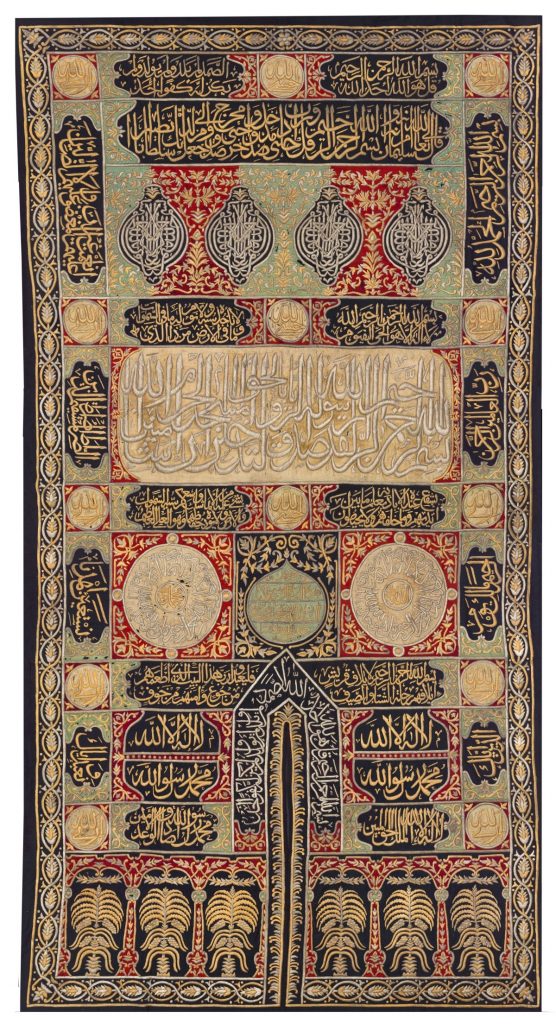
The curtain for the door of the Ka’bah from 1272 AH (1855 CE)
About the Author: Zafir Malik serves as the Associate Editor of The Review of Religions, having graduated from Jamia Ahmadiyya UK – Institute of Modern Languages and Theology. He is also a missionary of the Ahmadiyya Muslim Community and regularly appears as a panellist on Muslim Television Ahmadiyya (MTA) International and Voice of Islam radio station answering questions on Islam.
ENDNOTES
1. Mirza Bashir Ahmad M.A., The Life & Character of the Seal of the Prophets – Vol. I (Islam International Publications Ltd., 2011), 104.
2. Ibid, 106-107.
3. https://www.arabnews.com/node/1708721/saudi-arabia
4. https://www.islamiclandmarks.com/makkah-haram-sharief/kiswah-the-cover-of-the-kabah
5. Venetia Porter and Liana Saif, The Hajj: Collected Essays (The British Museum Press, 2013), 175.
6. Ibid.
7. Ibid.
8. https://www.arabnews.com/node/1533831/amp
9. This day marks the martyrdom of Hazrat Husain (ra), the grandson of the Holy Prophet (sa).
10. https://saudipedia.com/en/article/394/religion/the-grand-mosque/al-kaabas-kiswa
11. https://www.islamiclandmarks.com/makkah-haram-sharief/kiswah-the-cover-of-the-kabah
12. https://www.arabnews.com/node/1708721/saudi-arabia
13. Luitgard Mols, Arnoud Vrolijk, Western Arabia in the Leiden Collections (Leiden Publications, 2016), 57.
14. https://www.reviewofreligions.org/24721/hashimite-arab-revolt/
15. https://www.islamiclandmarks.com/makkah-haram-sharief/kiswah-the-cover-of-the-kabah
16. https://www.arabnews.com/node/2119016/saudi-arabia
17. https://www.arabnews.com/node/2605835/saudi-arabia

Add Comment