
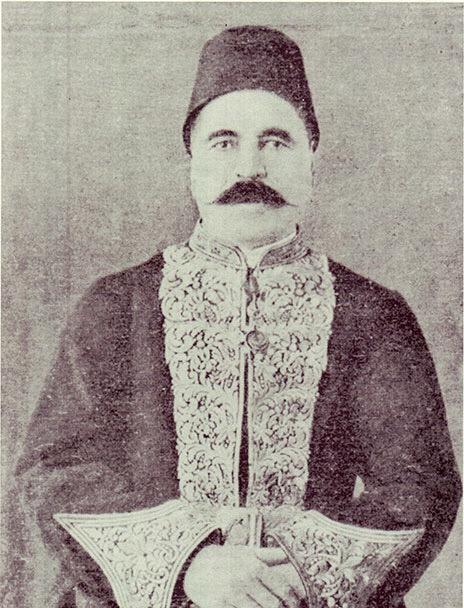
Rizwan Safir
All it takes is a simple tap. Quicker than the blink of an eye and in unlimited quantities, modern-day images are captured and distributed across the world. How Sadiq Bey would have envied the modern-day smartphone.
145 years ago, the world’s first photographer of Makkah and Madinah – Muhammad Sadiq Bey – ventured through deserts, scaled mountains and endured extreme temperatures, accompanied by his bulky large-format dry-plate camera and it assemblage of components.
It was the latest technology of its time – and yet, he was not strictly a photographer. These were not artistic photographs intended for mass reproduction. This was about control.
The story of the first images of Makkah and Madinah is a story of a declining Ottoman Empire, of jostling influence over the Hijaz region, and of two holy precincts that would soon develop into megalopolises beyond recognition.
The Ottomans, the Egyptians and the First Saudi State
Muhammad Sadiq Bey emerged in the late 19th century as a talented military engineer of the Ottoman army. Or more accurately, he emerged in an ambitious Egyptian army who were loosely subjects of a waning Ottoman Empire.[1]
Whilst the Ottomans had been in a state of decline for several decades, they maintained control over Islam’s two holiest sites – Masjid al-Haram (the Sacred Mosque) in Makkah and Masjid Nabawi (the Prophet’s Mosque) in Madinah. With this honour came legitimacy and prestige. Only one ruler in the Muslim world could proclaim this status, inviting the global Muslim population, or ummah, for pilgrimage under their protection.
Ottoman Sultans proudly referred to themselves as Khadim al-Haramain al-Sharifain, meaning ‘Servant’ or ‘Custodian of the Two Holy Mosques’ – a title held for almost 400 years.[2] It was also a title under threat.
In 1803, just over 20 years before Sadiq Bey’s birth, a nascent First Saudi State emerged from the heart of Arabia to conquer most of the Peninsula, including the Hijaz – thus wrestling the two Holy Mosques away from Ottoman sovereignty.[3] No longer could the Ottomans boast hegemony over the Muslim ummah. It was now the Wahhabis under the rising al-Saud dynasty that were in control of Islam’s spiritual core.
In response, the Ottoman’s looked to their powerful governor – the Pasha of Egypt. In 1805, Egypt was ruled by Muhammad Ali Pasha, a former Ottoman army officer who had risen through the ranks and seized power in Cairo.
In theory, he was the Ottoman governor of Egypt. In practice, he acted independently, serving personal political interests whilst treading carefully within the Ottoman realm.[4]
At the request of the Ottoman Sultan, Muhammad Ali dispatched successive armies led by his sons, Tusun and Ibrahim, eventually crushing the Wahhabis and reclaiming both holy sanctuaries in 1813.[5] Makkah and Madinah were back under Ottoman control – although increasingly reliant on Egyptian support.
Egypt’s Growing Presence
By the late 19th century, Egypt’s influence continued to grow. Egyptian rulers were no longer referred to as wali (governor) but instead Khadive – a higher and more hereditary title granted by the Sultan. Cairo was also where the mahmal (the symbolic palanquin) was dispatched to Makkah for the annual pilgrimage – this ornamental litter was empty inside but richly decorated.[6] Its purpose was ceremonial, representing the presence and patronage of the ruler. Accompanying the mahmal was the kiswah, an immense drapery produced in Cairo to adorn the Ka’bah and replaced annually during the days of Hajj. Egypt also sent grain and supplies for pilgrims arriving in Makkah.
With the distribution of food, the pomp and ceremony of the mahmal, the sacred cloth of the kiswah, and the earlier defeat of the Wahhabis all tracing back to Egypt, the average pilgrim could be forgiven for assuming Egypt’s Khadive, rather than the Ottoman Sultan, was overseer of the region.
Thus when Sadiq Bey arrived in Makkah in 1880, his presence was linked to sustaining Egyptian dominance.[7] Appointed treasurer for the Egyptian Hajj caravan, he had a parallel brief from the Khadive: to undertake a comprehensive survey of the Hijaz and the two holy sanctuaries.
He brought with him theodolites, compasses, chronometers, drawing instruments as well as field notebooks and journals – allowing him to record observations on topography, distances, tribal territories, and archaeological features.[8] This is how Sadiq Bey’s camera found its way to the Haramain (that is, Masjid al-Haram and Masjid Nabawi).
The Race to Survey the Hijaz
In 1880, photography had grown in presence but remained largely confined to studios.
Photo studios in the Middle East could be found in cosmopolitan centres such as Beirut, Istanbul and Cairo but were non-existent in the Hijaz or central Arabia at the time.[9]
It was therefore no surprise that word of Sadiq Bey’s camera and surveying equipment departing from Cairo had reached the Ottoman authorities, including the Sultan. Ottoman suspicion was heightened and perhaps justified – surveying and mapping activity is inextricably linked to political control.
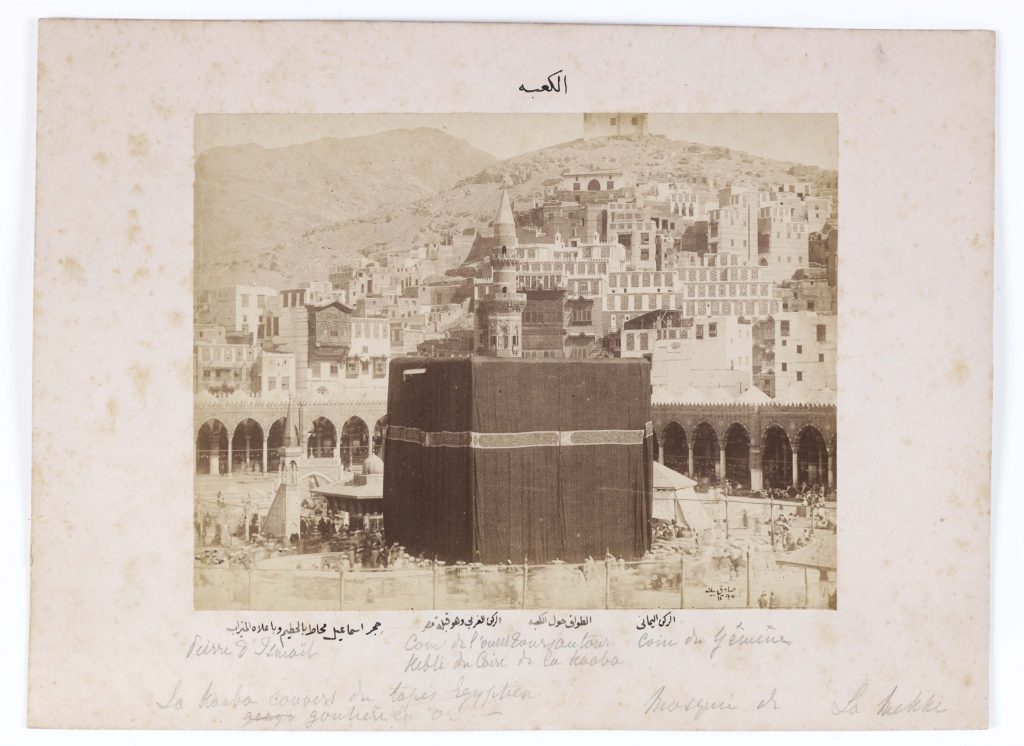
In response, six surveyors were dispatched from the Sublime Porte in Istanbul, including His Excellency Staff Lieutenant Colonel (Kaymakam) Ali Bey, photographer of the Ottoman Imperial Army.[10] They arrived around the same time Sadiq Bey and the mahmal reached Makkah.
Sadiq Bey or the Ottomans: Who Really Photographed Makkah First?
Despite the political tensions surrounding this survey showdown, the scene on the ground was relatively serene, if not jovial. Both parties appear in each other’s photographs and seem to have taken up similar positions when photographing the Haram, suggesting they were in close conversation.[11] In one instance, they simultaneously scaled the roof of the Mosque to capture its courtyard.
It could therefore be argued that Sadiq Bey was not the first to take photos of Masjid al-Haram; rather, this claim should be shared with his Ottoman counterparts.
However, two factors distinguished Sadiq Bey’s endeavours from the Ottoman mission. Firstly, Sadiq Bey had visited Makkah and Madinah nearly 20 years earlier, taking photographs for a previously commissioned survey. Sadly, none of these photographs survive as he refrained from publishing them, presumably due to their poor quality.[12] Nonetheless, his first expedition of 1861 remains the earliest known attempt to photograph the holy sanctuaries.
Secondly, Sadiq Bey’s 1880 images were immediately published to a wider audience through prestigious international societies. The Ottomans preferred secrecy, stashing the collection of photographs in the Sultans palace. Remarkably, it was not until 2006 that these photos were rediscovered and published widely.[13] As such, the mantle of Makkah’s first photographer has always been awarded to Sadiq Bey.
Whilst the author of Makkah’s first photographs could be contested, Sadiq Bey remains the clear frontrunner in Madinah. His 1880 collection of images of Islam’s second holiest city appears to stand for at least a decade, unlike Makkah where other photographers emerged soon after.
In total, Sadiq Bey published nearly 50 images from his epic journey. Around 20 were of Makkah and its environs, 10-12 of Madinah, with the remaining of the Hajj caravan en route from Cairo to Makkah and back.[14] For the first time in history, Islam’s sacred epicentre had been photographed.
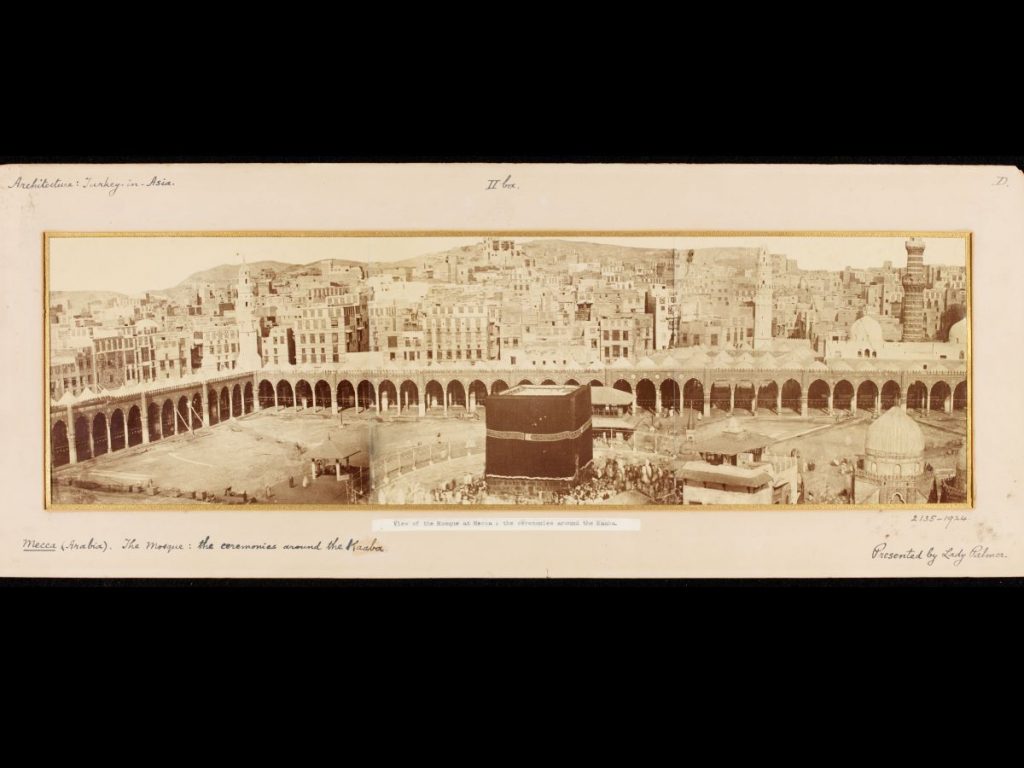
The first photo taken of Masjid al-Haram by Muhammad Sadiq Bey in 1880
A Changing World: Life in Makkah and Madinah in the Late 19th Century
The last 145 years has witnessed more change than any other 145-year period in history – Sadiq’s Bey’s photographs demonstrate that the two holy sanctuaries were no exception to inevitable and rapid transformation. Monumental towers rising in every direction have superseded traditional houses. Millenia-old mountains have been levelled or reshaped to accommodate a sprawling city and its endless tunnel network. The practices observed by Muslims visiting both sites has remained largely unchanged. What has changed drastically is the apparatus and organisation, not just in terms of infrastructure. Sadiq Bey’s images bring into focus buildings lost to time. Perhaps most prominent are the cluttered congregation of structures immediately encircling the Ka’bah.
Today, the circular courtyard surrounding the Ka’bah known as the mataf is unrestricted but in the late 19th century, stations of prayer known as maqamat occupied the immediate vicinity. Each station was dedicated to the four major Sunni schools of law or madhabs – Hanafi, Maliki, Shafi’i, and Hanbali.
Independent congregational prayers were held for followers of these respective schools of thought – each with their own imam, mihrab (prayer niche), minbar (pulpit for sermons) and area of adherents.
This was not a new phenomenon. Some 700 years earlier, the Andalusian traveller Ibn Jubayr noted that when he was in Makkah in the month of Ramadan in 579 Hijri/1184 CE, there were five simultaneous tarawih congregations taking place inside the Masjid – the fifth was for the Zaydis, a Shia group without a maqam.[15]
The well of Zamzam, a spring discovered at the time of Prophet Ibrahim (as) (Abraham), was also accessible. As was the Maqam Ibrahim, a stone bearing the footprints of Prophet Ibrahim (as) believed to have served as his platform during his construction of the Ka’bah. Today, this small building has been replaced by a domed structure made of gilded iron and glass.
Sadiq Bey’s other images of Makkah present a similar, equally radical contrast. The plains of Mina, where pilgrims set camp for Hajj, has evolved from a ‘find a place and pitch your tent’ setting into a tightly controlled complex of semi-permanent and air-conditioned mega tents, owing to the exponential increase in numbers.
The graves from the cemetery of Ma’la, where many family members of the Holy Prophet (sa) are buried, have been replaced by modest, unmarked stones, to prevent excessive veneration of graves – a practice forbidden in Islam. Perhaps the most dramatic change has been in the mosque itself. When Sadiq Bey visited, the Masjid al-Haram structure acted more as a perimeter for the inside mataf courtyard rather than a space for prayer. Today, the multi-storey complex accommodates over 3 million people and continues to rapidly expand.
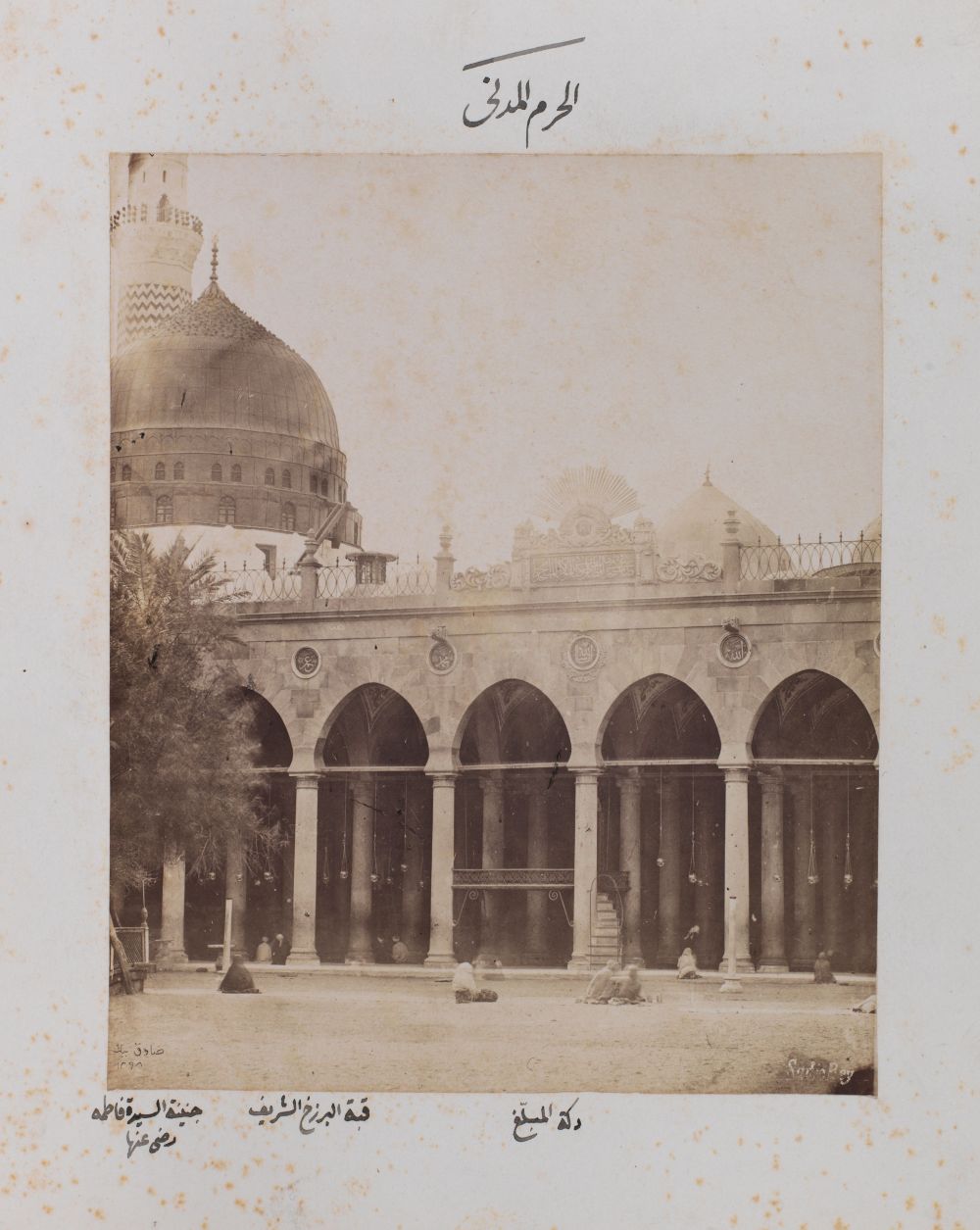
The Prophet’s (sa) Mosque captured by Muhammad Sadiq Bey in 1880.
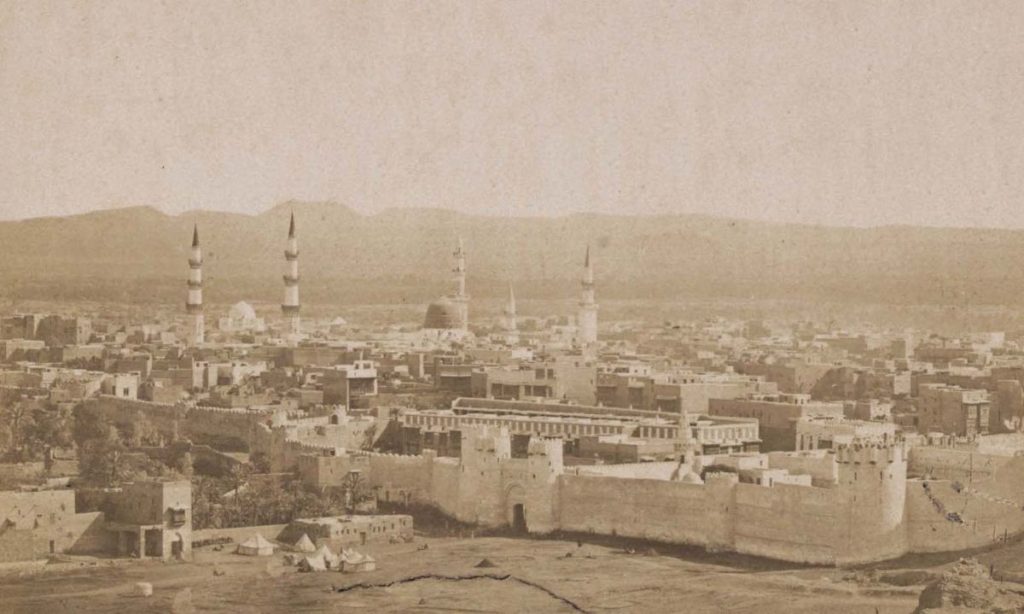
A general view of the Prophet’s (sa) Mosque captured by Muhammad Sadiq Bey in 1880
Awards and Accolades
Upon return to Cairo, Sadiq Bey set out to publish in haste, presumably spurred by a desire to outpace his Ottoman adversaries. He dutifully presented a bound photographic portfolio to the Khedive in 1881 and in May of the same year, presented his findings to the Khedivial Geographic Society, the foremost association of geography in Egypt.[16]
So impressed were the members of the society that they published and sent the photographs to Venice to be presented at the Third International Geographical Congress and Exhibition, in September 1881. The images received a ‘Diploma of Honour of First Class’, including the gold medal – the second highest accolade awarded at the exhibition.[17]
By 1883, Sadiq Bey had published an impressive body of catalogues, books, reports, maps, journals and images of his journeys. These were presented in both Arabic and French, the latter becoming the lingua franca following Napolean’s expedition almost a century earlier.
Sadiq Bey’s Legacy – Reducing the Hardship of Pilgrims
‘The suffering of the pilgrims was grievous; they bore the blazing sun and the bitter water with patience and faith, and often I saw among them the weak and the aged who, when overcome by the journey, would say: “We have come for God’s sake; if we die, it is upon His path.”’[18]
Sadiq Bey writing in al-Riḥla al-Ḥijāziyya. (Cairo, 1882)
Aside from dutiful professionalism or wider political considerations, Sadiq Bey cared deeply for the pilgrims he accompanied on the journey, speaking frequently of the hardships he witnessed. The overland journey from Cairo through the Hijaz was treacherous and he was determined to bring about betterment.
He submitted recommendations to the government that appear to have received support – within the coming decades work on the Hijaz railway would begin.[19] Paired with the increasing use of steamships, pilgrims travelling by foot had reduced significantly by the early 20th century.
Without Sadiq Bey’s determination, perhaps journeys by foot would have continued for several years more. And without Sadiq Bey’s determination, efforts to photograph the holy sanctuaries could have been entirely lost. As he noted on one occasion:
‘In the mountains near Madinah, my photographic instruments were nearly lost to the dust storms. The chemicals could not endure the heat, and the plates dried before exposure. Many nights were spent without rest, repairing glass and preparing new collodion under lamplight.’[20]
We owe a debt of gratitude to Sadiq Bey’s endurance, battling deep into the night with a solitary lamp to rescue his camera. His determination offered the world, including us some 145 years later, a fleeting glimpse into Makkah and Madinah in the late 19th century.
His skill and courage meant these were not mere ‘snaps’. This was an individual cognisant of landscapes, cityscapes and spatial relationships. [21] The beauty of Muhammad Sadiq Bey’s images lies not only in their aesthetic composition but in their spiritual and historical setting. His work captures a turning point in both Islamic and photographic history – when the sacred, the scientific, and the modern came together in a single lens.
Writing in one of his books, it seems the gravity of what he achieved had also dawned on him:
‘No one had ever preceded me in taking these images with this apparatus, the camera.’[22]
About the Author: Rizwan Safir is the Archaeology section Editor and Head of the Research Desk for the Review of Religions. He has worked on archaeological and cultural heritage projects across the Middle East for over 15 years, working for institutions such as the British Museum, Humboldt University Berlin and University of Copenhagen.
ENDNOTES
- Meraj Nawab Mirza and Abdullah Saleh Shawoosh, The Illustrated Atlas of Makkah and the Holy Environs (Jeddah: King Fahd National Library, 2016), 55.
- Musée du Louvre and Saudi Commission for Tourism and Antiquities, Roads of Arabia: Archaeology and History of the Kingdom of Saudi Arabia (Paris: Musée du Louvre and Somogy Art Publishers, 2010), 523.
- William Facey, Dir’iyyah and the First Saudi State (London: Arabian Publishing, 1997), 66.
- Michael Crawford, The Imam, the Pasha & the Englishman: The Ordeal of ʿAbd Allah ibn Saʿud, Cairo 1818 (London: Arabian Publishing, 2007).
- Ibid.
- Richard McGregor, “Mahmals in Procession – Spectacles from Cairo and Damascus” In The Hajj and the Arts of Pilgrimage: Essays in Honour of Nasser David Khalili, edited by Qaisra M. Khan (London: The Khalili Family Trust, 2020), 129–147.
- Arnoud Vrolijk, “Early Hajj Photography, 1880–1914.” In The Hajj and the Arts of Pilgrimage: Essays in Honour of Nasser David Khalili, edited by Qaisra M. Khan (London: The Khalili Family Trust, 202), 54, 129–147.
- Ibid.
- Stephen Sheehi, The Arab Imago: A Social History of Portrait Photography, 1860–1910 (Princeton, NJ: Princeton University Press, 2016), 166.
- Vrolijk, “Early Hajj Photography, 1880–1914,” 2020, 53.
- Ibid, 54.
- Ibid, 51
- Ibid, 54.
- William Facey and Gillian Grant, Saudi Arabia by the First Photographers (London: Stacey International, 1996).
- Ibn Jubayr, Muhammad ibn Ahmad, The Travels of Ibn Jubayr: A Medieval Journey from Cordoba to Jerusalem, trans. Ronald J. C. Broadhurst; foreword by Robert Irwin (London: Bloomsbury Publishing / I.B. Tauris, 2019), 117.
- Mirza and Shawoosh, The Illustrated Atlas of Makkah and the Holy Environs, 77.
- Vrolijk, “Early Hajj Photography, 1880–1914,” 2020, 51.
- Muhammad Sadiq Bey, al-Rihla al-Hijaziyya (Cairo: al-Matba’a al-Kubra al-Amiriyya, 1882).
- Vrolijk, “Early Hajj Photography, 1880–1914,” 2020, 53.
- Muhammad Sadiq Bey, Rapport sur les relevés topographiques de la route du pèlerinage égyptien (Venice: Imprimerie Royale, 1881).
- Claude W. Sui, “Pilgrimage to the Holy Sites of Islam and Early Photography,” in Wieczoreket al., To the Holy Lands, (New York: Prestel, 2008), 52.
- Muhammad Hammam Fikri, Muhammad Sadiq Basha, al-Rihlat al-hijaziyah [Muhammad Sadiq Pasha: Hijazi journeys] (Beirut: Badr lilnashr wal-tawziʾ, 1999), 127.
Add Comment