
Rabeeb Mirza, London, UK
Early Money and Its Challenges
What do a gold coin from Byzantium, a silver drachm from Persia, and a Bedouin trader in pre-Islamic Arabia have in common? They were all part of the evolving story of money – a story that shaped trade, politics, and even empires.
For thousands of years, money has been more than a medium of exchange. It has reflected power, belief, and trust. Gold and silver weren’t just precious – they were practical: durable, portable, and widely accepted. Stamped by states, these metals became the backbone of early economies.
While the early Islamic empire had to rely on Byzantine and Sasanian currency, the system began to evolve over a period of a few decades, culiminating in the reforms of ‘Abd al-Malik, who established an independent curency for the Islamic state, thus reducing its dependency on currencies from other states.
Arabian Trade and Foreign Coins
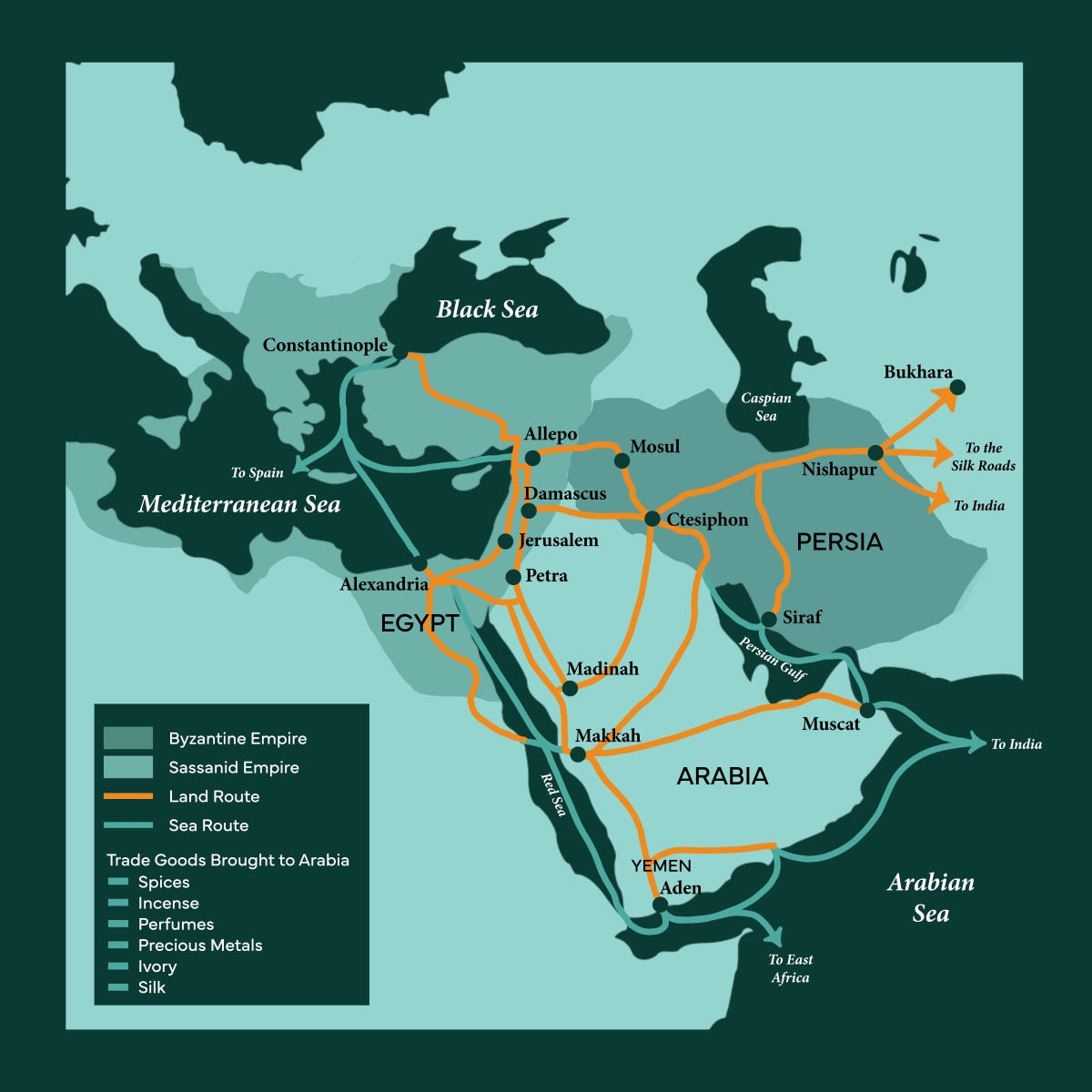
Before the rise of Islam, the Arabian Peninsula’s trade routes connected two major empires: the Byzantine to the west, and the Sasanian to the east. Their coins – the Byzantine gold solidus and the Sasanian silver drachm – flowed freely across markets, shaping Arab familiarity with both systems.
The Byzantines minted solidi of exceptional quality, each weighing about 4.55 grams, bearing Christian symbols and the emperor’s image. In regions like Syria, however, locally minted versions were slightly lighter in weight. To the east, Sasanian drachms (3.6 – 4.3 grams) featured the emperor beside a fire altar – a clear reference to Zoroastrianism – with inscriptions in Pahlavi script noting the ruler’s name, mint, and regnal year. These coins were traded by weight, not count, and maintained consistent silver quality across centuries.[1]
Continuity after the Islamic Conquests
After the Islamic conquests, these established monetary systems continued to be used. The Sasanian silver model continued, but Heraclius’s Byzantine silver coins (hexagrams) saw little circulation in Syria or Egypt. In former Sasanian provinces, mints still imprinted dirhams with the bust of Chosroes II or Yazdegerd III and Zoroastrian imagery. Only minor changes – Islamic inscriptions in Kufic script, new dating systems, and the names of Arab governors – indicated Islamic rule. In Syria and Egypt, local bronze coins mimicked Byzantine folles (bronze coins) but dropped the emperor’s image, sometimes replacing it with the name of the mint in both Greek and Arabic.
Interestingly, unlike Western Europe, the Islamic world did not produce widespread imitations of Byzantine gold coins. Instead, it relied on familiar forms – silver and bronze – adapted to new Islamic contexts.[2]
Scholarly Perspectives on Early Islamic Monetary Policy
It is at this point that a revealing scholarly perspective surfaces.
In ‘The Monetary Reforms of ‘Abd al-Malik’, British historian Philip Grierson, a noted numismatist at Cambridge, writes: ‘It is alleged that Muhammad took credit for having left to ‘Iraq its dirham and its qafiz, to Syria its mudd and its dinar, and to Egypt its ardeb and its dinar. Although this politic conservatism must be attributed to his successors rather than to himself, the fact that it operated is undeniable.’ Yet he ignores that this practise was adopted by his successors because they undertood that this was the wisdom that he taught.
Yet more striking is his next line: ‘The Arabs had entered a world more civilized than their own, and since they came not to destroy but to exploit.’
At first glance, such remarks may seem academic. But in subtle turns of phrase – the framing, the choice of verbs, the assignment of motive – a familiar tone emerges: one that casts early Islamic civilization as primitive and opportunistic rather than adaptive and strategic. This reflects a pattern in certain Western narratives, where Islamic governance is portrayed not as capable of innovation but merely as an inheritor of superior systems.
Such views often ignore the evidence of cultural synthesis, legal reform, and institution-building that marked early Islamic rule. Monetary policy, far from derivative, was deeply pragmatic – rooted in the realities of managing a vast, diverse empire.
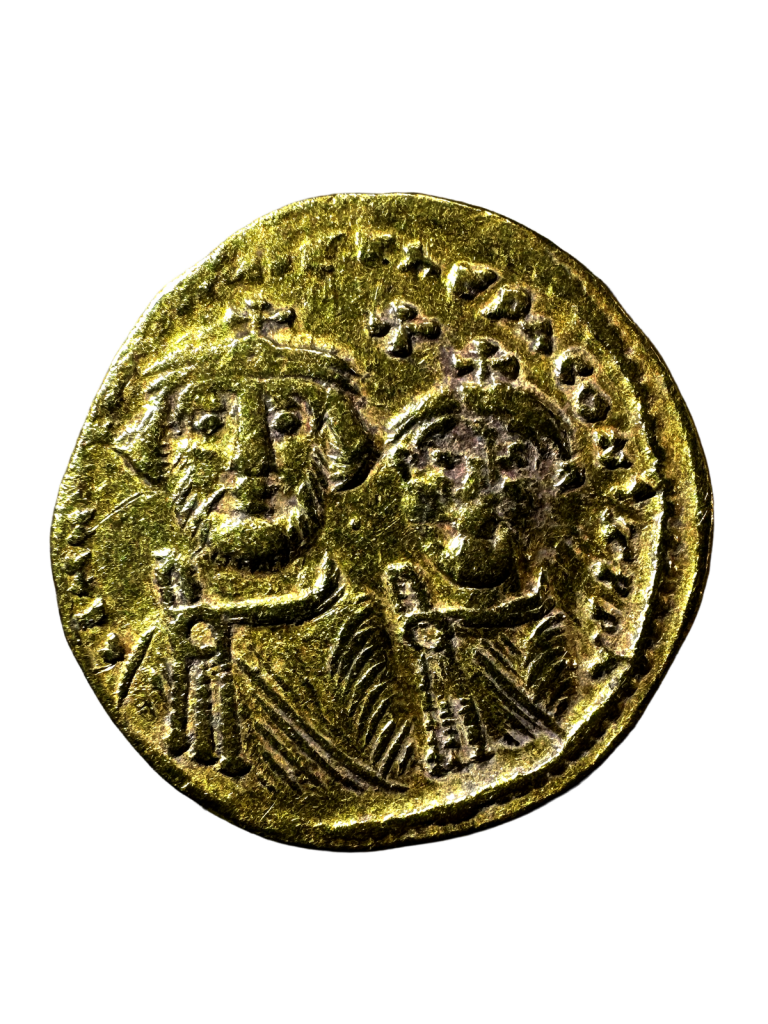
This 1400-year-old coin is from the Byzantine Empire, who traded with the Quraish, the tribe that controlled Makkah. The coin depicts the Christian Emperor Heraclius, who ruled between 616-625 CE. The Quraish would travel to Damascus in the summer to trade dates, leather and other materials in the town’s markets. Emperor Heraclius was the recipient of one of several letters sent by the Prophet Muhammad (sa) in 628-629 CE to rulers of neighbouring empires. Heraclius is said to have responded with admiration upon reading the letters, suggesting the Prophet (sa) carried the hallmarks of past prophets.
Ibn Khaldun and Islamic Coinage Philosophy
In contrast, the 14th-century historian Ibn Khaldun, writing from within the Islamic world, offered a different view. In his Muqaddimah, he noted that pre-Islamic empires decorated their coins with rulers, animals, and symbolic images. With Islam, this practice was largely abandoned. The simplicity of the faith, along with the modest Bedouin ethos of the early Arabs, led to a more functional use of coinage – gold and silver valued by weight, not by the imagery stamped on the coins.
He observed that during the early Islamic period, governments did not heavily regulate coinage. This lack of oversight eventually led to problems like debasement and fraud – not because of incompetence, but because of the decentralised and transitional nature of the early system:
‘The non-Arabs used coins and engraved special pictures on them…When Islam appeared, the practice was discontinued, because of the simplicity of Islam and the Bedouin attitude of the Arabs…The government paid no attention to the matter. As a result, the frauds practised with dinars and dirhams eventually became very serious.’[3]
Far from being a sign of failure, this phase represents a critical transformation – from coinage as imperial propaganda to coinage as a medium of fair trade, anchored in ethical weight and value.
In short, early Islamic monetary policy was neither passive inheritance nor opportunistic exploitation. It was an evolving system – one that absorbed, adapted, and redefined the meaning of money within the ethical and spiritual framework of a rising civilisation.
Pre-Islamic Standards and Early Muslim Monetary Law
Before Islam, the people of Makkah used silver dirhams by weight rather than by count, as though they were unminted bullion. Their system of measurement was highly structured. The dirham was the basic unit – the rest of the measures were by weight. Thus came the nawat, which was equal in weight to five dirhams; the nash, equal to twenty dirhams; the uqiyyah, worth 40 dirhams, and finally the ratl, which was worth 12 uqiyyah. The Holy Prophet (sa) affirmed this standard when he said, ‘The weight (measurement system) is that of the Makkans’.[4]
He also recognised gold and silver as formal currencies, making them subject to rulings on zakat, contracts, dowries, and other financial matters. The minimum threshold for Zakat was set at 200 dirhams or 20 dinars, based on multiple reports:
(a) Ibn Majah and Daraqutni report that ‘The Prophet (sa) used to collect half a dinar on every 20 dinars.’
(b) From Amr b. Shu’ayb: ‘There is no Zakat on anything less than 20 dinars or 200 dirhams’.[5]
(c) A letter attributed to the Prophet (sa) and the Caliph Umar (ra) states: ‘From gold, nothing must be taken until it reaches 20 dinars… then one half-dinar is due.’[6]
(d) Abu Dawud also reports from the Caliph Ali (ra): ‘If you have 200 dirhams and a year passes on them, five dirhams must be given…’[7]
Early Muslim jurists, including the Hanafis, held that a dinar equalled ten full-weight dirhams. Historians like al-Baladhuri observed only two legitimate dirham weight categories: ‘weight of ten’ and ‘weight of eight,’ with ‘weight of five’ dirhams recognized merely as half-units, not full currency. These classifications reflect the early effort to unify coinage and uphold consistent standards for monetary dealings in Islamic law.[8]
Sources and Standardisation Efforts
Al-Maqrizi, a student of Ibn Khaldun, drew much of his information on the dinar and dirham from al-Ahkam al-Sultaniyya by al-Mawardi, a prominent Sunni jurist and advisor to the Abbasid caliphs al-Qadir and al-Qa’im. However, it’s important to note that al-Mawardi was writing nearly three centuries after the coinage reforms of ‘Abd al-Malik (c. 697–699 CE), and his account reflects an effort to standardise Islamic coin weights retrospectively.
In al-Ahkam, al-Mawardi explains that the Islamic dirham was fixed at six daniqs, and ten dirhams equalled seven mithqals. He offers two explanations for this standard:
‘It has been suggested… that dirhams were minted by the Persians in three weights… [and] the total of 42 carats divided by 3 was settled upon… Others have argued that when Caliph ʿUmar ibn al-Khattab noticed the variety of dirhams in use… he ordered a study… [and] arrived at six daniqs as the weight of the Islamic dirham.’
This narrative reflects an effort by early Islamic authorities to reconcile inherited Persian coinage systems with Islamic legal and fiscal needs – particularly for obligations like Zakat – by establishing an average weight standard that would ensure fairness and consistency across the empire.
Some scholars on the other hand suggest that early exchanges were calculated using the Baghli [9] and Tabari [10] types of dirhams, and that the standardised legal dirham was not formally minted until 74 AH, during the Umayyad Caliphate.[11]
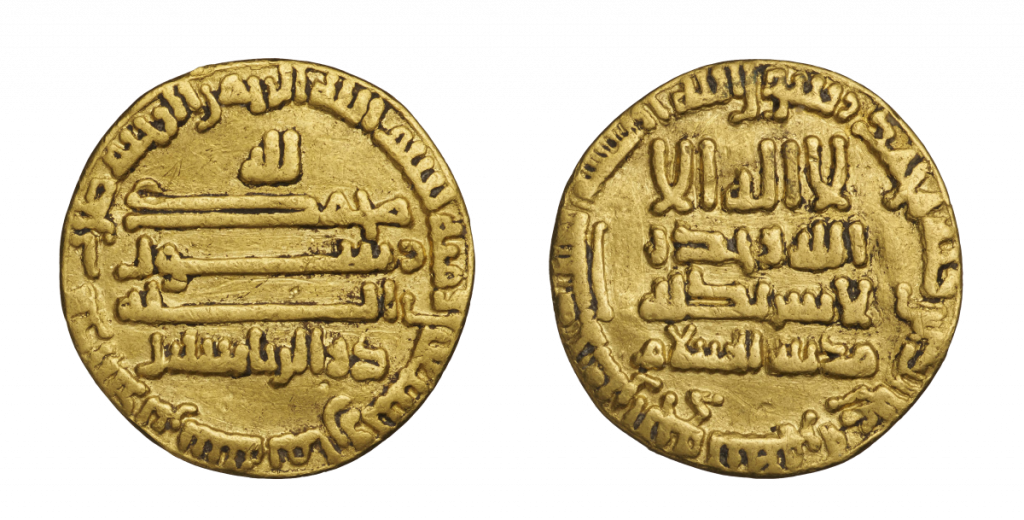
Gold dinar from 813-14 CE
Arab-Sasanian Coinage and Early Islamic Identifiers
The earliest Arab-Sasanian silver drachms – coins showing both Sasanian and early Islamic features – were struck during the caliphate of ‘Uthman (ra) (r. 644–656 CE). Dated to year 20 of the Yazdegerd era (A.H. 31/651 CE), these coins marked the first appearance of a distinct Muslim identifier: the Arabic phrase bism Allah [‘In the name of God’] added to the obverse side bearing the image of the Sasanian king. The inscription was placed in the second quadrant of the coin face (between three and six o’clock), symbolising the gradual integration of Islamic expressions into pre-existing Sasanian monetary designs.[12]
With regards to the dirham, according to Encyclopaedia Britannica it was during the caliphate of Ali ibn Abi Talib (ra), where new coins were issued bearing the name of the Islamic government, along with Qur’anic inscriptions, the mint location, and the year written in Kufic script. One such coin read: ‘This dirham has been coined in Basra in the year 40 AH.’ This marks the first independent Islamic coinage, though it appeared near the end of Hazrat Ali’s (ra) rule and did not continue after his death. Due to its rarity, it did not replace the widely circulating Sasanian dirham, which remained the main currency until the reforms of ‘Abd al-Malik ibn Marwan.[13]
Transitional Coinage under the Sufyanids
During the reign of the Sufyanid caliph Mu’awiya (r. 661–680 CE), new gold, silver, and copper coins were minted in Syria, reflecting emerging Islamic administrative structures. The gold solidi closely imitated Byzantine models but deliberately removed Christian symbols – the crosses on crowns and altars were replaced with neutral forms – yet these coins lacked any Arabic or Islamic identifiers, leading contemporaries, as noted in the Maronite Chronicle, to reject them ‘because they had no cross on them.’ This illustrates the transitional confusion in developing a distinctly Islamic coinage that was both religiously appropriate and publicly recognisable.
At the same time, Arab-Sasanian silver drachms continued to be struck across former Persian territories, largely maintaining Sasanian imagery but incorporating limited Arabic inscriptions such as bism Allah. A major innovation occurred later under ‘Abd al-Malik bin ‘Abd Allah, governor of Bishapur, whose issues dated AH 66–67 (685–686 CE) added the phrase Muhammad Rasul Allah – ‘Muhammad is the Prophet of God.’ This was the first known reference to the Prophet (sa) on coinage, signalling the gradual shift toward an explicitly Islamic monetary identity that would culminate under ‘Abd al-Malik ibn Marwan.[14]
Reforms of ‘Abd al-Malik ibn Marwan
This gradual assertion of Islamic identity through coinage reached its decisive moment under Caliph ‘Abd al-Malik ibn Marwan, whose comprehensive monetary reforms transformed not only the physical design of currency but also the economic sovereignty of the Islamic state.
Before the reforms of ‘Abd al-Malik in 74 AH (693–694 CE), the Islamic government had little control over the coins circulating in its territories, resulting in widespread inconsistencies in weight, alloy, and purity. A diplomatic dispute with Byzantium – triggered when ‘Abd al-Malik replaced Christian inscriptions on imported textiles with the Islamic creed – prompted the Caliph to establish independent Islamic coinage. He created state mints and introduced standardised dinars and dirhams, gradually withdrawing older Byzantine and Sasanian coins. A minting fee of one percent was imposed to cover production costs and ensure quality. Governors such as ‘Umar ibn Humayri, Khalid ibn ‘Abd Allah, and Yusuf ibn ‘Umar later refined coin standards, producing the highly regarded Khalidiyya and Yusufiyya coins.
The reformed dinar weighed approximately 4.25 grams (one mithqal) and retained the value of the Byzantine solidus but featured inscriptions affirming Islamic faith and sovereignty instead of imperial imagery. The dirham was standardized at roughly 2.27 grams, based on a fixed ratio of seven mithqals per ten dinars, establishing a stable and reliable exchange rate across the empire. This reform unified the monetary system, reduced fraud, and symbolised the political and economic independence of the Islamic state from Byzantine and Sasanian influence. Tests on surviving coins show that the purity of Umayyad dinars reached about 87.9%, while Abbasid dinars under Harun al-Rashid achieved nearly 97.1%. These standards reflected a remarkable level of precision given the limited technology of the era.
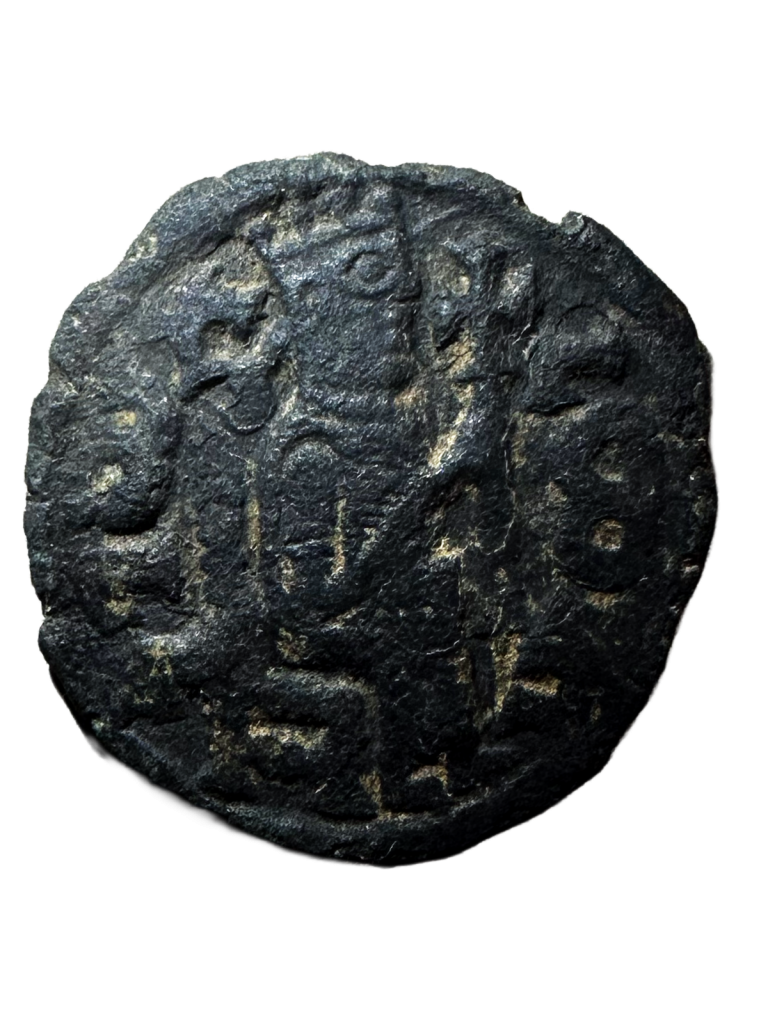
This coin, also over 1400 years old, depicts the Najashi (or King) of Aksum, a powerful Christian civilisation encompassing modern-day Ethiopia and Eritrea. The Najashi (whose name was Ashamah) is a highly respected figure in Islamic history, recognised for his compassion and just rule. Around 613-15 CE, several years after the Holy Prophet (sa) began his mission, a group of early Muslims left Makkah to avoid persecution and travelled to Abyssinia. They were granted complete refuge by the Najashi and remained under his protection for several years, despite attempts by the Quraish to influence the ruler and have them expelled. Najashi was also a recipient of a letter from the Prophet Muhammad (sa) in 628-629 CE.
These standards reflected a remarkable level of precision given the limited technology of the era.
Initially, the dinar-to-dirham ratio was set at 10:1 (Ibn Asakir, 1975), but after the Islamic conquests of Persia, Syria, and Egypt, an increase in silver supply raised the dinar’s value to 13 dirhams (Imam al-Shushtari, 1964). This ratio remained stable until the time of Caliph Hisham ibn ‘Abd al-Malik, then rose to 15:1 at the beginning of the Abbasid era. By 227 AH, it had increased further, reaching 22 dirhams per dinar by 244 AH (al-Ḥusayni al-Shirazi, 1976). However, the rate later declined, returning to 10:1 by 299 AH (Ibn al-Jawzi, 1932). During the Fatimid period, the ratio rose again to 18 dirhams per dinar, reflecting the shifting balance between gold and silver supplies over time.[15]
About the Author: Rabeeb Mirza is a missionary of the Ahmadiyya Muslim Community, currently serving in the translation department of Muslim Television Ahmadiyya (MTA) International. He has previously served in Feltham, UK and Ireland.
ENDNOTES
1. Signs of Sovereignty: The ‘Shahada,’ Qur’anic Verses, and The Coinage of ‘Abd al-Malik, Jere L. Bacharach, Muqarnas Vol. 27 (2010) Pg. 3.
2. Journal of the Economic and Social History of the Orient, Vol. 3, No. 3 (Oct., 1960), p. 242.
3. The Muqaddimah: An Introduction to History, Published in 1969 and translated by Franz Rosenthal, p. 217.
4. Sunan al-Nasa’i, Kitab al-Buyu’, Hadith 4594, Sunan al-Nasa’i, Kitab al-Zakat, Hadith 2520, Sunan Abi Dawud, Kitab al-Buyu’, Hadith 3340.
5. Sahih al-Bukhari, Hadith 580.
6. Sunan Abi Dawud, Hadith 1566.
7. Sunan Abi Dawud, Hadith 1577.
8. Malaysian Journal of Syariah and Law – Vol. 12, No.1 / April 2024 pp. 249 – 250
9. The Baghli dirham (named after the person who minted it) was minted under the order of the Caliph Umar (ra) and was in fact, a recoinage of the Wafi (Kasravi) dirham and weighted 20 carats and contained 8 daniqs.
10. The Tabari dirham (from Tabaristan, in the north of Iran), was recoined by Khalid ibn al-Walid in the year 15 AH, weighted 10 carats and contained 4 daniqs.
11. Review of Islamic Economics, Vol. 8, No. 2, 2004 p. 54.
12. Signs of Sovereignty: The ‘Shahada,’ Qur’anic Verses, and The Coinage of ‘Abd al-Malik, Jere L. Bacharach, Muqarnas Vol. 27 (2010) p. 4.
13. Review of Islamic Economics, Vol. 8, No. 2, 2004 pp. 53-54
14. Signs of Sovereignty: The ‘Shahada,’ Qur’anic Verses, and The Coinage of ‘Abd al-Malik, Jere L. Bacharach, Muqarnas Vol. 27 (2010) pp. 4-5.
15. Review of Islamic Economics, Vol. 8, No. 2, 2004 pp. 53-56, 63.


Add Comment